
How to Use This Guide
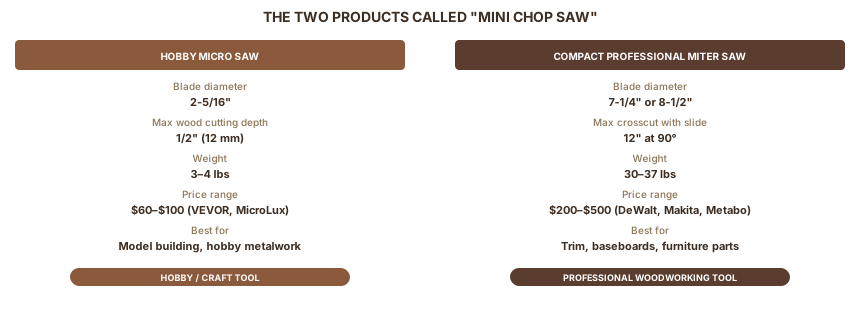
Two completely different products show up when you search "mini chop saw." One is a craft tool the size of a stapler. The other is a compact professional saw that handles real woodworking in tight spaces. Which one you need depends on what you're actually cutting.
- Doing model or craft work (brass tube, balsa, hobby components): the hobby micro saw in Part 1 is for you.
- Cutting trim, furniture, or renovating: go to Parts 2 through 4.
- Not sure you need a power saw at all: Part 5 covers alternatives that skip the saw stand entirely.
Mini Chop Saw at a Glance
The smallest power saw built for real woodworking uses a 7-1/4" blade, weighs about 30 lbs, and handles standard trim without issue. The hobby micro saws marketed as "mini miter saws" use 2-5/16" blades and max out at 1/2" cutting depth. They're for model building, not carpentry.
| Smallest hobby micro saw blade | 2-5/16" (VEVOR, MicroLux) |
| Max wood depth — hobby micro | 1/2" |
| Smallest professional miter saw | 7-1/4" blade |
| Compact saw weight range | 30–37 lbs |
| Max crosscut — 7-1/4" with slide | 12" at 90° |
| Wall clearance — best compact designs | Near-zero (Metabo HPT, Makita LS0815F) |
In this guide:
- What "mini chop saw" actually means
- The best compact miter saws compared
- What each size can cut
- How much space you need
- Alternatives that don't need a stand
Part 1: What "Mini Chop Saw" Actually Means
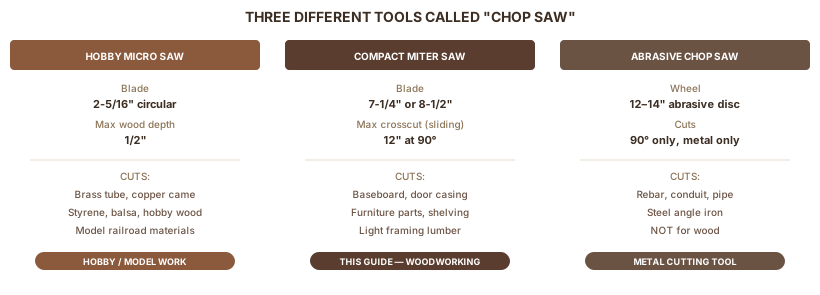
Search "mini chop saw" and you get two products with nothing in common.
The hobby micro saw
The VEVOR Mini Miter Cut-Off Chop Saw, the MicroLux from Micro-Mark, and similar tools are genuinely small. The MicroLux weighs 3 lbs 4 oz. The VEVOR runs a 90W motor. Both spin 2-5/16" blades at 7,800 RPM and cut 0 to 45° miter angles.
The catch: max cutting depth in wood is 1/2". Soft metal: 2/5". Ferrous metal: 4mm.
These tools have a real audience. Model railroad builders use them to cut brass tubing and styrene. Stained glass artists cut zinc and copper came. Hobby fabricators cut wooden dowels and balsa sheet. The MicroLux runs about $100 from Micro-Mark; the VEVOR runs $60 to $80 at Lowe's and Home Depot.
If you want to cut a 2×4, a piece of baseboard, or any lumber wider than a craft stick, a hobby micro saw won't do it. It's not a small version of a job-site miter saw. It's a different tool entirely.
The compact professional miter saw
Most woodworkers searching for a "miniature miter saw" want a saw that uses a 7-1/4" or 8-1/2" blade instead of the standard 10" or 12". These are real tools. They handle trim work, furniture parts, and light framing. They're smaller and lighter than a standard miter saw, not a toy.
A 7-1/4" saw can't cut a 4×4 post. For standard baseboards, door and window casing, small furniture parts, and most work in a 125 to 200 sq ft shop, they cover 90% of what you need.
Chop saw vs. miter saw
A chop saw cuts straight down at 90°. No angle adjustment. Most chop saws are metal-cutting tools that use abrasive wheels to cut rebar and conduit. A miter saw rotates left and right to cut precise angles and is designed for wood. In casual woodworking conversation, people say "chop saw" to mean any miter saw.
A compound miter saw adds bevel tilt to the miter rotation. A sliding compound miter saw adds rails so the blade travels forward and back, significantly increasing crosscut width. That sliding function is why a 7-1/4" saw can cross-cut a 12" board.
RELATED: Miter Joints Understanding miter joint geometry helps you get the most out of any miter saw, compact or full-size.
Part 2: The Best Compact Miter Saws for Small Shops
A compact sliding miter saw unlocks something a hand miter box can't: compound cuts, positive angle stops, and speed. These three models cover the main small-shop scenarios.
Top pick: DeWalt DCS361 (7-1/4" cordless)
For a small shop with limited outlets, cordless is the practical choice. The DeWalt DCS361 runs on the 20V MAX platform. If you already own any DeWalt 20V tool, you have compatible batteries.
On a single 4.0Ah battery, the DeWalt DCS361 delivers 183 cuts through 2×4 pine. That's enough for a full trim job on a small room before you swap. The 11-position miter detent plate covers the angles you'll actually use: 0°, 15°, 22.5°, 31.6°, and 45° in both directions.
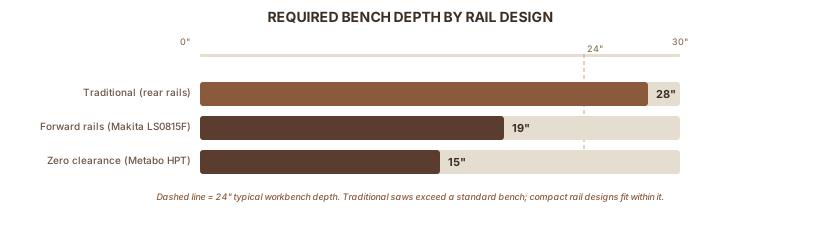
Weighs 30 lbs. Measures 25.25" long × 19.88" wide × 15.69" tall. Standard rear-sliding rails, so plan for about 26" of bench depth. Single bevel only.
Price: About $200 to $250 bare tool, $350 to $400 with battery and charger Best for: Anyone in the DeWalt 20V ecosystem, or anyone who wants to work anywhere in the shop without hunting for an outlet
Best for wall placement: Makita LS0815F (8-1/2" corded)
The Makita LS0815F solves the biggest small-shop problem: traditional sliding saws need 26 to 30" of bench depth because the rails extend backward. The LS0815F uses L-shaped rails that project toward the operator instead. You can place this saw within a few inches of a wall.
The 8-1/2" blade delivers 12" crosscut capacity at 90°, the same as most 10" sliding saws. Depth is 2-9/16". At 45°, crosscut drops to 8-1/2". The 10.5A direct-drive motor with soft start spins at 5,000 RPM and pulls through dense hardwoods without bogging.
Dimensions: 29-3/4"L × 17-3/4"W × 19-1/4"H. Weight: 31.1 lbs.
Price: About $400 to $450 Best for: A dedicated workstation against a wall; regular trim work where you want maximum capacity in minimum footprint
Most compact footprint: Metabo HPT C3607DRAQ4M (7-1/4" hybrid)
The Metabo HPT C3607DRAQ4M takes wall clearance further than any other model in this class. Its zero-clearance side rails mean the saw sits flush against a wall with no rear clearance needed. The 36V MultiVolt platform runs on either a battery or household AC power.
Cutting specs: 12-13/64" slide cut, 2-9/32" depth. Dual bevel to 45° both directions, with 57° right miter. At 34 lbs, it's the heaviest of the three.
Price: About $400 to $500 bare tool Best for: The most space-constrained setups where the saw needs to touch the back wall
Compact saw comparison
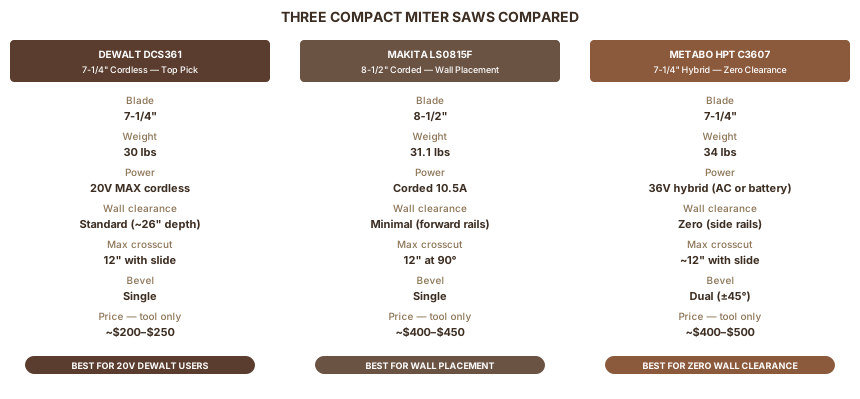
| DeWalt DCS361 | Makita LS0815F | Metabo HPT C3607 | |
|---|---|---|---|
| Blade | 7-1/4" | 8-1/2" | 7-1/4" |
| Weight | 30 lbs | 31.1 lbs | 34 lbs |
| Power | 20V cordless | Corded 10.5A | 36V hybrid |
| Wall clearance | Standard (~26" depth) | Minimal (forward rails) | Zero (side rails) |
| Max crosscut | 12" with slide | 12" with slide | ~12" with slide |
| Bevel | Single | Single | Dual |
| Price — tool only | ~$200 to $250 | ~$400 to $450 | ~$400 to $500 |
Part 3: Cutting Capacity by Blade Size
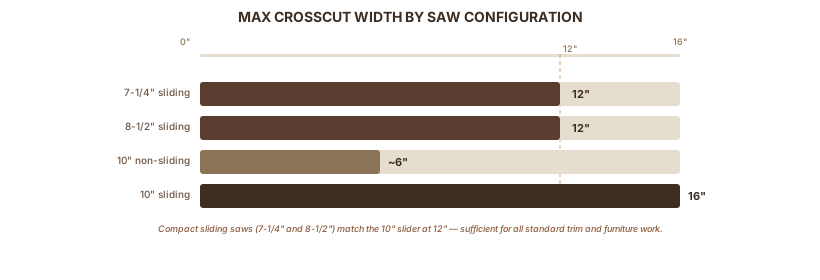
The main reason to move up to a 10" saw is cutting capacity. Compact saws handle most trim and furniture work just fine; they hit limits with wide stock and large posts.
Standard trim covers baseboards up to 3-1/2", door and window casing, and shoe molding. Any 7-1/4" or 8-1/2" sliding saw handles all of it. Wide baseboard (5-1/2" to 6") cuts fine with the slider engaged.
Crown molding is more nuanced. Crown nested flat on the fence requires enough fence height and table width for the piece to register. An 8-1/2" saw handles 3-1/2" crown. Wider crown profiles need a 10" or 12" saw.
Posts (4×4 and larger) are where compact saws stop. A 7-1/4" blade at max depth won't reach through a 4×4. Building a deck or fence: get the bigger saw.
| Task | 7-1/4" sliding | 8-1/2" sliding | 10" non-sliding | 10" sliding |
|---|---|---|---|---|
| Baseboard 3-1/2" | ✓ | ✓ | ✓ | ✓ |
| Wide base 5-1/2" | ✓ | ✓ | ✓ | ✓ |
| Crown nested 3-1/2" | Limited | ✓ | ✓ | ✓ |
| Door/window casing | ✓ | ✓ | ✓ | ✓ |
| 2×4 upright | ✓ | ✓ | ✓ | ✓ |
| 12" board flat | ✓ (slider) | ✓ (slider) | ✗ | ✓ |
| 4×4 post | ✗ | Limited | Limited | ✓ |
Furniture-scale work (table legs, rails, stretchers, shelf components) is well within compact saw territory. Furniture parts rarely exceed 3 to 4" width, and board length doesn't matter for a saw with a slider.
Part 4: How Much Space You Actually Need
Buy the wrong design and the saw fits on the bench but can't cut. Understanding the space requirements before purchase avoids that problem.
The rear-clearance problem
Traditional sliding miter saws extend their rails backward during a cut. A standard 10" sliding saw needs about 26 to 30" of bench depth. Set it 6" from a wall and the rails hit the wall mid-cut.
The Makita LS0815F and Metabo HPT C3607DRAQ4 solve this with forward- or side-projecting rail designs. The Makita's L-shaped rails project toward you; the saw head travels on rails that don't extend behind the saw body. The Metabo's side rails stay completely within the saw's footprint. Both models sit far closer to a wall than a traditional design.
A wall-friendly design drops bench depth from about 28" to 18 to 19". In a 10×15 ft garage, that's a workbench that fits where a traditional setup can't.
Infeed and outfeed support
The saw footprint is only part of the equation. Long boards need support on both sides of the blade. A 6-foot baseboard needs about 3 feet of support on each side. Roller stands work; a long workbench works. Minimum practical bench length: 5 to 6 feet.
A wall-mounted fold-down shelf in a garage or basement shop is a clean solution. The shelf stores the saw when not in use and provides the infeed/outfeed surface while cutting. The floor stays clear the rest of the time.
Part 5: Alternatives That Work Without a Saw Stand
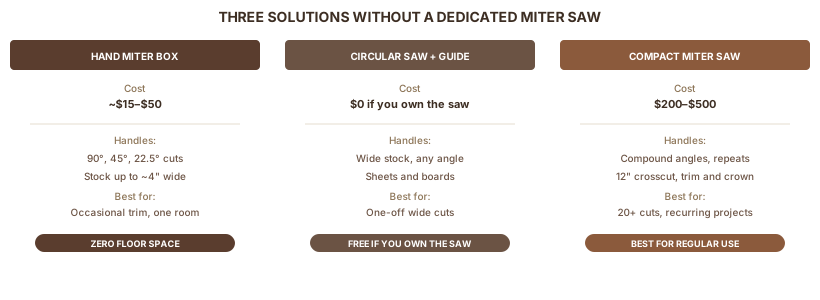
Many people searching for a "mini miter saw" would be better served by a $15 hand tool or by a circular saw they already own.
Hand miter box + backsaw
The Stanley 1-20-600 miter box costs about $15 at any hardware store. Indexed slots cut 90°, 45°, and 22.5° angles. The included saw is adequate; a decent backsaw in those slots produces accurate, repeatable cuts in material up to about 3 to 4" wide.
This tool stores in a drawer and weighs less than 2 lbs. For occasional trim work (a doorframe, a baseboard, a picture frame) it covers the need with zero saw stand, outlet, or floor space.
Limits: no compound cuts, fatiguing for large volumes, awkward for anything over 4" wide. For trimming one room without a power tool, a miter box is the honest answer.
For finer work, vintage Stanley No. 150 or No. 60 miter boxes with a quality backsaw cut dead-accurate miters. They turn up used for $20 to $50.
Circular saw + angle guide
For wider material a miter box can't reach, a circular saw with a speed square or clamped straightedge cuts clean miters.
RELATED: When a Circular Saw Can Replace a Table Saw The same principles apply to miter cuts: with the right guide, a circular saw handles more than most people expect.
A miter saw at a positive stop cuts faster for repetitive work. A circular saw with a guide takes longer per setup but costs nothing if you already own one.
When to get the power saw
More than 20 to 30 miter cuts on a single project: the time savings of a power saw justify the cost. Crown molding requires compound angles that no hand miter box handles. If trim work recurs in your projects, the $200 to $450 cost of a compact saw pays back quickly in saved time.
Quick Reference
| Your situation | Best tool |
|---|---|
| Hobby/craft work — 1/2" stock max | Hobby micro saw (VEVOR ~$70, MicroLux ~$100) |
| Occasional trim, zero storage space | Hand miter box (Stanley ~$15) |
| Regular trim, small furniture, compact shop | Compact sliding miter saw (7-1/4" or 8-1/2") |
| Wide crown, 4×4 posts, production trim | Standard 10" or 12" miter saw |
Sources
Research for this guide drew on manufacturer specification sheets, tool reviews from established trade publications, and woodworker forum discussions on compact saw use in small shops.
- DeWalt DCS361B product page — official specifications and performance data
- Makita LS0815F product page — specifications and rail design details
- Metabo HPT C3607DRAQ4 product page — zero-clearance rail design and specs
- Micro-Mark MicroLux Mini Miter Chop Saw — hobby micro saw specifications
- Woodsmith — Chop Saw vs. Miter Saw — terminology definitions
- Family Handyman — Chop Saw vs. Miter Saw — terminology and use cases
- ToolGuyd — Best Miter Saw Size — size and capacity comparison
- Pro Tool Reviews — Buying a Miter Saw — practical capacity guidance
- Bob Vila — Best Miter Box Sets — hand miter box options
- Home Depot — VEVOR Mini Chop Saw — hobby micro saw availability and reviews
Tools Used
Also Referenced
Tagged
How We Research
We don't take affiliate revenue or accept review units. Picks come from multi-source research — manufacturer specs, OSHA / EPA / ASTM regs, and long-form practitioner threads — plus Ahmed's hands-on use where relevant. When we recommend something, we explain why.
Up Next
Single vs Double Bevel Miter Saw
POWER TOOLS · Beginner