
Mafell Track Saw at a Glance
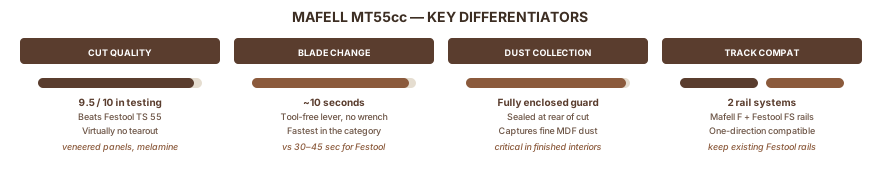
Mafell is the track saw Festool owners buy when they want better cut quality. The MT55cc (corded) runs on Festool tracks, has the fastest blade change in the category, and produces cuts that win head-to-head tests against every other brand. The trade-off: sold through one US distributor, professional-use warranty terms, and slightly heavier than competing cordless options.
| Brand origin | Germany (Oberndorf a.N.), in-house manufacturing since 1899 |
| Primary model | MT55cc (corded) / MT55 18M bl (cordless) |
| Motor | 1,400W corded; 18V brushless cordless |
| Max cutting depth | 57mm (2-1/4") at 90°; 40.5mm at 45° |
| Bevel range | -1° to 48° |
| US distributor | Timberwolf Tools (exclusive since 2007) |
| Corded price | ~$598–$700 (MT55cc at Timberwolf) |
| Warranty | 1 year standard; 3 years with online registration within 30 days |
In this guide:
- The model lineup — MT55cc, MT55 18M bl, and the KSS cross-cut system
- [Head-to-head vs Festool, Makita, and Bosch across six categories](#part-3-mafell-vs-the-competition)
- Track cross-compatibility — will Mafell run on your Festool rails?
- Who should buy one — and who should buy Festool instead
How to Use This Guide
If you're comparing brands and want the head-to-head breakdown, jump to Part 3. If you've decided on Mafell and want to know which model, start with Part 2. If you want the US buying situation (pricing, warranty, and where to actually purchase one), go to Part 6.
Part 1: What Makes Mafell Different
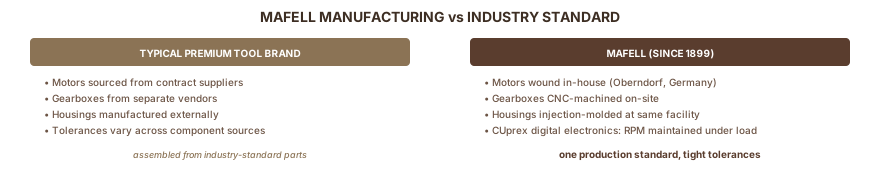
Mafell (Maschinenfabrik Fellbach) has been making professional woodworking tools in Germany since 1899. They built the world's first portable carpentry machine in 1926. Today the company operates from Oberndorf am Neckar, about an hour south of Stuttgart, and manufactures nearly every component in-house: CNC machining, injection molding, motor winding, all done at the same facility.
That matters because most "premium" tools are assembled from parts sourced across multiple contract manufacturers. Mafell's motors, gearboxes, and housings come off the same production line. It shows in tolerances and long-term durability.
Their primary market is the European carpentry trade: professional joiners, timber framers, and finish carpenters in Germany, Austria, Switzerland, France, and Spain. Mafell doesn't have a prosumer line. The tools are engineered for all-day commercial use and priced accordingly.
In the US, Timberwolf Tools has been the exclusive distributor since 2007. You won't find Mafell at Home Depot or through standard tool dealer networks.
How this differs from Festool: Festool markets aggressively to both professionals and prosumer hobbyists through a wide dealer network and an extensive accessory ecosystem. Mafell stays narrow: professional trades, tight distribution, no big-box retail. If you've never heard of Mafell, that's why. The tool gets sold to carpenters who buy it because it works, not because of brand recognition.
Part 2: The Mafell Model Lineup
MT55cc: The Main Buy
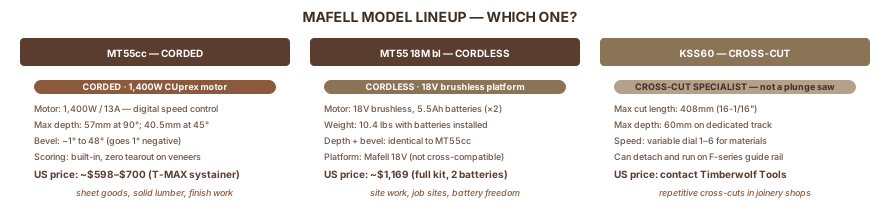
The MT55cc is the tool most people mean when they search for "Mafell track saw." It's a corded plunge-cut saw designed for sheet goods, ripping solid lumber, cross-cuts, and bevel work on a guide rail.
MT55cc specifications:
- Motor: 1,400W (13A), CUprex compact motor with digital electronics
- Speed: 3,600–6,250 RPM (variable)
- Blade: 160mm (6-3/8"), 1.8mm kerf
- Maximum depth at 90°: 57mm (2-1/4")
- Maximum depth at 45°: 40.5mm
- Bevel range: -1° to 48° (goes 1° negative, which matters for flush cuts)
- Ships in T-MAX systainer
- US price: approximately $598–$700 at Timberwolf
The CUprex motor responds electronically to load changes, maintaining consistent blade speed through knots and dense grain. A standard universal motor slows under load. The CUprex digital control compensates before you hear a bog.
MT55 18M bl: The Cordless Option
The MT55 18M bl runs on Mafell's 18V platform with a brushless motor. Blade diameter, depth, and bevel specs match the corded version. It's the answer for site work, job sites without power access, or anyone who runs tools on battery.
- Weight with batteries: 10.4 lbs
- Comes with 2x 5.5Ah batteries in full kit configuration
- US price: approximately $1,169 at Timberwolf
At 10.4 lbs, it's heavier than Festool's cordless offerings. For overhead cuts or long days on scaffold, that difference is real.
KSS60: The Cross-Cut System
The KSS60 is a different tool category. It's a dedicated cross-cut saw that mounts to a short, purpose-built track. Think of it as a very precise chop-saw station, not a track saw for sheet goods.
- Cutting depth: up to 60mm on its dedicated track
- Maximum cut length: 408mm (16-1/16")
- Variable speed: 1–6 dial for different materials
- Can detach from the cross-cut station and run on a standard F-series guide rail
Who buys the KSS60: timber framers and joinery shops doing high-volume repetitive cross-cuts. It's not a substitute for the MT55cc in a furniture or cabinetmaking shop. It's a specialist tool for a specific production workflow.
First-Use Setup
Out of the box, the MT55cc needs two steps before it's ready:
- Trim the splinter guard. Run the saw along the edge of the rail to trim the rubber splinter guard flush. This creates a zero-clearance edge that becomes your reference line when aligning the saw to a cut mark. Do this once; after that, the edge of the splinter guard shows exactly where the blade will cut.
- Check lateral offset. Confirm the base plate sits centered on the rail by running a test cut on scrap and measuring the kerf position. Adjust the rear trunnion if needed. Mafell ships the saws with this largely dialed in, but a quick verification takes 2 minutes and prevents surprises on real material.
That's the full setup. Unlike some tools, the MT55cc doesn't require blade-parallel adjustment or extensive calibration.
Part 3: Mafell vs the Competition
The Quick Comparison
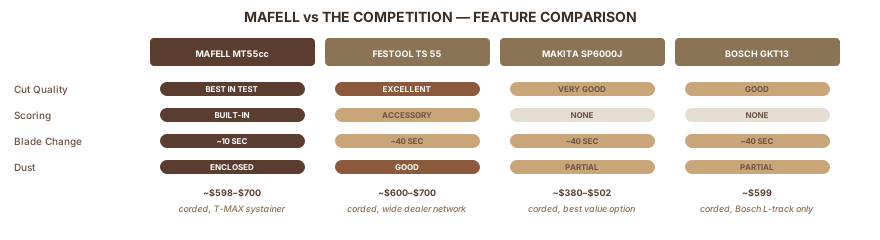
| Mafell MT55cc | Festool TS 55 | Makita SP6000J | Bosch GKT13 | |
|---|---|---|---|---|
| Motor | 1,400W / 13A | ~1,200W | 12A | 13A |
| Max depth (90°) | 57mm | ~55mm | 56mm | 55mm |
| Bevel range | -1° to 48° | 0° to 47° | 0° to 48° | 0° to 48° |
| Scoring function | Built-in | Accessory only | No | No |
| Blade change | Lever (tool-free) | Spindle lock + wrench | Tool required | Tool required |
| Track compatibility | Mafell F + Festool FS | Festool FS only | Mafell F + Festool FS | Bosch L-track |
| US corded price | ~$598–$700 | ~$600–$700 | ~$380–$502 | ~$599 |
Cut Quality
In Tool Box Buzz's cordless track saw head-to-head test, the Mafell MT55 18M bl took first place: virtually no marks on the cut face, winning the 90-degree test by a measurable margin. Festool came second, Makita third.
That result matches long-term ownership reports. The Last Carpenter's 8-year review of the MT55cc: "In eight years of hard use, it's never given a problem or let me down."
The quality gap between Mafell and Festool is small but real. For visible cuts on veneered panels or pre-finished sheet goods where a single tear-out ruins the piece, Mafell's edge matters. For rough rips and general construction, the difference is academic.
Dust Collection
Mafell's blade guard completely encloses the blade. Festool's guard is partially open. That gap at the rear of the cut, where Festool lets fine dust escape, is sealed on the Mafell. In tests and owner reports, Mafell captures the fine dust that Festool misses.
For cabinet installers cutting in finished rooms, or anyone working with materials like MDF that produce hazardous fine dust, Mafell's dust collection is a practical advantage.
Blade Change
Push one button, flip a lever. The blade guard opens like a car hood and the arbor locks automatically. No separate spindle-lock step, no wrench. The entire process takes about 10 seconds. Festool and Makita require a spindle lock and a wrench, adding 30–45 seconds per change.
If you change blades several times daily, the Mafell mechanism compounds into meaningful time savings. If you change blades occasionally, it's a convenience feature, not a buying reason.
Scoring Function
The MT55cc has a built-in scoring function. On the first pass, the saw makes a shallow scoring cut before the blade plunges to full depth. This severs the top veneer fibers before the main cut reaches them, producing zero tearout on melamine, veneered MDF, and pre-finished plywood.
Festool offers a scoring blade as an accessory. It works, but the integration is bolted-on compared to Mafell's factory-built mechanism. Makita and Bosch don't have this feature in their basic configurations.
Bevel Adjustment
Mafell's bevel is smooth and has positive stops at common angles. One note: the MT55 has lateral trunnion adjustment only at the rear of the base. Festool's TS and TSC models have adjustment at both front and rear trunnions. This matters if you run multiple brand saws on the same rails. Festool's dual-point adjustment makes it faster to calibrate different saws to identical zero-offset positions. If you're running one saw, it's irrelevant.
Part 4: The Mafell Track System
Track Sizes
Mafell's F-series guide rails come in five standard lengths:
| Rail | Length |
|---|---|
| F80 | 0.8m (2.6') |
| F110 | 1.1m (3.6') |
| F160 | 1.6m (5.2') |
| F210 | 2.1m (~7') |
| F310 | 3.1m (~10') |
A self-aligning connector joins rails end-to-end and maintains straightness across the joint. Users who've owned both systems often cite Mafell's connector as more rigid and reliable than Festool's. The shorter standard lengths (F80, F110, F160) make Mafell's system more portable than Festool's, where the standard 55-inch rail is the go-to.
Cross-Compatibility
This is the most frequently asked question about Mafell, and the answer directly affects the cost of switching:
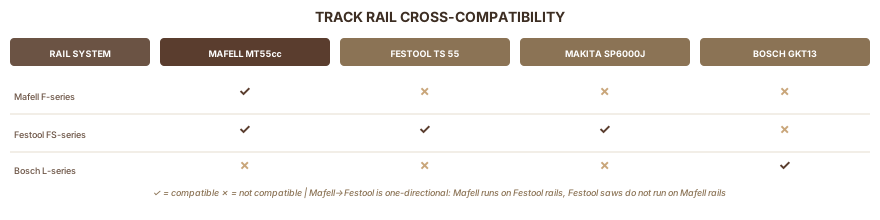
Mafell MT55cc and MT55 18M bl run on Festool FS-series tracks. If you already own Festool rails, you can add the Mafell saw without replacing a single track. The MT55 runs on Mafell F-rails and Festool FS-rails interchangeably.
Festool TS and TSC saws do not run on Mafell F-rails. Compatibility goes one direction.
Makita SP6000J also runs on Festool FS-rails. If you're considering Makita as an alternative, it also lets you keep existing Festool track infrastructure.
Bosch GKT track saws use Bosch L-tracks. This is a separate ecosystem with no cross-compatibility.
RELATED: Sheet Goods for Cabinets A track saw (any brand) transforms sheet goods handling. This guide covers which panels to buy and how to break them down efficiently.
Mafell Rail vs Festool Rail
If you're buying new tracks rather than reusing existing Festool rails:
- Mafell rails are narrower and lighter than Festool
- Festool rails are stiffer and have glide strips on the top surface (some prefer how saws slide on Festool rails)
- Mafell's anti-slip strips are closer to the splinter guard, allowing clamping on narrower workpieces
- Mafell has two clamping slot positions; Festool has one
Both systems produce straight, accurate cuts. The preference is personal.
Part 5: Who Should Buy a Mafell Track Saw

Buy the Mafell MT55cc if:
- Cut quality is the primary criterion: you're cutting veneered panels, pre-finished sheet goods, or any material where tearout ruins the piece
- You need a built-in scoring function
- You change blades frequently and want the fastest mechanism available
- You do commercial carpentry, professional cabinet installs, or timber framing
- You already own Festool tracks and want to upgrade the saw without replacing your track system
- You want modular short-track portability with the best connector system
Buy Festool instead if:
- You need the widest accessory ecosystem and maximum parts availability in the US
- You run multiple track saw brands on the same rails and want dual-trunnion lateral adjustment for easier calibration
- Weight matters and lighter cordless options are important for your work
- Anti-kickback electronics are a priority (Festool's KICKBACK STOP is the best in the category)
- You need more than one US service point for repairs
Buy Makita instead if:
- Budget is the driving factor: the SP6000J at $380–$502 is the best value in the category
- Good-enough cut quality is acceptable for your application
- You're already in the Makita battery ecosystem
The honest verdict: At the same price as Festool, the Mafell MT55cc gives you slightly better cut quality and dust collection, plus a significantly faster blade change and a built-in scoring function. The trade-off: a narrower service network and professional-use warranty terms. For a serious woodworker cutting pre-finished panels, doing cabinet installs, or working at consistently high quality standards, that trade is worth making. For occasional DIY use where any quality track saw will do, it doesn't justify buying through a single distributor.
Part 6: Pricing and Where to Buy in the US
Timberwolf Tools is the exclusive US distributor and has been since 2007. They carry the full Mafell range: saws, guide rails, blades, replacement parts, and accessories. For warranty service, all US claims go through Timberwolf (1-800-869-4169).
TF Tools (tftools.com) and Axminster Tools USA also carry Mafell. Amazon and eBay listings exist but are often gray market. Warranty support is uncertain through those channels.
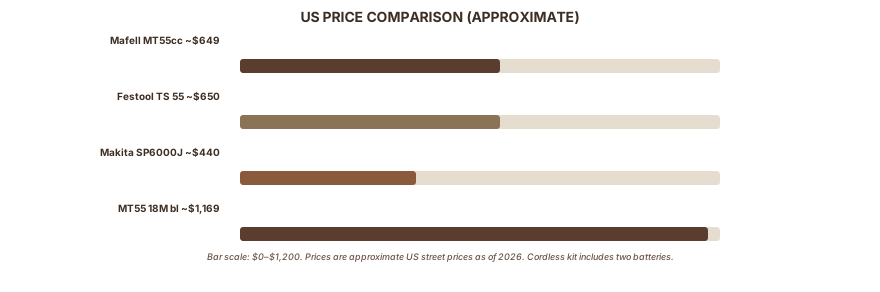
Current US pricing (approximate):
| Model | Price |
|---|---|
| MT55cc (corded, T-MAX systainer) | ~$598–$700 |
| MT55 18M bl (cordless kit, 2x batteries) | ~$1,169 |
| F160 guide rail (5.2') | ~$154 |
| F80 guide rail (2.6') | ~$75–$90 |
Warranty
The standard warranty is 1 year from purchase. Register at garantie.mafell.de within 30 days and it extends to 3 years. Read the fine print: Mafell's warranty covers commercial and professional use. Products purchased for personal household use are technically sold "as is." In practice, Timberwolf handles warranty claims and is responsive. But if you're buying as a hobbyist and want bulletproof warranty coverage, Festool's consumer-facing warranty structure is simpler.
Quick Reference
| Feature | Mafell MT55cc | Festool TS 55 | Makita SP6000J |
|---|---|---|---|
| Motor | 1,400W | ~1,200W | 12A |
| Max depth (90°) | 57mm | ~55mm | 56mm |
| Bevel | -1° to 48° | 0° to 47° | 0° to 48° |
| Scoring | Built-in | Accessory | No |
| Blade change | Tool-free lever | Spindle + wrench | Wrench |
| Track compat. | Mafell + Festool | Festool only | Mafell + Festool |
| US price | ~$598–$700 | ~$600–$700 | ~$380–$502 |
| US warranty | 3 yr (registered) | 3 yr | 1 yr |
| US service | Timberwolf only | Wide dealer network | Wide dealer network |
Sources
This guide draws on manufacturer specifications, independent head-to-head testing, long-term owner reviews, and community discussions from professional woodworkers and carpenters who use Mafell tools daily.
- Timberwolf Tools Mafell page — US exclusive distributor, brand overview and current pricing
- Timberwolf MT55cc product page — corded MT55cc specifications
- Mafell AG MT55 product page (US) — official motor, depth, and bevel specs
- Mafell AG company history — founding and manufacturing background
- Tool Box Buzz best cordless track saw head-to-head — independent cut quality testing, Mafell vs Festool vs Makita
- The Last Carpenter MT55cc long-term review — 8-year real-world ownership assessment
- CutTheWood Mafell vs Festool comparison — feature-by-feature comparison review
- Woodworker's Journal track saw review — trade magazine independent testing
- Timberwolf Mafell warranty page — US warranty terms and professional-use clause
- Timberwolf MT55 18M bl product page — cordless specifications and pricing
- Festool Owners Group guide rail compatibility thread — Mafell/Festool track cross-compatibility discussion
- Mafell Users Forum MT55 with Festool rails — user confirmation of rail compatibility
- Timberwolf F160 guide rail — track system sizing and specs
- ContractorTalk Mafell fan club thread — professional trade user experiences
Tagged
How We Research
We don't take affiliate revenue or accept review units. Picks come from multi-source research — manufacturer specs, OSHA / EPA / ASTM regs, and long-form practitioner threads — plus Ahmed's hands-on use where relevant. When we recommend something, we explain why.