
Maple Stain at a Glance
Staining maple is a notoriously difficult finishing challenge because the wood's tight, diffuse-porous grain resists uniform pigment absorption, producing dark, irregular blotches across the surface. The problem is structural: maple's pores are so small and densely packed that stain pools in softer grain pockets while barely penetrating the surrounding wood. Left untreated, a pigment stain will often leave maple looking worse than bare, unfinished wood. Three proven approaches — wood conditioner, toner-based finishes, and dye stains — each attack that uneven absorption differently.
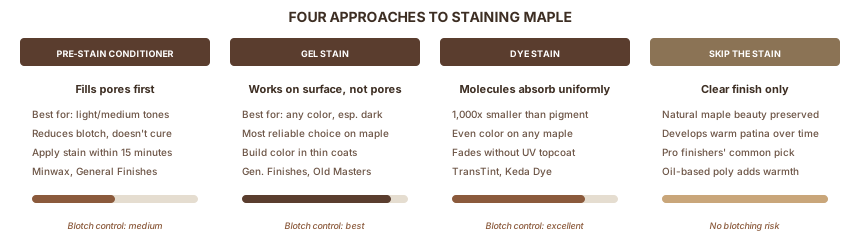
Three approaches reliably get even color on maple: pre-stain conditioner (for light-to-medium tones), gel stain (for any color, especially dark), and dye stain (for uniform penetration on any tone). A fourth option, skip the stain entirely, is what most professional finishers actually recommend for hard maple.
| Hard maple Janka hardness | 1,450 lbf |
| Soft maple Janka hardness | 700–950 lbf |
| Pre-stain conditioner timing | Apply stain within 15 minutes of conditioner |
| Best gel stain for dark maple | General Finishes Java or Antique Walnut |
| Final sanding grit | 180 (stop here — going higher makes staining worse) |
| Dye molecule size vs. pigment | ~1,000x smaller — penetrates maple uniformly |
In this guide: Why maple blotches · Hard vs. soft maple · Three approaches that work · Surface prep · Realistic expectations
Part 1: Why Maple Blotches
The wood anatomy behind the problem
Wood species fall into two categories based on how their pores are distributed. That distribution determines how evenly they accept stain.
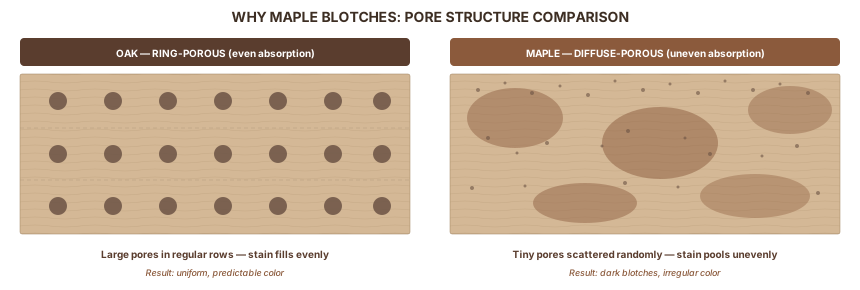
Ring-porous species (oak, ash, walnut, hickory) have large pores concentrated in annual growth rings. Apply stain and the pigment settles into those big, consistent pores. Color distributes evenly. Staining is predictable.
Diffuse-porous species (maple, birch, cherry, beech) have very small pores distributed throughout the wood with no distinct ring structure. Maple is the extreme example: one of the densest, most closed-grained diffuse-porous hardwoods in North America. Its Janka hardness of 1,450 lbf reflects how dense and tightly packed those wood fibers are.
What blotching actually is
When pigment stain hits maple's surface, it encounters wildly uneven absorption capacity. Tiny density variations throughout the wood, zones near medullary rays, areas with different early-wood and late-wood cell structure, spots near knots or figure, absorb stain at different rates. Dense areas absorb almost nothing. Slightly less dense areas absorb too much. The result: dark, irregular patches where stain pooled, and pale areas where the tight wood blocked penetration.
This is different from pine blotching, which follows a predictable stripe pattern because pine alternates hard resinous late-wood bands with soft early-wood bands. Maple's blotching is random and hard to predict. Figured maple, including curly maple, bird's eye, and tiger maple, is especially unpredictable because the figure itself creates swirling density variations.
Lighter stains show blotching more clearly
With a pale golden stain, you can see exactly where pigment soaked in versus where the wood rejected it. Darker stains can partially hide blotching because the whole surface ends up dark regardless of where the stain absorbed. If you're committed to using liquid pigment stain on maple, going darker is actually safer than going lighter.
Part 2: Hard Maple vs. Soft Maple
Most woodworkers treat "maple" as a single species. In practice, lumber yards and hardware stores sell two distinct categories that behave differently under stain.
Hard maple (Acer saccharum — sugar maple)
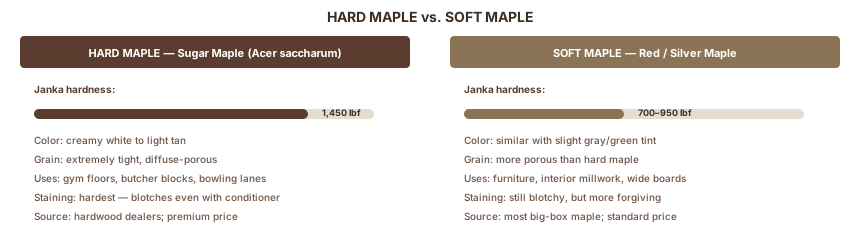
According to The Wood Database, hard maple has a Janka hardness of 1,450 lbf, creamy-white to light tan color, and a grain so tight it's used for gym floors, bowling lanes, and butcher blocks. You'll find it at hardwood specialty dealers, labeled as hard maple or sugar maple, at premium prices.
This is the species that makes finishing professionals wince. Even with pre-stain conditioner, blotching is common. For any color beyond the lightest tones, gel stain or dye is the right tool.
Soft maple (Acer rubrum, Acer saccharinum, and others)
"Soft" maple covers several species. Red maple and silver maple are the most common. The Wood Database's soft maple entry puts Janka hardness at 700–950 lbf, lower than hard maple. The color is similar but often carries slight gray, green, or brown undertones. It's more porous, so stain penetrates more evenly.
Most maple at big-box stores, Home Depot and Lowe's, is soft maple. It's cheaper, more widely available, and comes in wider boards. It's still prone to blotching and still benefits from conditioner or gel stain, but the results are more forgiving than hard maple.
How to tell them apart
| Hard Maple | Soft Maple | |
|---|---|---|
| Janka hardness | 1,450 lbf | 700–950 lbf |
| Color tone | Pure creamy white | Slight gray/green tint |
| Weight | Noticeably heavy | Lighter |
| End-grain scratch | Resists fingernail | Dents more easily |
| Where to find it | Hardwood dealers | Big-box stores |
| Price | Premium | Standard |
If you bought maple at Home Depot and it's blotching, you have soft maple. The approach is the same as for hard maple, just slightly less critical.
Part 3: Three Approaches That Work
These solutions address maple's staining problem through different mechanisms. Choose based on the color you want and the products you can get.

Option 1: Pre-stain wood conditioner (for light-to-medium colors)
Pre-stain conditioner is a thin penetrating liquid, typically mineral spirits plus alkyd resin, that partially fills maple's pores before you apply stain. Pre-filling those pores reduces and equalizes how much liquid stain the wood subsequently absorbs. The result: more uniform color, but also lighter and less saturated overall.
Products:
- Minwax Pre-Stain Wood Conditioner — the most accessible option, sold at Home Depot and Lowe's
- Minwax Water-Based Pre-Stain Wood Conditioner — pair with water-based stains
- General Finishes Pre-Stain Wood Conditioner — higher quality, better blotching reduction
- DIY alternative: wipe-on poly thinned 50/50 with mineral spirits, applied as a wash coat
The 15-minute rule: Minwax's application guidance specifies applying stain within 15 minutes of the conditioner going on, while it's still wet. Wait until it dries and the surface seals completely. The stain won't penetrate and you'll get almost no color.
Honest limitation: Conditioner is not a complete solution for maple. It reduces blotching but doesn't eliminate it. It also limits color depth, since the conditioner fills pores that would otherwise hold stain. Your final color will be noticeably lighter than the stain chip suggests. This works for honey tones, light goldens, and light browns. It's the wrong tool for walnut-dark or espresso finishes.
RELATED: Minwax Stain Chart Color chips and coverage reference for Minwax stain products.
Option 2: Gel stain (most reliable for any color on maple)
Gel stain is thick, about the consistency of pudding. Unlike liquid stains, it doesn't rely on wood absorption. It sits on the surface, you work it in like a paste, then wipe off the excess. Because color doesn't depend on how much the wood absorbs, maple's tight, uneven porosity is irrelevant. You get consistent color regardless of density variation.
Products (in order of quality):
- General Finishes Gel Stain — widely considered the best consumer product. Colors include Java (deep espresso), Antique Walnut, American Walnut, Red Mahogany, and Pecan. Available at Woodcraft and Rockler.
- Old Masters Gel Stain — solid quality; find it at Sherwin-Williams stores.
- Varathane Premium Gel Stain — good value at Home Depot.
- Minwax Gel Stain — widely available at Lowe's and Home Depot.
Application sequence:
- Sand to 180 grit; hand-sand the final pass with the grain (see Part 4)
- Remove all dust with a vacuum and tack cloth
- Stir the gel stain thoroughly. Pigment settles to the bottom during storage.
- Apply with a chip brush, foam brush, or old t-shirt; work it into the surface with the grain
- Let it sit 3–5 minutes (check the manufacturer label, times vary)
- Wipe off firmly with a clean lint-free rag, moving with the grain
- Dry 8–24 hours per manufacturer spec before applying another coat
- Between coats: sand lightly with 400-grit, wipe clean, apply next coat
- Topcoat with polyurethane or another clear finish once you've reached the desired color
Color range: Gel stain excels at medium and dark colors. General Finishes Java or Antique Walnut can achieve deep espresso tones on maple that liquid stain never could. For very light or subtle tones, gel stain falls short. Light colors on maple are better done with conditioner plus liquid stain.
The one real limitation: Applied too thick or without firm wipe-off, gel stain looks painted on, filmy and opaque rather than natural. The wipe-off step is critical. Build color in thin coats rather than trying to achieve it in one heavy application.
| Color goal | Recommended gel stain | Approximate coats |
|---|---|---|
| Dark espresso | General Finishes Java | 2–3 |
| Dark walnut | General Finishes Antique Walnut | 2–3 |
| Medium brown | General Finishes American Walnut | 1–2 |
| Light brown | Old Masters Provincial | 1 |
Option 3: Dye stain (for the most uniform penetration)
Standard pigment stains fail on maple because the solid pigment particles, 1–10 microns in size, require pores to hold them mechanically. Dye stains work differently. As Bob Flexner explains in Understanding Wood Finishing, the colorant is dissolved rather than suspended: dye molecules measure roughly 1–10 nanometers, about 1,000 times smaller than pigment particles. Dyes penetrate everywhere the solvent can travel, including into maple's dense, tight grain. The result is highly uniform color on difficult wood.
Products:
- TransTint Dye Concentrates (Homestead Finishing Products) — the go-to for woodworkers. Liquid concentrate in 2oz and 8oz bottles ($10–15). Mix with water or denatured alcohol. Colors include Golden Amber, Dark Walnut, Cherry, Black, and Red. Available at Woodcraft and Rockler.
- Keda Dye — powder-based, mix with water, alcohol, or acetone. Available on Amazon. Good for experimentation without committing to a full TransTint lineup.
Application:
- Sand to 180 grit
- If using water-based dye: pre-wet the surface with water, let dry completely, then sand lightly with 220-grit to knock down the raised grain
- Mix dye lighter than you think you need; test on scrap first
- Apply quickly with a foam brush, sponge, or lint-free rag. Dye dries faster than stain, so work efficiently.
- Wipe off excess immediately
- Dry time: 30 minutes for alcohol-based, 1–2 hours for water-based
- Apply clear topcoat
Limitations: Dyes fade under UV light faster than pigment stains. Avoid dye on surfaces near windows or outdoors without a UV-blocking topcoat. Hard to achieve very dark colors with dye alone. Not available at most hardware stores.
For serious color work on maple, finishers layer the approaches: dye first for base color, seal with dewaxed shellac, then apply gel stain or a glaze over the shellac for depth and warmth, then a final clear topcoat. This produces multi-dimensional color that no single product can.
Part 4: Surface Prep for Staining Maple
Surface preparation mistakes account for half of maple staining failures. Get this right before you open any stain.
Stop sanding at 180 grit
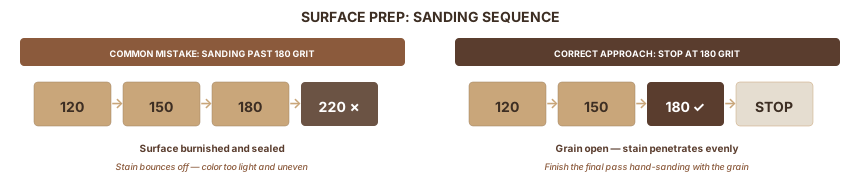
Sand through 120 to 150 to 180 grit and stop. Don't go to 220.
At 220 and above, sandpaper polishes rather than cuts. It burnishes the wood surface, compressing and sealing maple's already-tight grain. Stain can't penetrate a burnished surface. You'll get almost no color, or the color you get will be even more uneven than if you'd stopped at 180.
This is the most common setup mistake when staining maple. If you're getting very light, uneven results with a liquid stain, check whether you over-sanded. Sand back to 180 and try again.
The orbital sander problem
Random orbital sanders leave circular swirl marks in the wood. On open-grained wood like oak, these marks disappear into the pores. On maple with any dark stain, those swirl marks show as visible dark circles through the finish.
For the final 180-grit pass on maple that will be stained, switch from the orbital sander to a sanding block or folded sandpaper, and hand-sand with the direction of the grain. This removes the swirl marks and leaves only linear scratches that align with the grain and become invisible. Check the surface under a raking light before you proceed. Hold a lamp at a low angle to the surface and look for circular marks.
Remove mill marks
Lumber from the planer has a slight washboard surface from the cutting head. You can feel it by running your hand across the board, or see it in raking light. Mill marks absorb stain differently from the surrounding surface and will show through the finish. Remove them at 120 grit before moving to finer grits.
Dust removal
Vacuum the surface, then wipe with a tack cloth. If using oil-based stain, a lint-free cloth dampened with mineral spirits works well. Dust under gel stain creates visible bumps.
Part 5: Realistic Expectations
What you can actually achieve on maple
| Goal | Best approach | Difficulty |
|---|---|---|
| Natural/clear | Oil-based or water-based polyurethane | Easy |
| Warm amber/honey tone | TransTint Golden Amber dye, or oil-based poly | Moderate |
| Light-to-medium brown | Pre-stain conditioner + liquid stain | Moderate |
| Dark brown / walnut color | Gel stain, 2–3 coats | Moderate |
| Espresso / dark coffee | General Finishes Java Gel Stain | Moderate |
| Gray / ash tone | Specialty technique; test extensively | Hard |
| Maple looking like walnut grain | Not achievable. Grain pattern stays as maple. | Very hard |
Consider skipping the stain
Many professional finishers don't stain hard maple. Maple's natural color is beautiful: creamy, smooth, distinctive. Over time, hard maple develops a warm honey-amber patina from UV exposure that takes years to develop and can't be faked with stain. An oil-based polyurethane adds warmth while protecting the surface. A water-based poly keeps it light and contemporary for a Scandinavian or modern aesthetic.
Forcing maple into a walnut or dark cherry color fights the wood's character. Even with gel stain, the grain pattern reads as maple. The texture, the tight pore structure, the subtle figure all say "maple" regardless of the color. If you want walnut's look, use walnut. The best wood for staining is a species whose grain accepts color evenly, which maple resists by nature.
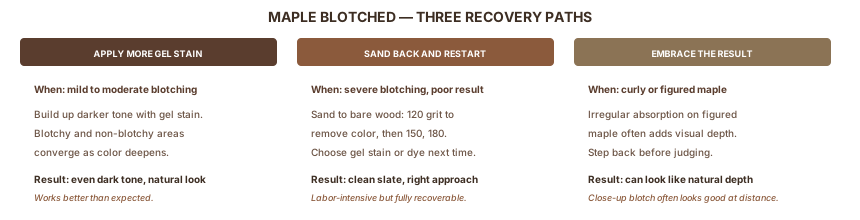
If blotching already happened
Apply more gel stain. Additional gel stain coats can even out liquid stain that blotched. As you build up darker color with gel stain, the blotchy and non-blotchy areas converge. This works better than you'd expect.
Sand back and restart. If the result is unsatisfactory, sand the entire surface back to bare wood: 120 grit to remove the stain color, then 150, then 180. Start over with gel stain or conditioner.
Embrace it. With figured maple, what reads as blotching from close range often adds visual depth when you step back from the finished piece. Curly maple and bird's eye maple can look striking with irregular stain absorption.
Sources
Research on this guide drew on manufacturer application guidance, wood species reference data, and woodworking finishing literature.
- General Finishes Gel Stain — product line, colors, and application instructions for gel stain on difficult woods
- Minwax Pre-Stain Wood Conditioner — conditioner application guidance, 15-minute timing window
- Old Masters Gel Stain — gel stain product available at Sherwin-Williams
- Varathane Premium Gel Stain — product line confirmation
- TransTint Dye Concentrates — dye concentrate products; water and alcohol mixing guidance
- The Wood Database — Hard Maple — Acer saccharum species data, Janka hardness
- The Wood Database — Soft Maple — Acer rubrum/saccharinum species data and comparison
- Bob Flexner, Understanding Wood Finishing — blotching mechanism, conditioner action, dye vs. pigment particle science
Wood Species
Tagged