
Red Oak at a Glance
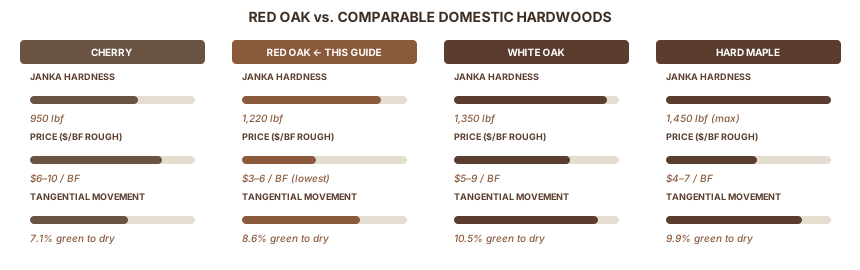
Red oak (Quercus rubra) is a ring-porous domestic hardwood — the most abundant in North America — characterized by large, open vessels, no tyloses, and a Janka hardness of 1,290 lbf, available for roughly $3–6 per board foot. The open vessels with no tyloses are the defining structural fact: they cause blotchy stain absorption, wick moisture freely, and make the wood unsuitable for outdoor projects or cutting boards. That same structure is why red oak has a dated cabinet reputation — but the blame belongs to heavy pigmented stains, not the wood itself.
| Species | Quercus rubra (Northern Red Oak) |
| Janka hardness | 1,220 lbf — harder than cherry (950), softer than white oak (1,350) |
| Dried weight | 45 lbs/ft³ (720 kg/m³) |
| Price range | $3–6/BF rough; one of the most affordable domestic hardwoods |
| Tangential movement | 8.6% — flat-sawn panels move noticeably across seasons |
| Best for | Interior furniture, cabinets, Craftsman-style work, trim, flooring |
| Watch out for | Outdoor use, cutting boards, high-contrast stain on unfilled grain |
In this guide:
- What separates red oak from white oak (and how to tell them apart)
- Grain character, color, and what drives the dated aesthetic
- Finishing choices that make or break the final look
- How much red oak actually moves and what that means for joinery
Part 1: What Red Oak Is
When woodworkers say "red oak," they mean Quercus rubra, Northern Red Oak. The red oak group includes over 40 North American species, but Q. rubra is the commercial standard. It grows across eastern North America, from Nova Scotia south to Georgia and Alabama, with the most productive timber stands concentrated in the Appalachian Plateau: Pennsylvania, West Virginia, and New York.
Trees reach 60–115 feet tall and 2–4 feet in diameter. The faster growth compared to white oak means more volume per acre, which is why red oak reaches the lumber yard at a lower price.
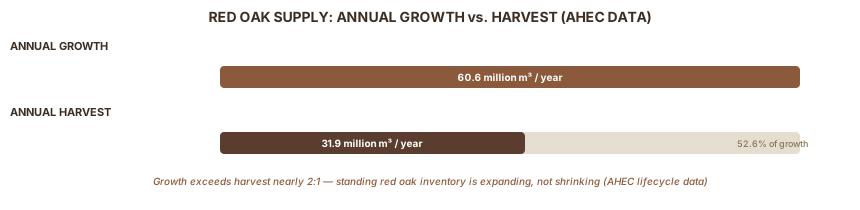
According to AHEC's species data, red oak accounts for roughly 35% of total US hardwood inventory. Current growth (60.6 million cubic meters per year) exceeds harvest (31.9 million cubic meters per year) by nearly 2:1. The standing stock is growing, not shrinking. AHEC's lifecycle assessment also shows a carbon-negative footprint: carbon absorbed during the forestry stage substantially exceeds processing and transport emissions.
Red oak is abundant, renewable, and cheap. At $3–6/BF rough, it delivers the workability and hardness of a premium domestic hardwood without the price of walnut, cherry, or white oak.
Part 2: Red Oak vs. White Oak
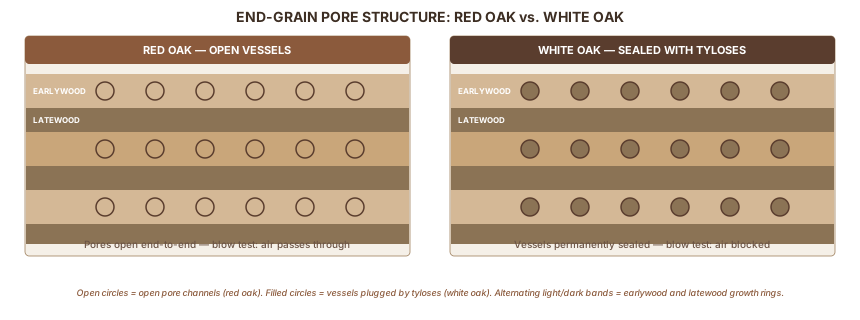
Red oak has open pores. White oak has closed pores.
Red oak's large pore channels (vessels) run continuously from end to end with no obstructions. The Wood Database's identification guide notes you can hold a short piece of red oak end-grain up and blow air through it. White oak's vessels are plugged with tyloses, bubble-like cellular outgrowths that form during heartwood development and permanently seal the pores.
The Honest Chisel calls this "the one difference you must know." Every practical distinction between the two species flows from pore structure.
| Property | Red Oak | White Oak |
|---|---|---|
| Janka hardness | 1,220 lbf | 1,350 lbf |
| Dried weight | 45 lbs/ft³ | 47 lbs/ft³ |
| Pore structure | Open, no tyloses | Closed with tyloses |
| Water resistance | Interior only | Exterior capable |
| Barrel/marine use | Cannot hold liquids | Traditional for both |
| Cutting board use | Not recommended | Acceptable |
| Stain absorption | Absorbs readily | Slightly less predictable |
| Price | $3–6/BF | $5–9/BF |
| Ray fleck (quartersawn) | Subtle | Dramatic |
How to tell them apart at the lumber yard:
- The blow test. Take a short end-grain piece (6 inches is enough). Cover one end with your hand and blow through the other. Air passes through red oak; white oak blocks it.
- Color. Red oak heartwood has a distinctly pink to reddish-brown cast. White oak is tan to olive-brown. More neutral, no reddish tones.
- Quartersawn ray fleck. Both species show medullary rays when quartersawn. White oak's rays are longer and produce a more dramatic silvery fleck. Red oak's fleck is present but subtler.
Part 3: Grain Character and Visual Properties
Red oak is ring-porous: its large pores are arranged in distinct growth rings visible to the naked eye. Run a fingertip across an unfinished board and you'll feel the channels. This coarse texture distinguishes red oak from diffuse-porous species like cherry or hard maple, where the pores are smaller and evenly distributed.
Color runs from a soft, almost pale pink in fresh-milled sapwood-adjacent heartwood to a deep reddish-brown in mature heart. The sapwood (white to light tan) appears as a lighter band along the edges of sawn boards. Unlike cherry, red oak does not darken with UV exposure. What you see at the lumber yard is roughly what you get after finishing.
Medullary rays are the other defining visual feature. According to WoodWeb's reference on rays and flecks, these radial cells extend outward from the tree's core and, when quartersawn, appear as silvery, reflective flecks across the face of the board. Red oak's ray fleck is real but subtler than white oak's. Shorter rays mean a quieter pattern.
Quartersawn red oak is worth seeking out for two reasons: it looks dramatically different from the plain-sawn variety associated with builder-grade cabinets, and it moves much less across seasons. For drawer faces, cabinet doors, and wide tabletop panels, quartersawn is the better option.
The staining trap. The open pores absorb stain deeply and create high contrast between the dark, stain-saturated channels and the lighter face wood. Dark orange-toned stains applied to unfilled, plain-sawn red oak produce exactly the look people complain about: a caricature of wood grain that shouts 1985 kitchen remodel. The wood is not the problem. The stain choice and grain prep decisions are.
Part 4: Working Properties
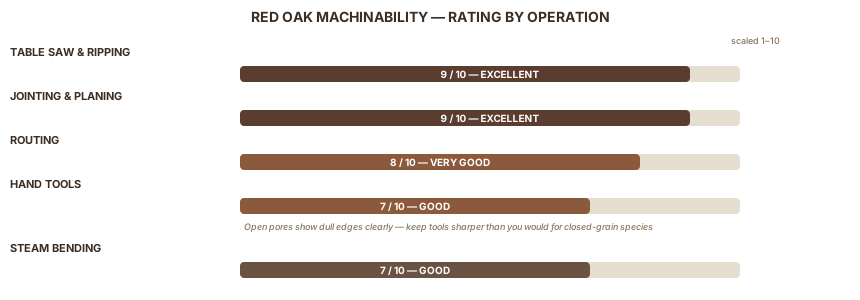
Red oak earns consistently high marks for machinability. The USDA's assessment of domestic hardwood machinability ranked red oak near the top alongside white oak. In practice: table saw, router, jointer, and planer all produce clean results with sharp tooling. Straight grain is typical; interlocked grain is uncommon in this species. Both reduce tear-out risk at the planer and router table.
Hand tools work well with a caveat: the coarse, open pores telegraph dull edges more than a closed-grain wood would. A plane iron at 70% sharpness that produces acceptable results on maple will leave distinct chatter marks on red oak. Keep your edges sharp.
Routing presents no surprises at normal feed rates. Climb cuts aren't typically necessary. Use spiral upcut bits for plunge routing to clear chips from the open channels.
Steam bending: Red oak is one of the better domestic species for it. The open cell structure allows steam penetration and flexibility.
Sanding is straightforward. Sand through 120, 150, 180, then 220 before finishing. The open grain holds sanding dust. Blow it out with compressed air or a stiff brush before applying any sealer or finish. Residual dust in pores contaminates the first finish coat and can cause adhesion problems.
Weight: At 45 lbs/ft³, red oak is heavy for a domestic hardwood. A full 4×8 sheet of 3/4" red oak plywood weighs roughly 85 pounds. Account for the weight when moving sheets.
Part 5: Finishing and Stain Response
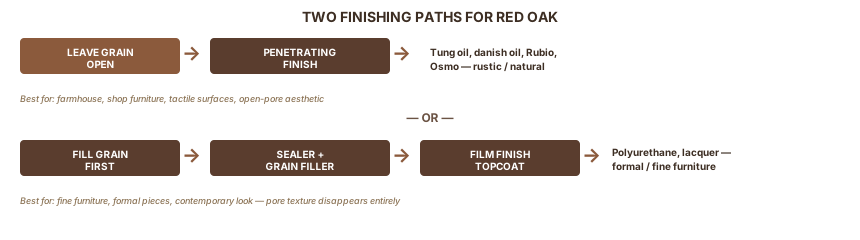
The open grain forces a choice before you open a can of finish: fill the pores or leave them open?
Leave the grain open when you want a tactile, natural surface. Penetrating finishes (tung oil, danish oil, hardwax oils like Rubio Monocoat or Osmo) work in the pores rather than over them. You get protection without a thick film, and the wood has texture you can feel. This approach suits rustic, farmhouse, and shop furniture well.
Fill the grain when you want a smooth, formal surface. Apply a thin sealer coat first, then work paste wood filler (Timbermate, Famowood, or Aquacoat Clear Grain Filler) across the grain with a squeegee or rag. Let it cure, sand flush to the sealer, then build your topcoat. The result is a glass-smooth surface where the pore pattern is invisible to touch. WoodWeb's red oak finishing guide walks through the sequence in detail. This is what fine furniture in red oak requires.
Staining choices matter more with red oak than with most species. The pores absorb stain deeply and create contrast. Your stain choice determines whether the result looks like a period Stickley piece or a 1989 contractor special:
- Golden or honey-oak tones on unfilled grain: Maximum contrast, vivid orange-red. This is exactly the dated look. Avoid unless you're deliberately going for it.
- Gray or charcoal stains: Neutralize the warm pink cast, read as contemporary. Works well with clear topcoats.
- Dark walnut or espresso on filled grain: Sophisticated result; the grain texture disappears and the color reads clean.
- Clear/natural with no stain: The wood's warm character shows without caricature. Often the best choice for Craftsman and transitional work.
A pre-stain wood conditioner isn't required the way it is for pine or cherry. Red oak doesn't blotch. But it reduces the deep pore darkening if you want a more even, less high-contrast result.
For topcoats, polyurethane (oil or water-based) is the durable standard. See the full process in the applying polyurethane guide.
RELATED: Red Oak Stains
Specific stain color comparisons and results on red oak — before and after.
Part 6: Seasonal Movement and Joinery
Red oak moves. Plan for it.
[The USDA Forest Products Laboratory Wood Handbook](https://www.fpl.fs.usda.gov/documnts/fplgtr/fplgtr190/chapter_04.pdf) documents red oak's shrinkage values:
| Dimension | Shrinkage (green to oven-dry) |
|---|---|
| Radial | 4.4% |
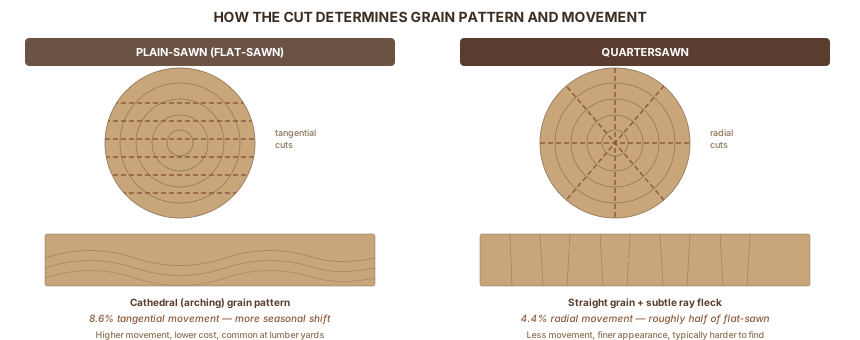
| Tangential | 8.6% |
| Volumetric | 12.8% |
| T/R ratio | 1.9 |
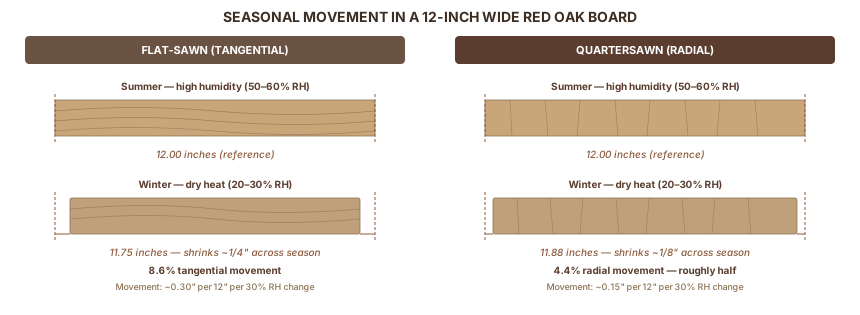
The T/R ratio of 1.9 is the critical number. Flat-sawn (tangential) red oak moves nearly twice as much as quartersawn (radial). A 12-inch wide flat-sawn panel will expand and contract roughly 3/16" to 1/4" across a full seasonal humidity cycle: from the dry heat of winter (20–30% RH) to humid summer (50–60% RH). That gap shows up in your joints.
According to Wood Database's species page, red oak has "fairly high shrinkage values" resulting in "mediocre dimensional stability, especially in flat-sawn boards." Quartersawn red oak moves about half as much for the same board width.
Joinery rules for red oak furniture:
- Frame-and-panel construction: Panels must float in their grooves. Never glue a solid wood panel into a frame. It will either crack the frame or buckle the panel.
- Table tops: Attach with figure-8 fasteners, wooden buttons with elongated slots, or commercial desktop fasteners. Do not drive screws through the apron directly into the top.
- Breadboard ends: Glue and peg only at the center. Elongated mortises in the breadboard allow the main panel to move without stressing the joint.
- Wide glue-ups: Multiple narrower boards produce a more stable panel than a single wide board. Alternating growth ring orientation (one cup-up, one cup-down) partially self-corrects for movement.
- Drawers: Use quartersawn red oak for drawer sides where movement would otherwise cause binding. Or use oak plywood, which eliminates movement entirely for box sides.
Target moisture content: 6–8% for furniture in heated interiors, per USDA FPL guidance. Verify your lumber with a moisture meter before gluing up. Poorly dried stock acclimated to 12%+ will move far more than you expect once it reaches equilibrium indoors.
RELATED: Oak Plywood When seasonal movement would cause binding in drawer sides or case backs, oak plywood is the no-movement alternative that still delivers the oak look.
Part 7: Red Oak's Reputation
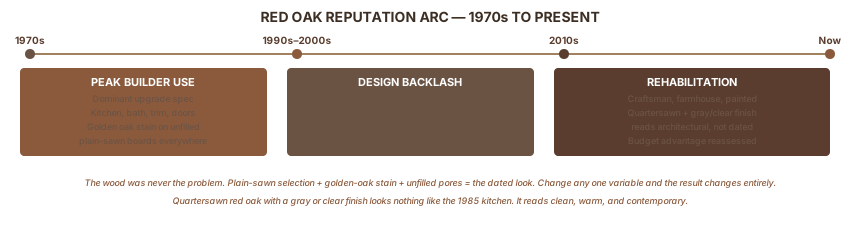
Red oak dominated residential construction upgrades from the 1970s through the 1990s. Kitchen cabinets, bathroom vanities, interior doors, trim: if you bought a "builder upgrade" package in that era, you got red oak. This was driven by abundance and cost, not by design choice.
Mass producers did the worst possible things with it. Plain-sawn boards with mismatched cathedral grain. Golden-oak stain applied directly to unfilled pores. No attention to quartersawn options or grain matching. The combination produced high-contrast, orange-toned results on every surface of every room in every tract house from 1979 to 1997.
When the design backlash arrived (Shaker minimalism, European influence, contemporary clean lines), red oak became the thing to react against. The wood got blamed for what manufacturers chose to do with it.
The Fine Woodworking community has discussed this directly: the material itself is sound. WoodCentral's analysis puts it bluntly: "the death of red oak prestige," driven by overexposure and poor execution.
Quartersawn red oak with a gray-toned or clear finish looks nothing like the dated reference. It reads architectural and contemporary. Architect Magazine has argued for its design rehabilitation, noting that its warmth and grain character work well in Craftsman, transitional, and contemporary-casual contexts when properly finished.
The styles where red oak still excels:
- Craftsman and Arts & Crafts (Stickley, Greene and Greene) — this was always the prestige context for red oak, and it remains legitimate
- Rustic and farmhouse furniture — the open grain and warm color suit the aesthetic
- Painted applications — red oak takes paint exceptionally well; the open grain telegraphs minimally through primer
- Shop furniture — workbenches, tool cabinets, storage: durable, affordable, doesn't require a perfect finish
When contemporary or Scandinavian minimalism is the goal, choose white oak, ash, or hard maple. Their more neutral color and tighter grain read cleaner in those styles.
Part 8: Project Suitability and Honest Assessment
Red oak works well for:
- Interior dining tables, chairs, and beds — 1,220 lbf Janka handles daily abuse without issue
- Kitchen and bath cabinets — the traditional use; still a solid choice with better finish decisions
- Interior doors and architectural millwork — the industry-standard species for a reason
- Flooring — the highest-volume domestic hardwood flooring species in the US
- Bookshelves, entertainment centers, and storage furniture
- Shop benches and tool cabinets
- Craftsman and Mission-style furniture
- Any piece destined for paint
Avoid red oak for:
- Outdoor furniture, decking, or exterior millwork — no tyloses means moisture ingress and accelerated decay
- Cutting boards and food-prep surfaces — the open vessels trap bacteria and food particles; tannic acid transfers a bitter taste to food. Woodworking Clarity confirms this is a genuine concern, not just forum caution. Better options: hard maple, walnut, white oak
- Fine furniture intended for contemporary design contexts where coarse grain reads as a mismatch
- Projects positioned directly next to white oak — the color difference is jarring side by side
The cost case:
At $3–6/BF, red oak lets you build large or complex pieces without consuming the project budget. A dining table at 20 board feet of red oak runs $80–120 in lumber. The same table in walnut: $200–350. The design work, the joinery, and the shop hours are identical. For a piece going into your own home (a kitchen table, a bookshelf, a bedroom dresser), that math is worth considering.
The calculus changes for sellable work. Buyers associate species with value, and walnut or white oak commands a market premium red oak cannot match. Budget accordingly.
Red oak is a choice, not a compromise. Make it consciously.
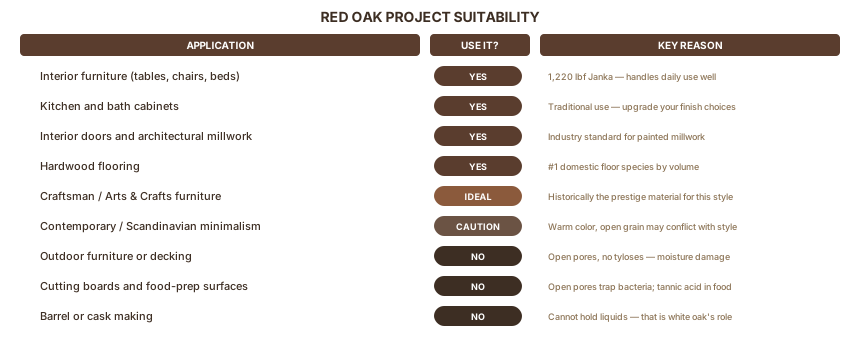
Quick Reference
| Application | Use Red Oak? | Notes |
|---|---|---|
| Interior furniture | Yes | Hardness and workability both strong |
| Kitchen cabinets | Yes | Traditional use; upgrade your finish choices |
| Interior doors/trim | Yes | Industry standard for painted millwork |
| Hardwood flooring | Yes | #1 domestic floor species by volume |
| Outdoor furniture | No | Open pores, no tyloses: moisture damage |
| Cutting boards | No | Open pores trap bacteria; tannic acid |
| Barrel/cask making | No | Cannot hold liquids; that's white oak |
| Craftsman/Arts & Crafts furniture | Yes | Historically the prestige material for this style |
| Contemporary minimalist furniture | Use with caution | Warm color and open grain may conflict with style |
Sources
Technical properties, sustainability, and species data for this guide draw from the USDA Forest Products Laboratory, the Wood Database, and AHEC's species documentation.
- Wood Database — Red Oak — Janka hardness, density, shrinkage values, working properties
- Wood Database — Distinguishing Red and White Oak — pore structure, tyloses, identification methods
- AHEC — American Red Oak — growth and harvest volumes, range, carbon lifecycle
- USDA FPL Wood Handbook, Chapter 4 — shrinkage coefficients, moisture relations
- WoodWeb — Red Oak Finishing Basics — grain filler and finish techniques
- WoodWeb — Rays and Flecks in Oak — medullary ray structure
- The Honest Chisel — Red vs. White Oak — tyloses explanation
- Fine Woodworking Forum — Red Oak Unpopular — community reputation context
- WoodCentral — The Death of Red Oak Prestige — design history
- Architect Magazine — Red Oak in Contemporary Design — design rehabilitation
- Woodworking Clarity — Red Oak for Cutting Boards — food safety analysis
How We Research
We don't take affiliate revenue or accept review units. Picks come from multi-source research — manufacturer specs, OSHA / EPA / ASTM regs, and long-form practitioner threads — plus Ahmed's hands-on use where relevant. When we recommend something, we explain why.
Up Next
Why Cherry Wood Darkens Over Time
WOOD & MATERIALS · Beginner