
How to Use This Guide
Macassar ebony stops people in their tracks. The jet-black heartwood striped with gold and brown looks unlike anything in a domestic hardwood pile. At a Janka hardness of 3,220 lbf and a density of 68 lbs per cubic foot, it's more than twice as hard as hard maple — and at $80–150 per board foot for 4/4 stock from US dealers like West Penn Hardwoods or Cook Woods, it's priced like the specialty material it is. If you've seen a piece and want to know if you can actually work with it, and whether it's legal to buy, this guide answers both questions directly.
If you want to see it: Start with Part 1: What Macassar Ebony Looks Like — including why no two boards are identical.
If you're about to cut it: Jump to Part 3: How to Work with Macassar Ebony — tools, planing, gluing protocol.
If you need to finish it: Part 4: Finishing Macassar Ebony covers the oily-surface problem and what actually works.
If you're not sure it's legal: Part 5: Sourcing Macassar Ebony Legally clarifies the CITES situation specifically.
Macassar Ebony at a Glance
Macassar ebony (Diospyros celebica) is a dense Indonesian hardwood with a signature striped black, brown, and gold figure unlike any other ebony. It's harder than anything you'll find at a home center, legally accessible for US buyers, and best suited for small-scale specialty work: inlay, turning, knife handles, and instrument components.

| Scientific name | Diospyros celebica |
| Family | Ebenaceae (ebony family) |
| Origin | Sulawesi (Celebes), Indonesia |
| Janka hardness | 3,220 lbf (14,323 N) |
| Specific gravity | 1.01 — sinks in water |
| IUCN status | Vulnerable |
In this guide:
- What it looks like (and why it varies so much)
- Physical properties and what they mean in the shop
- How to cut, plane, and glue it
- Finishing on oily tropical hardwood
- Is it legal to buy? — CITES, the Lacey Act, and what to ask your supplier
- What it's actually used for, by skill level
- Dust safety
Part 1: What Macassar Ebony Looks Like
Diospyros celebica grows only on Sulawesi, Indonesia, where "Macassar" comes from the island's principal seaport. The heartwood is dark brown to jet-black, cut through with bands of golden-brown to reddish-brown. The stripes aren't subtle. They're the whole point. The sapwood is pale yellowish-white with a sharp boundary at the heartwood.
The natural luster is exceptional. A freshly scraped surface looks polished. This is the wood's actual surface, no topcoat applied.
Why no two boards look the same
The woodworking community notices this. A Reddit thread titled "Macassar ebony has a very high degree of variance" drew dozens of comments from people surprised by how different boards from the same species can look.
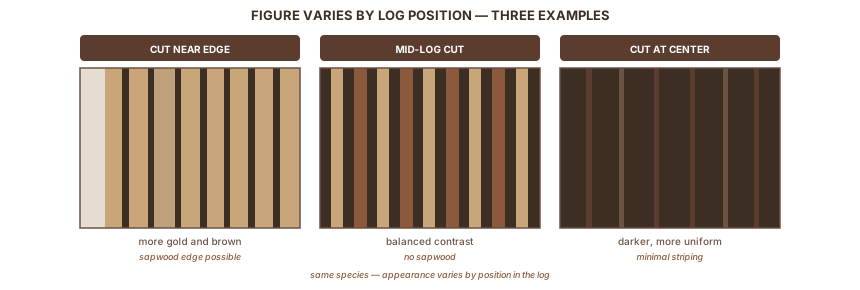
The variance has real causes:
Position in the log. Outer heartwood (the most recently converted rings near the sapwood) carries more of the brown and gold coloring. Inner heartwood, the oldest wood at the core, is often darker and more uniformly black. A board sawn from near the center looks completely different from one sawn near the edge.
Tree genetics. Individual trees in the same forest produce different stripe densities and color distributions. This is biological variation within the species, not a quality defect.
Growth conditions. Trees under water or nutrient stress grow more slowly and develop more compressed growth rings. Wide rings from fast growth tend to show more pronounced stripe contrast. Dense forest competition produces slower growth and more uniform coloration.
Age at harvest. Younger trees have a higher ratio of sapwood to heartwood, and less developed heartwood color. This results in lighter, more varied boards.
Practical consequence: When you're specifying macassar ebony for a project where appearance matters, buy in person or from a dealer that photographs individual pieces. Ordering by species name alone will give you results that span the full visual range.
Managing client expectations
If you're building for someone who says "I want ebony," clarify before you order. True black ebony (Gabon or Ceylon species) is uniform jet-black. Macassar is striped. Both are legitimately called ebony, and neither is better. They're different aesthetics. Show a sample first.
Part 2: Physical Properties
The numbers
| Property | Value |
|---|---|
| Janka hardness | 3,220 lbf (14,323 N) |
| Average dry weight | 68 lbs/ft³ (1,090 kg/m³) |
| Specific gravity | 1.01 |
| Texture | Fine to medium, uniform |
| Grain | Generally straight; interlocked; sometimes wavy |
| Natural luster | Very high |
Source: Bell Forest Products
Context: what 3,220 lbf actually means
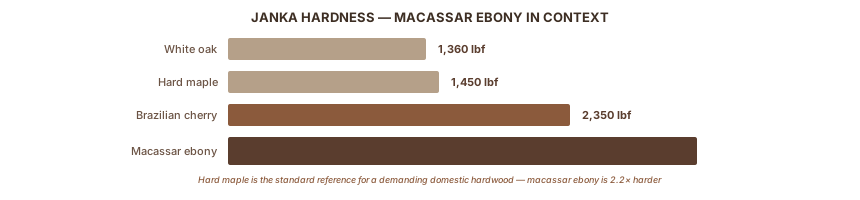
Hard maple, already considered a demanding domestic hardwood, rates around 1,450 lbf on the Janka scale. White oak is 1,360 lbf. Brazilian cherry (jatoba), which wears out finish carpenters' carbide saw blades, rates around 2,350 lbf.
Macassar ebony at 3,220 lbf is more than twice as hard as hard maple. Your tools will tell you immediately when you make the first cut.
A specific gravity of 1.01 means macassar ebony sinks in water. Most North American hardwoods float. This density is what gives it the exceptional polish and resonance that makes it attractive for musical instruments and turned objects.
Macassar ebony vs. other ebonies
Not every wood called "ebony" is the same species or has the same legal status. How macassar compares:
| Species | Origin | Visual character | Legal status (US) |
|---|---|---|---|
| Macassar ebony (D. celebica) | Sulawesi, Indonesia | Striped black/brown/gold | Legal with SVLK documentation |
| Gabon/African ebony (D. crassiflora) | West Africa / Madagascar | Uniform jet-black | Madagascar specimens restricted |
| Ceylon ebony (D. ebenum) | South India, Sri Lanka | Jet-black | Madagascar specimens restricted |
| African blackwood (Dalbergia melanoxylon) | Sub-Saharan Africa | Purple-black | CITES Appendix II |
Source: Wikipedia: Ebony
The key point: macassar ebony is the most legally accessible ebony species on the US market because the global CITES Appendix II restriction on Diospyros species applies to specimens from Madagascar, not Indonesia.
Part 3: How to Work with Macassar Ebony
Two factors make macassar ebony demanding to work: extreme hardness and interlocked grain. They're separate problems with separate solutions.
Tools and Blades: Carbide Is Not Optional
At 3,220 lbf Janka, macassar ebony dulls HSS (high-speed steel) cutting edges faster than almost any domestic hardwood. Carbide tools are the baseline. This applies to saw blades, router bits, plane irons, and drill bits.
For sawing, use a 60–80 tooth carbide blade for crosscuts and a clean-cutting rip blade for ripping. Maintain moderate feed pressure. Don't force the cut. The density generates heat; slow, steady cuts produce cleaner results than pushing for speed.
Planing: Working with Interlocked Grain
Interlocked grain means the wood fibers don't run straight through the board. They alternate direction in bands, like strands in a rope. Planing in one direction cuts with the grain in some sections and against it in others.
For hand planing, set the blade to a high cutting angle (55–60°) and take thin shavings. The high angle reduces tearout from reversing grain. If tearout appears, try the opposite direction or switch to a cabinet scraper.
For machine planing, take light passes, no more than 1/32 inch per pass. Listen for the change in cut sound that signals a grain reversal, and reduce feed pressure when you hear it.
Cabinet scrapers are your friend. On macassar ebony, a well-tuned cabinet scraper produces cleaner surfaces than sandpaper for final prep. The high oil content clogs sandpaper quickly, and fine ebony dust fills abrasive grit fast. Scrape to 150-grit equivalent, then follow with light 220-grit if needed.
Gluing: The Oil Problem and the Solution
The natural oil content in macassar ebony is high enough to prevent standard yellow glue from bonding reliably. The oil sits on the surface and acts as a release agent.
The degreasing protocol:
- Wipe all gluing surfaces with naphtha
- Let it flash off completely. Minimum 30 minutes.
- Apply adhesive and clamp immediately. Don't let the surface sit after degreasing.

How adhesives perform after degreasing:
| Adhesive | Performance | Notes |
|---|---|---|
| Epoxy | Best — high structural integrity | Greatest oil tolerance, gap-filling |
| Cyanoacrylate (CA) | Excellent for small joints | Fast cure; good for inlay |
| Titebond III | Acceptable | Requires thorough degreasing |
| Standard Titebond (original) | Not recommended | Adhesion marginal even with prep |
Routing
Use carbide bits only. Take light passes, no more than 1/8 inch deep per pass. Climb-cut when entering dense sections to prevent tearout at edges. Don't rush.
For beginners: start small
If you've never worked with wood this hard and oily, begin with pen blanks or small knife handle scales. These require minimal joinery, the degreasing protocol is easy to execute on small surfaces, and the cost per piece is low enough that a learning mistake doesn't hurt badly.
Part 4: Finishing Macassar Ebony
The core problem
Macassar ebony's natural oil content interferes with how film finishes cure. The oils essentially prevent polymerization at the surface. You can apply a coat of oil-based polyurethane to an unprepared macassar ebony board and it will stay tacky for weeks, or never cure at all.
The fix is straightforward once you understand why it happens.
The easy path: oil finishes
Tung oil or danish oil works without surface prep. These finishes are chemically compatible with the wood's natural oils. They penetrate and enhance the figure rather than sitting on top.
Apply thin coats and wipe off excess before each coat skins over. Let each coat cure fully (24 hours minimum for danish oil, longer for tung oil) before the next. Three to four coats is typical. Buff lightly between coats with 0000 steel wool.
Oil finishes bring out the depth and contrast of macassar ebony's striped figure better than most film finishes. For decorative work, small boxes, and display pieces, this is the right choice.
Film Finishes: The Protocol
For polyurethane, lacquer, or any film-forming finish on macassar ebony:

- Wipe with naphtha. Let it flash off completely. 30 minutes minimum. This removes surface oils.
- Apply dewaxed shellac as a barrier coat. Zinsser SealCoat works well; apply one to two thin coats. The shellac isolates the wood's oils from the topcoat.
- Sand lightly with 320-grit to knock down raised grain.
- Apply your topcoat (oil-based polyurethane, lacquer, water-based finish).
The shellac barrier coat is the step most woodworkers skip, and the reason most finishing failures on oily exotics happen. Don't skip it.
CA finish for turned pieces
Pen turners and wood turners use cyanoacrylate as a topcoat on exotic hardwoods. It bonds despite the oils, cures hard and glossy, and doesn't require degreasing prep.
Apply thin (watery) CA in light coats, cure with accelerator between coats, and sand progressively from 400 to 2000 grit, then polish with compound. The result is durable, high-gloss, and shows the figure well.
Part 5: Sourcing Macassar Ebony Legally
Is it legal to buy?
Yes, from legitimate US dealers with documentation.
Not all ebony is CITES-restricted. Macassar ebony isn't, but the legal situation needs a quick explanation.
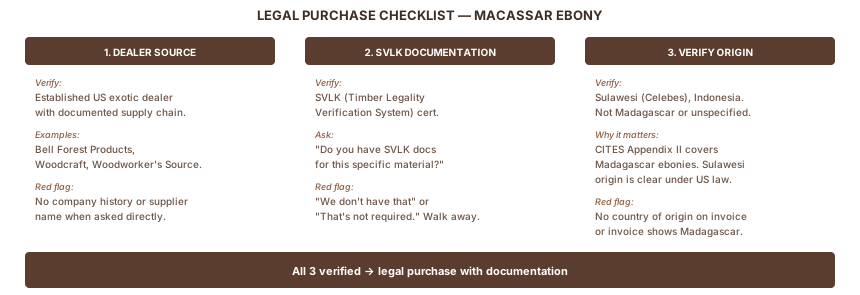
CITES Appendix II applies to Diospyros species from Madagascar. This listing was added in 2016 and covers the Madagascar ebonies primarily. Macassar ebony (D. celebica) comes from Sulawesi, Indonesia. It is not covered by this global CITES restriction.
Indonesian law: Indonesia regulates its timber exports through the SVLK (Sistem Verifikasi Legalitas Kayu, or Timber Legality Verification System). Wood legally exported from Indonesia carries SVLK certification. Ask any supplier for this documentation.
The Lacey Act (US): US law prohibits importing or trading wood products that were illegally harvested under the laws of the country of origin. Even though macassar ebony isn't CITES-listed, you can't legally buy material that was illegally logged in Indonesia. The Lacey Act puts the responsibility on the buyer to verify the chain of custody.
The Gibson Guitar case
In 2011, Gibson Guitar paid $300,000 in penalties for importing ebony and rosewood that violated sourcing laws. Documentation requirements apply to buyers at every level, not just importers.
Buy from dealers who can provide the paperwork.
Practical buying guidance
Buy from established US dealers. Companies with established supply chains (Bell Forest Products, Woodcraft, Woodworker's Source, specialty exotic hardwood dealers) maintain the documentation required for legal import.
Ask for SVLK certification. A legitimate supplier can provide it. If they can't, that's a meaningful signal.
Be cautious about cheap "rough ebony." The keyword "rough ebony" appears frequently in search results. Some of this material is legitimately rough-sawn solid wood. Some comes from sources with unclear provenance. Ask before buying.
Consider macassar ebony veneer. Veneer delivers the same dramatic striped figure at a fraction of the solid wood cost. More surface area per log makes it the more sustainable choice. For cabinet panels, drawer fronts, and architectural applications, veneer is often the right call anyway.
Pricing context
As of early 2026, Bell Forest Products lists small pen blanks starting around $4–5 each, with hand-picked solid boards up to $100+. This reflects the species' scarcity, typically small available sizes, and the premium for verified legal sourcing.
Part 6: Project Applications
Macassar ebony's small typical size, high density, and exceptional figure make it best suited for specialty work rather than large furniture.
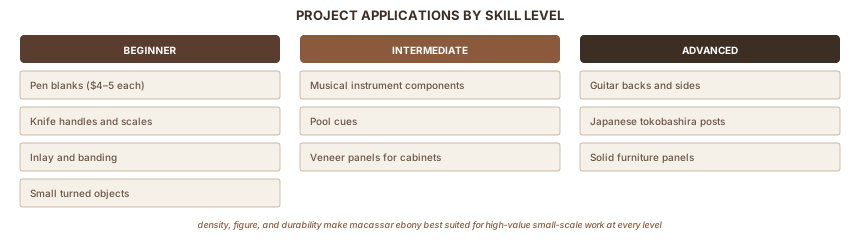
Small-scale (accessible for beginners)
Pen blanks. At around $4–5 per blank, this is the entry point. Pen blanks turn cleanly, show the figure beautifully, and teach you how the wood behaves before you invest in larger material.
Knife handles and blade scales. A natural fit. Very hard, takes an outstanding oil finish, holds up to decades of use, and looks better over time. Degreasing protocol applies before attaching scales with epoxy.
Inlay and banding. The high contrast between macassar ebony and lighter woods (maple, ash, birch) makes inlay striking. Small pieces are affordable. The natural luster means inlay looks polished even before the final finish.
Small turned objects. Chess pieces, small boxes, handles. The fine texture responds well to turning tools, and the material sands and polishes easily at the lathe.
Medium-scale (intermediate)
Musical instrument components. Guitar fingerboards, violin tailpieces, chin rests. Traditional use; high value per small piece.
Pool cues. A traditional high-end use that plays to the wood's hardness and figure.
Veneer panels. Cabinet faces, drawer fronts, architectural panels. Most economical way to use macassar ebony at scale.
Large-scale (advanced)
Guitar backs and sides. High-value luthiery application; requires mastery of thin-stock work on a hard, interlocked-grain species.
Traditional Japanese tokobashira. Decorative posts in traditional Japanese architecture. Japan was historically the primary importer of macassar ebony, and this use drove much of that demand.
Solid furniture panels. Technically possible; extremely expensive and demanding. Most woodworkers use veneer instead.
Part 7: Safety
Dust hazards
Macassar ebony dust causes acute dermatitis (skin inflammation), conjunctivitis (eye irritation), and nasal irritation. It may also act as a skin sensitizer: repeated exposure can trigger an allergic response that grows more severe over time.
This risk is real. Sawing, routing, sanding, and turning all generate fine ebony dust in quantity.
Source: Bell Forest Products: "Dust can cause acute dermatitis, conjunctivitis, sneezing, possibly a skin sensitizer."
PPE minimum requirements
- Respirator with P100 (HEPA) filter. Not a dust mask. Paper dust masks don't filter particles at this size. N95 at minimum; P100 preferred.
- Eye protection. Safety glasses or goggles (not reading glasses).
- Skin protection. Nitrile gloves when sanding or scraping. Long sleeves are a reasonable precaution.
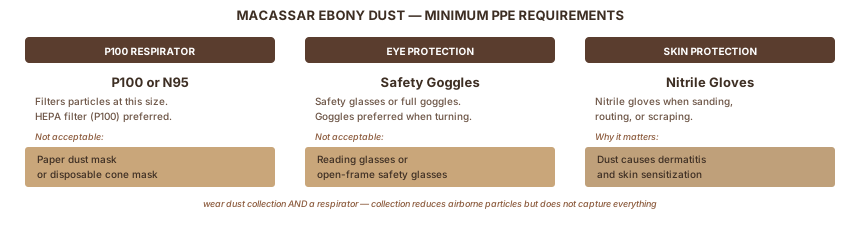
Wear both: dust collection at the source and a P100 respirator. Collection reduces what goes airborne but doesn't capture everything.
Turners generate the finest particles and highest airborne concentrations. Use a full-face shield plus P100 respirator when turning macassar ebony, and ensure the space has active ventilation.
Where This Fits
Macassar ebony is a specialty material. Not a first choice for furniture, but an excellent choice for high-value small work. It opens doors to inlay, instrument components, and turned pieces that reward exceptional figure and durability.
Before this: If you're new to working with exotic hardwoods in general, start with a more forgiving species (padauk, purpleheart, cocobolo for a taste of oil-content issues). These will teach you carbide requirements and finishing prep at lower cost per mistake.
Alongside this: Finishing on oily tropicals is a skill that transfers across species. The naphtha-degreasing and shellac-barrier approach applies to cocobolo, rosewood, teak, and similar dense exotics.
After this: If macassar ebony appeals for luthiery work, dig into fingerboard prep and fret installation. The species properties here are just the starting point for instrument-grade work.
FAQ
Is macassar ebony legal to buy in the US?
Yes, with proper documentation. Macassar ebony (Diospyros celebica) is listed by the IUCN as Vulnerable but is not on CITES Appendix II — meaning it can be imported under the Lacey Act if the supplier provides Indonesian SVLK (Sistem Verifikasi Legalitas Kayu) documentation. Reputable US dealers including Bell Forest Products, West Penn Hardwoods, and Cook Woods stock it routinely with the paperwork in order. Avoid eBay or "estate find" listings — without an SVLK chain, you risk seizure under the Lacey Act.
How much does macassar ebony cost?
Expect $80–150 per board foot for 4/4 (about 1 inch thick) stock from a US specialty dealer in 2026. Smaller turning blanks priced by weight run $30–50 per pound. Pen blanks (3/4" × 3/4" × 5") run $5–12 each. Prices vary with figure — boards with the strongest black-and-gold striping command 30–50% premiums over plainer cuts. Buy only what you need; this isn't a "stock the rack" species.
Why is macassar ebony so hard to glue?
The wood is dense (specific gravity 1.01 — it sinks in water) and contains natural oils that interfere with glue adhesion. Standard PVA wood glue often fails on a freshly planed surface within months. The fix is a 2-step protocol: wipe the glue surface with naphtha to remove surface oils, let it flash off for 5 minutes, then glue with epoxy or polyurethane. Titebond III works for low-stress assemblies but is not the right choice for high-stress joints.
Do I need carbide tools for macassar ebony?
Yes. At 3,220 lbf Janka hardness (more than twice hard maple's 1,450 lbf), macassar ebony will dull HSS steel within minutes. Use carbide-tipped saw blades, carbide router bits, and carbide turning tools. Sharpen often — even carbide degrades faster than it does on domestic hardwoods. Plan for 30–50% more sharpening sessions than you'd expect for oak or maple work.
Is macassar ebony dust dangerous?
Yes. Like most dense tropical hardwoods, macassar ebony dust is a documented respiratory irritant and skin sensitizer. Use a P100 respirator and active dust collection at the source whenever you cut, plane, or sand it. Turners generate the finest particles — a full-face shield plus P100 is the minimum kit. Don't rely on a beard-friendly N95 alone for prolonged work.
Sources
Research on macassar ebony's properties, legal status, and applications drew from technical product data, botanical references, and documented woodworking community experience.
- The Wood Database — Macassar Ebony — Janka hardness, density, specific gravity, working properties, and allergic reaction notes
- Wikipedia: Diospyros celebica — species overview, distribution, IUCN status, drying characteristics
- Wikipedia: Ebony — species comparisons, CITES listing context, Gibson Guitar case
- Bell Forest Products — Janka hardness, density, specific gravity, grain, texture, dust hazard documentation, pricing