
How to Use This Guide
Router templates solve a specific problem: how to route the same shape, in the same place, on multiple workpieces without re-measuring every time. Once you set up a template for a hinge mortise or a curved leg, every part comes out identical.
This guide covers the mechanics behind how templates work, how to calculate the offset that trips up most beginners, what to make templates from, and how to build your first one.
- If you're confused about guide bushings and offset: Start with Part 1 and Part 2. The offset calculation is the single concept that unlocks the whole system.
- If you're choosing template material: Jump to Part 3.
- If you're ready to build a template: Part 4 covers the process, including the scoring method.
- If you want to see what templates can do: Part 5 lists the eight most useful applications.
- If something went wrong: Part 6 has the most common mistakes and their fixes.
Router Templates at a Glance
A router template is a shaped piece of material — usually 1/4" to 3/4" thick — that guides a router along a fixed path. The template doesn't move; the router follows its edge. The result is a repeatable cut that matches every time.
| Best starter material | 1/2" MDF |
| Guide bushing standard | Porter-Cable (fits most routers) |
| Offset formula | (Bushing OD – Bit diameter) ÷ 2 |
| Zero-offset method | Flush-trim or pattern bit |
| Recommended attachment | Woodturner's double-faced tape |
| Template thickness | Match to your bushing's shank length (usually 1/4"–3/4") |
In this guide:
- How the two systems work — bushings vs. bearing bits
- The offset formula and a table of common bushing/bit pairs
- What to make templates from — four materials compared
- Making a template, including the scoring method
- Eight applications: hinge mortises to inlays
- Mistakes that produce bad cuts — and how to avoid them
Part 1: How Router Templates Work
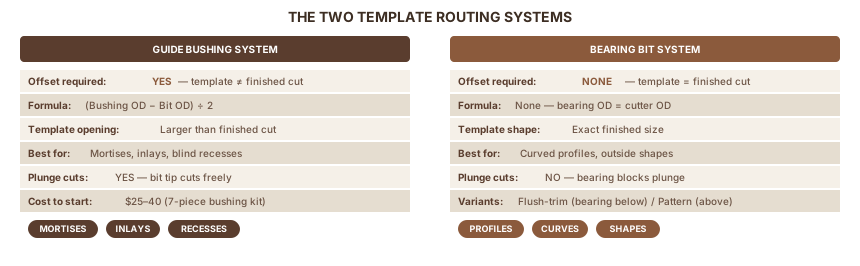
Template routing has one mechanical principle: something guides the router bit's path along the template edge. That guide is either a bushing attached to the router base plate, or a bearing built into the router bit. The two systems work differently. Knowing which one to use makes every template decision simpler.
The Guide Bushing System
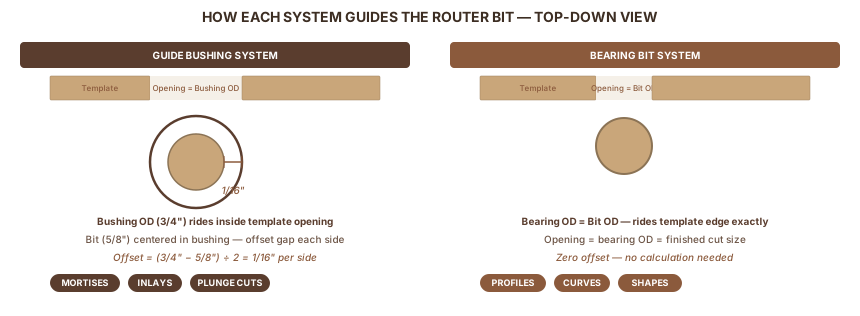
A guide bushing is a cylindrical collar that screws into the router's base plate. It surrounds the router bit without touching it. The outer wall of the bushing rides along the template edge, keeping the bit on a consistent path.
Most routers (DeWalt, Bosch, Makita, Milwaukee, Ridgid) use the Porter-Cable base plate standard: a 1-3/16" center hole that accepts Porter-Cable-style bushings. Fine Woodworking calls this the most useful router accessory most woodworkers don't own. Bushings from Rockler, MLCS, Woodhaven, and POWERTEC all fit this standard. You're not locked into one brand.
The catch: the bushing is always larger in diameter than the router bit. That size difference creates a gap between the bit and the template edge. That gap is the offset. Your template has to account for it.
| Bushing OD | Typical Paired Bit | Offset (each side) |
|---|---|---|
| 5/16" | 1/4" | 1/32" |
| 1/2" | 3/8" | 1/16" |
| 5/8" | 1/2" | 1/16" |
| 3/4" | 5/8" | 1/16" |
| 1" | 7/8" | 1/16" |
The bushing system is the right choice whenever you need to plunge the router into the wood: mortises, recesses, and inlays. A plunge cut requires the bit tip to cut downward freely, and a bushing keeps the path accurate without obstructing the tip.
A starter guide bushing kit (seven or eight bushings, a centering pin, lock nuts, and a storage case) runs $25–40. Rockler, MLCS, and Woodhaven all offer compatible sets. One kit handles most template work you'll ever do.
Flush-Trim and Pattern Bits
The second approach puts the guide mechanism on the bit itself. A ball bearing, the same diameter as the cutter, rides along the template edge. Because the bearing equals the cutter, there's no offset. Your template is exactly the size of the finished cut.
Two variations:
- Flush-trim bit: bearing at the bottom of the cutter. Template sits on top of the workpiece; the router runs above and the bearing follows the template edge underneath.
- Pattern bit: bearing at the top of the cutter. Template sits on top; the router runs underneath (or up through a router table).
The bearing method is faster to set up. No offset calculation, no offset-adjusted template. It's the right choice for duplicating outside shapes: curved chair legs, decorative aprons, shaped handles. The limitation is plunging. The bearing at the bit tip blocks the bit from cutting downward into a blind cavity.
Which System to Choose
| Situation | System |
|---|---|
| Routing a mortise or recess | Guide bushing |
| Routing an inlay cavity | Guide bushing |
| Cutting a hinge mortise | Guide bushing |
| Duplicating a curved outside shape | Flush-trim or pattern bit |
| Following an exterior edge | Flush-trim bit |
| Large production run of duplicate parts | Flush-trim bit (faster setup) |
When in doubt: if the router needs to plunge, use a bushing. If you're following an existing edge or shape, use a bearing bit. Stumpy Nubs has a detailed breakdown of where each system excels.
RELATED: Using a Router The router setup fundamentals — collet, speed, feed direction — that apply to all template work.
Part 2: The Offset Calculation
The offset is what makes or breaks a template. Get it right and every cut lands where you intended. Miss it and your mortises come out consistently too big or too small by a fixed amount. Frustrating, because the cuts are accurate. They're just not where you wanted them.
The Formula
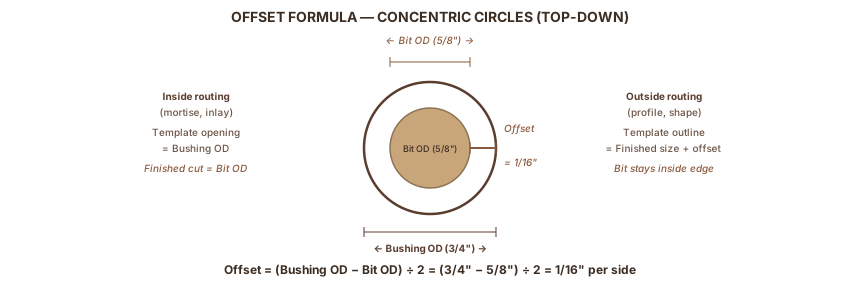
Offset = (Bushing OD – Bit diameter) ÷ 2
Wealden Tool's offset guide is the clearest explanation of this formula. Example: 5/8" bushing and a 1/2" straight bit. (0.625 – 0.500) ÷ 2 = 0.0625" = 1/16"
The offset is 1/16" on each side of the cut. Your template must be sized accordingly:
- Inside routing (mortise, recess): Make the template opening 1/16" SMALLER than the finished cavity on each side. The bushing runs along the outside of the opening and pushes the bit outward 1/16" per side. The routed cavity ends up 1/8" larger than the template opening total (1/16" per side × 2 sides).
- Outside routing (following exterior): Make the template outline 1/16" LARGER than the finished shape. The bushing keeps the bit 1/16" inside the template edge.
The direction flips depending on which side of the template the bushing runs. Do one test cut on scrap before routing the actual workpiece.
Common Bushing/Bit Pairs and Their Offsets
| Bushing OD | Bit OD | Offset (each side) | Template vs. Finished Size |
|---|---|---|---|
| 5/16" | 1/4" | 1/32" | 1/32" smaller (inside) or larger (outside) |
| 1/2" | 3/8" | 1/16" | 1/16" per side |
| 5/8" | 1/2" | 1/16" | 1/16" per side |
| 5/8" | 9/16" | 1/32" | 1/32" per side |
| 3/4" | 5/8" | 1/16" | 1/16" per side |
To minimize the offset, choose a bushing OD as close to the bit diameter as possible. The 5/16" bushing with a 1/4" bit gives only 1/32" offset. At that scale, pencil-line width matters more than the offset itself. Popular Woodworking's bushing calculator lets you compute offsets for any bushing/bit pair.
Zero-Offset: Skip the Math
With a flush-trim or pattern bit, the bearing equals the cutter diameter. Template size = finished cut size. No calculation. If you're building a template for outside profiling and don't need to plunge, this is the simpler system.
The Inlay Two-Step
Inlay routing uses the offset to its advantage. The Rockler inlay bushing kit is a pair of bushings with a specific offset between them. It works like this:
- Route the cavity using the larger bushing. The cavity is slightly smaller than the template opening.
- Remove the larger bushing, install the smaller one (or no bushing), and route the inlay piece from the same template. The inlay is slightly larger than the cavity.
- The offset difference between the two bushing sizes creates a snug friction fit. Same template, two cuts, perfect fit.
Part 3: Template Materials
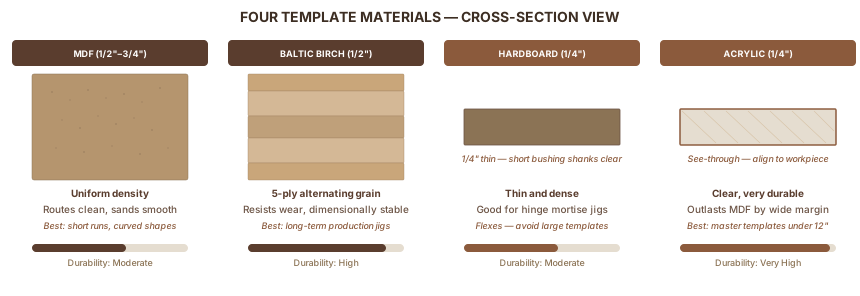
You don't need exotic materials for router templates. MDF from a home center covers most work. Four options, each with a clear use case:
Material Comparison
| Material | Thickness | Durability | Workability | Cost | Best For |
|---|---|---|---|---|---|
| MDF | 1/2"–3/4" | Moderate | Excellent | Very low | Short-run, curved shapes, one-off fixtures |
| Baltic birch plywood | 1/2" | High | Good | Low | Long-term production templates |
| Hardboard/Masonite | 1/4" | Moderate | Good | Very low | Hinge mortises, shelf-pin templates |
| Acrylic/polycarbonate | 1/4" | Very high | Moderate | High | Master templates; transparent for workpiece visibility |
MDF shapes easily with a rasp and sands smooth. The flat, dense surface gives the guide bushing a consistent edge to follow. It absorbs moisture over time, so templates in a damp shop may eventually bow. For production templates used weekly, seal the edges with epoxy.
Baltic birch plywood resists wear and stays dimensionally stable through seasonal changes. It's the right call for templates you'll use for years: cabinet hinge jigs, mortise-and-tenon templates, shelf-pin jigs. The edge shows plies, which can cause minor inconsistencies where the bushing crosses a glue line. Seal the edges with epoxy to fix this.
Hardboard (1/4" Masonite) is thin enough that short bushing shanks clear it reliably. Good for hinge mortise jigs and any template where 1/4" thickness helps. Avoid it for large templates; it flexes too much to hold a straight edge.
Acrylic is what professional shops use for master templates. You can see the workpiece through it for alignment, and it outlasts MDF by a wide margin. Cut it with a carbide blade at high speed and slow feed to avoid chipping. Temperature changes cause dimensional shifts in large pieces; save acrylic for templates under 12".
The Hybrid System
Experienced template makers use acrylic as a permanent master and route MDF working copies from it. The acrylic master is accurate and durable and never touches a workpiece. The MDF copy takes the wear. When an MDF copy wears out or gets damaged, route a new one from the acrylic master in five minutes.
This approach pays off once you've made a template worth replicating: a cabinet door mortise jig, a guitar body outline, a leg taper fixture.
What Not to Use
Avoid softwoods (pine, cedar): the bearing compresses into the grain and gives an inconsistent edge. Particleboard crumbles at the edge after a few uses. Standard (non-Baltic-birch) plywood has voids in the core that cause the bit to chatter when the bushing passes over them.
Part 4: Making Your First Template
You need 1/2" MDF, a jigsaw or scroll saw, a rasp, sandpaper, and a square. That covers most templates. If the template has a rectangular opening (a mortise template, a handle cutout), the scoring method produces a sharper result with less work.
Basic Method (Any Shape)
- Transfer the shape to the template blank. Draw directly, trace a paper pattern, or transfer with carbon paper.
- Drill starter holes for inside cuts — any inside corner gets a 1/4" drill hole so the jigsaw has room to turn.
- Rough cut to within 1/8" of the line with a jigsaw or scroll saw. Accuracy doesn't matter here — you're just removing bulk.
- Refine to the line with a rasp, file, or oscillating spindle sander. Work to the line consistently; check straight sections with a straightedge.
- Sand to 120 grit on all template edges. Smooth edges let the bearing or bushing follow cleanly.
- Test on scrap before routing the actual workpiece.
- Write the template info directly on the template in permanent marker: bushing size, bit diameter, offset amount, date made. You'll thank yourself six months later.
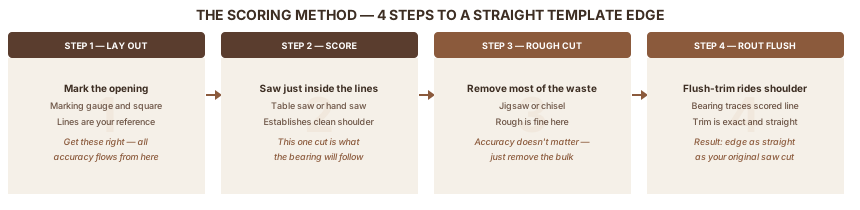
The Scoring Method (Rectangular and Polygonal Openings)
This technique makes dead-accurate straight-sided template openings without a CNC. The scored line acts as a register edge for a bearing-guided bit to follow.
- Lay out the opening precisely with a marking gauge and square. These lines are your reference; get them right.
- Score along the lines with a saw — table saw or a sharp hand saw, cutting just inside the lines. You're establishing a straight, clean shoulder, not removing all the waste.
- Remove most of the waste with a jigsaw or chisel. Rough is fine.
- Rout to the scored line using a flush-trim or pattern bit. The bearing rides along the scored shoulder — the one cut that was accurate — and trims the rough cut perfectly flush with it.
The result is a template edge as straight as your saw cut. On a table saw, that's very straight. This is the technique that showed up in the r/woodworking thread and in this YouTube tutorial on the scoring method. It's not widely taught, which is why it's worth knowing.
Adding Registration Features
A bare template needs help finding its position on a workpiece every time. Two additions that pay off:
Fence strip: Glue a strip of the same material along one edge. The fence registers against the workpiece face or edge. Same position every time, no measuring.
Stop block: Glue a block at one end that the workpiece butts against. Controls length position.
Mark center lines on the template with a marking gauge and permanent marker. Align these to center lines on the workpiece for fast positioning.
Attaching the Template
| Method | Best For | Hold Strength | Residue? |
|---|---|---|---|
| Woodturner's double-faced tape (cloth) | Most template work | High | Slight |
| Carpet tape | Light-duty, quick setups | Moderate | Yes |
| Toggle clamps (built into jig) | Production runs | Very high | None |
| Screws (into waste areas) | Heavy cuts, large templates | Very high | None |
| Hot glue | Small parts | Moderate | None |
Woodturner's double-faced tape is the go-to. Apply it in at least four spots, press the template and workpiece together firmly for 10 seconds, then route. It holds through aggressive cuts and releases cleanly with a chisel or plastic pry tool. For production runs (the same template on 20 cabinet doors), toggle clamps built into the jig are faster.
RELATED: Router Jigs How to build jig systems that incorporate templates with built-in clamps and fences.
Part 5: What You Can Do with Templates
The usefulness of a template library grows over time. Each template you make is a fixture you can reuse. Templates replace what would otherwise require a CNC machine or hours of hand-fitting per part. A hinge mortise jig that took an hour to build saves that hour across every door you ever hang. The eight applications below are the ones worth building templates for.
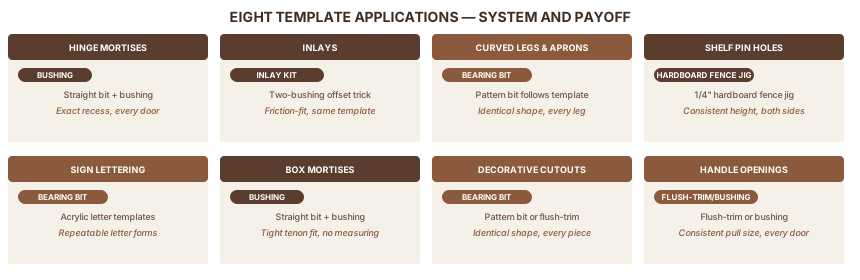
Eight Core Applications
| Application | System | What the Template Controls |
|---|---|---|
| Hinge mortises | Bushing + straight bit | Recess depth, exact size, placement along door edge |
| Inlays | Rockler inlay bushing kit | Cavity and inlay piece routed from same template |
| Curved legs and aprons | Pattern bit | Consistent shape across all four legs |
| Shelf pin holes | 1/4" hardboard fence jig | Consistent spacing, identical height both sides |
| Sign lettering | Flush-trim (table or hand) | Letter form accuracy |
| Box mortises for doors/frames | Bushing + straight bit | Tight tenon fit without measuring each mortise |
| Repeat decorative cutouts | Pattern bit or flush-trim | Identical shape on every piece |
| Handle and pull openings | Flush-trim or bushing | Consistent handle size on cabinet pulls |
For hinge mortises, the Porter-Cable style hinge template jigs are the commercial standard. They're adjustable for different door thicknesses and hinge sizes, and they use the bushing system. Rockler's version is the most widely available.
For inlays, Bob Penoyer's inlay routing guide walks through the two-bushing method in detail. Read it before attempting your first inlay.
Templates vs. Stencils
A stencil is a marking tool. You trace through it with paint or a pencil. A router template is a cutting guide: the bushing or bearing physically constrains the router's path. You can use a stencil-like shape as a router template (letter forms work this way), but the guide mechanism is always the bushing or the bearing. The stencil gives you the shape. The bushing or bearing makes the cut accurate.
For sign lettering, sign supply vendors sell commercial acrylic letter template sets. Run the router through each letter opening with a V-groove bit or straight bit, guided by the bushing.
Part 6: Common Mistakes and How to Avoid Them
Most template routing problems come from the same handful of causes. 731 Woodworks and Katz-Moses Tools both cover these in detail. The fixes are specific.
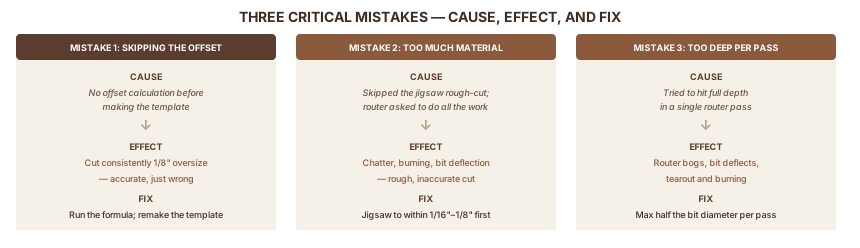
| Mistake | What Happens | Fix |
|---|---|---|
| Not calculating offset | Cut consistently too big or small by a fixed amount | Calculate (bushing OD – bit OD) ÷ 2; remake the template with the correct dimensions |
| Starting a cut on end grain | Tearout at corners of mortises and recesses | Start on long grain; make a very light climb cut at the end-grain corner to pre-sever fibers, then complete with a conventional cut |
| Too much material left for the router | Chatter, burning, deflection | Bandsaw or jigsaw the workpiece to within 1/16"–1/8" of final line before routing |
| Cutting too deep in one pass | Router bogs, bit deflects, tearout | Never exceed half the bit diameter per pass for depth; take multiple passes |
| Routing in the wrong direction | Router bucks, grabs the workpiece | Always move the router so the bit pushes against the direction of travel (conventional cut); never climb cut except for tiny cleanup passes |
| Bit set too high | Cutter contacts template material | Set bit height so only the workpiece is cut; bearing or bushing guides the path, the bit tip should not reach the template |
| Poor template attachment | Template shifts mid-cut | More tape contact points; clamps wherever possible; for large templates, use screws through template into a backing board |
The most common problem for first-time template users: forgetting the offset. A hinge mortise that's 1/8" too big in every dimension is almost always a 1/16" offset (5/8" bushing, 1/2" bit) that wasn't accounted for. 1/16" per side × 2 sides = 1/8" total oversize. Run the formula once on paper before making the template.
RELATED: Mortises Mortise layout, sizing rules, and the full mortise-and-tenon system. Templates accelerate the cutting phase of this joint.
Sources
Manufacturer documentation, woodworking magazine guides, and community research informed this guide. Key technical claims are linked inline above.
- Katz-Moses Tools — Guide Bushings 101 — bushing system overview, flush-trim vs. bushing comparison
- Fine Woodworking — Add Bushings to Your Router Kit — bushing system introduction
- Wealden Tool — Guide Bush Offset Formula — offset calculation
- Trend Tool — Offset Formula PDF — manufacturer TDS for offset calculation
- Popular Woodworking — Router Bushing Calculator — interactive offset calculator
- Woodpeck — Guide to Pattern Routing — pattern routing overview
- The Scoring Method — YouTube — scoring method tutorial
- Sawmill Creek — Router Templates Using Scoring Method — community discussion
- Woodsmith — Making and Using Router Templates — comprehensive template guide
- Popular Woodworking — Template Routing — technique overview
- Bob Penoyer — Router Inlay Basics — inlay routing technique
- Katz-Moses Tools — Template Routing Basics — template routing overview
- Stumpy Nubs — Router Bushings vs. Bearings — bushing vs. bearing analysis
- Router Forums — Best Material for Templates — community material comparison
- LumberJocks — Best Material for Templates — community consensus
- Woodweb — Template Materials — professional reference
- Fine Woodworking — Adhering a Router Template Without Clamps — attachment methods
- 731 Woodworks — Router Mistakes — common beginner mistakes
Tools Used
Tagged
How We Research
We don't take affiliate revenue or accept review units. Picks come from multi-source research — manufacturer specs, OSHA / EPA / ASTM regs, and long-form practitioner threads — plus Ahmed's hands-on use where relevant. When we recommend something, we explain why.
Up Next
Must-Have Router Bits for Beginners: The Short List
POWER TOOLS · Beginner