
QUICK ANSWER: Resaw capacity is the spec that matters most when buying a band saw — the maximum vertical thickness it can cut between the blade guide and the table. A 14" band saw with 6" of resaw handles bookmatching and most furniture work; a 10" benchtop with 4–5" of resaw is fine for occasional curved cuts but constrains thicker material. Best $700–900 pick: Grizzly G0555LX (14", 6" resaw, 13-1/2" throat). Best under-$500 benchtop: RIKON 10-305 (10", 4-5/8" resaw). Spend on resaw capacity if you'll use it; on motor power if you cut hardwoods regularly.
Best Band Saw for Woodworking — Quick Picks
| Pick | Best for | Resaw capacity | Motor | Approx price | Why it makes the list |
|---|---|---|---|---|---|
| Wen 3962 (10") | Beginners + apartments | 6 inches | 3.5 A induction | $400 | Compact, quiet, learns the fundamentals on it before trading up. |
| Rikon 10-326 (14") | Dedicated home shops | 13 inches | 1-1/2 HP | $1,100 | The hobby-shop sweet spot. Big resaw, factory-aligned, runs blades from 1/8" → 3/4". |
| Laguna 14 | 12 (14") | Serious home shops | 12 inches | 1-3/4 HP | $1,500 |
| Grizzly G0513ANV (17") | Furniture + small-pro | 12-1/8 inches | 2 HP | $1,800 | Anniversary edition: heavier table, better fence, better dust port for the same chassis. |
| Powermatic PM1500 (15") | Pro shops + heavy resaw | 14 inches | 3 HP | $2,400 | Cast iron through-and-through. Cuts 14-inch hardwood without flexing. The forever saw. |
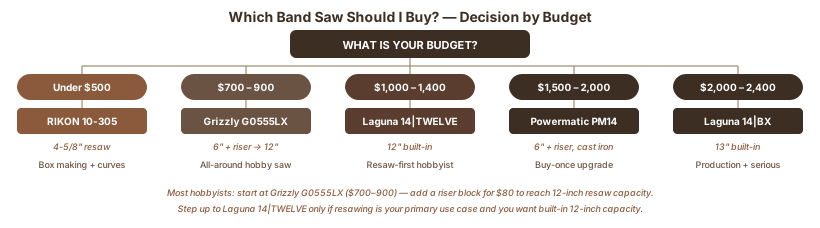
| Budget | Pick | Resaw cap | Throat | Why it wins |
|---|---|---|---|---|
| Under $500 | RIKON 10-305 (10-inch) | 4-5/8" | 9-3/4" | Best benchtop for occasional use |
| $700-900 | Grizzly G0555LX (14-inch) | 6" | 13-1/2" | The "first real" band saw for hobby shops |
| $1,000-1,400 | Laguna 14|TWELVE | 12" | 13-7/8" | Resaw-first design at hobby budget |
| $1,500-2,000 | Powermatic PM14 | 6" | 13" | Cast-iron build that lasts decades |
| $2,000+ | Laguna 14|BX | 13" | 14" | Best resaw capacity at this price tier |
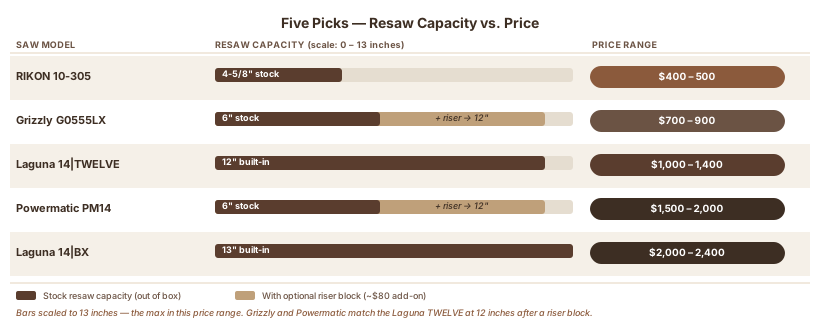
The honest answer for most woodworkers: the Grizzly G0555LX or its equivalents (Rikon 10-326, Jet JWBS-14SFX) at $700-900 is the right first band saw. The RIKON 10-305 is a stopgap; the Laguna and Powermatic options are upgrades you grow into after 1-2 years.
Jump links: What "best" actually means · Resaw capacity is the deciding spec · The 5 picks · What's not on this list · FAQ
Part 1: What "Best" Actually Means
A band saw isn't bought for one cut. It's bought for two:
- Resawing — slicing a thick board into thinner ones. A 5/4 cherry plank into two 1/2" panels for box sides. A 12/4 walnut slab into book-matched bookends.
- Curves — circles, freeform shapes, bandsaw boxes, and irregular profiles a jigsaw can't follow precisely.
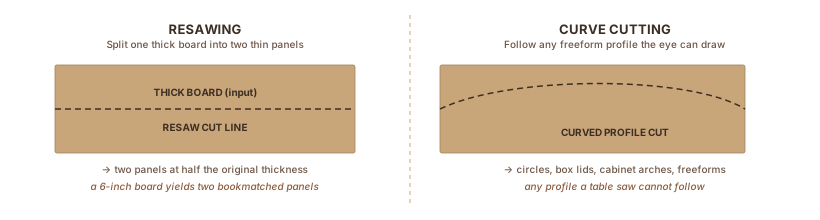
A band saw that can resaw 6" of hardwood will also handle every curve a hobbyist throws at it. A band saw that handles tight curves (small wheels, short blade) often can't resaw at all.
So when you read a "best band saw" listicle, watch for which capability the reviewer prioritized. Most online reviewers prioritize neither — they list features in spec-sheet order. This guide ranks by resaw capacity first, fence rigidity second, throat depth third. Horsepower comes last; almost no hobby work needs more than 1.5 HP.
The metric that doesn't matter as much as it sounds: wheel diameter. A 14" wheel saw with a riser block and a 1 HP motor outperforms a 12" wheel saw with no riser at the same power. The wheel size dictates blade length, not cutting capacity.
Part 2: Resaw Capacity Is the Deciding Spec
Resaw capacity = the height of stock you can slice down the middle. A saw rated at "6 inches" can split a 6" tall board into two thinner ones. Most stock band saws ship at 4-6". Add a riser block (about $80 on a 14" Grizzly or Jet) and you get +6", taking a 6" saw to 12" — enough for most furniture-grade resawing.
Per the Wood Database's lumber dimensions reference, most cabinetry hardwoods are sold in nominal 4/4 (about 7/8" finished) up to 12/4 (about 2-3/4" finished) thicknesses. Resawing 4/4 to two 5/16" panels for box sides needs only 1" of resaw capacity. Resawing a 12/4 walnut slab to bookmatched panels needs 12".
Practical numbers:
- Hobby furniture builder: 6" resaw is enough 90% of the time
- Box maker: 5" resaw is enough
- Resawing-focused woodworker (intarsia, instrument backs): 12-13" resaw needed; consider Laguna 14|BX
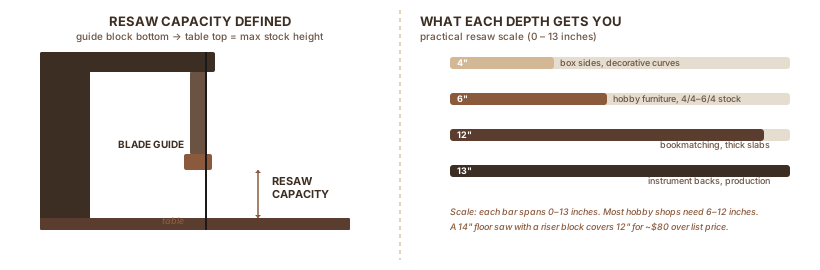
What the resaw capacity won't tell you: whether the saw can actually resaw to that depth without bogging or wandering. That's a function of:
- Motor power — 1 HP minimum for 6" hardwood resaw; 1.5 HP+ for 8"+ stock
- Blade tension — needs to reach 30,000+ PSI on a 1/2" or 3/4" blade for clean resawing. Cheap saws max out around 18,000 PSI.
- Fence rigidity — a flexing fence ruins resaw cuts before the blade does
A $400 saw with stated "6-inch resaw capacity" will struggle on 6" of dense hardwood. A $1,400 saw with the same stated capacity will resaw it cleanly.
Part 3: The 5 Picks
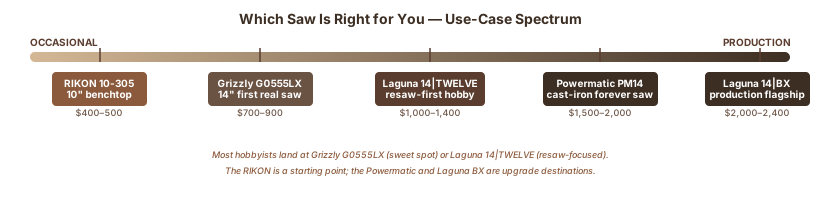
1. RIKON 10-305 — under $500, best benchtop
| Spec | Value |
|---|---|
| Wheel diameter | 10" |
| Resaw capacity | 4-5/8" |
| Throat depth | 9-3/4" |
| Motor | 1/3 HP, 110V |
| Weight | 80 lbs |
| Best for | Occasional curve cuts, hobbyist box-making, scroll work |
Why it's here: The RIKON 10-305 is the only sub-$500 band saw that doesn't feel like a toy. It tracks blades reasonably well, has a serviceable fence, and handles 4/4 hardwood resawing if you go slow. The under-power (1/3 HP) is the limit — push 2-3" of hardwood and you'll bog.
What you give up: Anything beyond 4-5/8" resaw. Tight curves below 1/4" radius (the small wheels can't handle small blades). Long-running production work (the 1/3 HP motor will overheat under sustained load).
Skip if: You're planning any project that needs resawing thicker than 1/4 stock. The ceiling is low. Save another $200-300 and jump to the Grizzly G0555LX.
2. Grizzly G0555LX — $700-900, the first "real" band saw
| Spec | Value |
|---|---|
| Wheel diameter | 14" |
| Resaw capacity | 6" (12" with riser block) |
| Throat depth | 13-1/2" |
| Motor | 1 HP, 110V (3/4 HP after Grizzly's spec corrections) |
| Weight | 247 lbs |
| Best for | The hobby-shop standard for everything-at-once |
Why it's here: This is the saw most experienced hobbyists recommend as a first purchase. The 14" wheel + 1 HP motor + serviceable fence + cast-iron table = a saw that handles 95% of what hobby woodworking demands. With an $80 riser block, resaw capacity goes from 6" to 12" — enough for any resawing project a hobby shop needs.
Equivalent saws at this price tier from Rikon (10-326), Jet (JWBS-14SFX), and Laguna's lower line are within 5% of the Grizzly's performance. Grizzly's pricing is usually slightly lower at parity. All three brands have decent customer service.
What you give up: Smoothness. The fit and finish at this price is rougher than the Powermatic at $1,500. The fence is straight but not buttery. The blade tracking can drift over months. None of these is a deal-breaker, but you'll feel the difference if you upgrade later.
Best for: Hobbyists who need one band saw to cover everything for the next 5-10 years.
3. Laguna 14|TWELVE — $1,000-1,400, resaw-first hobby saw
| Spec | Value |
|---|---|
| Wheel diameter | 14" |
| Resaw capacity | 12" (no riser needed) |
| Throat depth | 13-7/8" |
| Motor | 1.75 HP, 110V |
| Weight | 333 lbs |
| Best for | Resawing-focused hobbyist; box and instrument makers |
Why it's here: Laguna designed the 14|TWELVE around resawing as the primary use case. The 12" resaw capacity is built in (not a riser-block aftermarket addition), the motor is 1.75 HP, and the fence is rigid enough to handle the load. If your work is heavy on resawing — bookmatching panels, slicing thin laminations, instrument backs — this saw is meaningfully better than the Grizzly even though it's only $300-500 more.
What you give up: Throat depth. At 13-7/8" the throat is similar to the Grizzly, but the saw's optimization is for tall-and-thin (resawing), not wide-and-flat (large curve cuts). For a band saw that does both equally, look at the Powermatic PM14 instead.
4. Powermatic PM14 — $1,500-2,000, cast-iron build that lasts
| Spec | Value |
|---|---|
| Wheel diameter | 14" |
| Resaw capacity | 6" (12" with riser) |
| Throat depth | 13" |
| Motor | 1 HP (1.75 HP variant available), 110V |
| Weight | 308 lbs |
| Best for | Buy-once-cry-once hobbyist; the saw your kids inherit |
Why it's here: The PM14 is the same architecture as the Grizzly G0555LX (14" wheels, 6"+riser resaw) but with substantially better fit and finish. Cast-iron upper guide, machined ground table, fence rigidity that doesn't deflect under load. This is the saw you buy when you've outgrown the Grizzly OR when you want to skip the upgrade path entirely.
Per Powermatic's PM14 spec sheet, the saw uses a precision-balanced cast-iron flywheel system — meaningfully smoother running than stamped-steel competitors. You feel this on long resaw cuts where a wobbling wheel translates to a wandering blade.
What you give up: Money. At $1,500-2,000 you're paying about 2× the Grizzly for ~30% better build quality. Whether that's worth it is a personal call. Most woodworkers eventually buy this saw second; some buy it first and skip the intermediate step.
5. Laguna 14|BX — $2,000-2,400, best resaw capacity at this tier
| Spec | Value |
|---|---|
| Wheel diameter | 14" |
| Resaw capacity | 13" |
| Throat depth | 14" |
| Motor | 1.75 or 2.5 HP, 110/220V |
| Weight | 392 lbs |
| Best for | Production resawing; instrument makers; full-time woodworkers |
Why it's here: The 14|BX is Laguna's flagship 14" saw and represents the resaw capacity that used to require a 17-18" cabinet saw. 13" resaw with no riser block, 2.5 HP motor option, 220V wiring for sustained heavy cuts. This is a production tool — overkill for hobbyists who resaw occasionally, perfect for woodworkers whose business is built around resawing or who routinely work with 12+/4 stock.
What you give up: Floor space. At nearly 400 lbs and 70" tall, the 14|BX needs a permanent home. If your shop is a one-car garage, this might be too much saw.
Part 4: What's Not on This List
Why no Jet JWBS-14SFX? It's a fine saw — essentially a Grizzly G0555LX with Jet's customer service. We could've listed it instead of the Grizzly; we didn't only because the Grizzly is consistently cheaper at parity. If you find a deal on the Jet, buy that one.
Why no Sawstop band saw? Sawstop doesn't make one. (The Sawstop technology is specific to table saws, where stock-flesh contact triggers the blade brake. Band saw blades don't have a flesh-detection equivalent.)
Why no Wen / Skil / Ryobi options? Those are toolset additions, not woodworking band saws. They'll cut wood but not flat, not square, and not sustainably. If you're tempted, get the RIKON 10-305 instead.
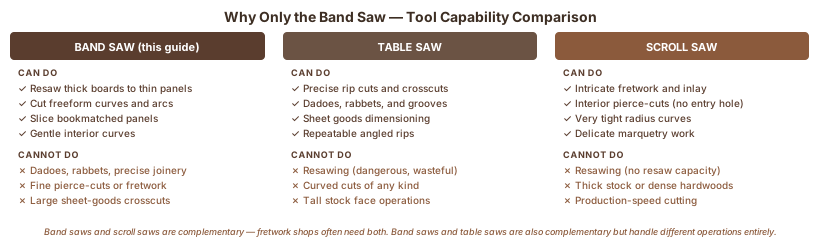
Why no scroll saws? Scroll saws are a different tool. They cut intricate curves and pierce-cuts (interior cutouts), but they're slow, low-capacity, and can't resaw. If your work is fretwork or marquetry, you need a scroll saw AND a band saw.
FAQ
What's the most important spec on a band saw?
Resaw capacity, then fence rigidity, then throat depth. Wheel diameter and horsepower are derivatives — they enable resaw capacity but don't define it.
Do I need a 220V circuit for a band saw?
For 1 HP motors and below: no, 110V is fine. For 1.75-3 HP motors: 220V is preferable for sustained heavy cuts (less voltage drop, longer motor life). Most hobby shops can run hobby band saws on 110V.
How long do band saw blades last?
For occasional hobby use: 6-12 months on a quality blade (Lenox, Olson, Wood Slicer). Sharpening doesn't restore them — once dull, replace. Per Highland Woodworking's blade selector, a 1/2" Wood Slicer resaw blade is the right starter blade for any 14" saw and lasts ~40-60 hours of cutting before replacement.
What's the difference between a 14" saw and a 17" saw?
Wheel diameter only. A 17" saw can take a longer blade (more blade life) and has more throat depth (further from the column to the blade). Resaw capacity is independent of wheel size — it's set by the upper-guide-to-table distance, which any 14"+ saw with a riser block can match or exceed.
If you're choosing between a 14" Powermatic PM14 ($1,800) and a 17" Grizzly G0513 ($1,200), the 14" Powermatic is usually the better pick for fit and finish. The 17" Grizzly is the better pick if throat depth matters more than build quality.
Can a band saw replace a table saw for resawing?
Yes, and it should. A band saw resaws cleaner, safer, and with less material waste than any other shop tool. A table saw can rip-cut to thickness with multiple passes (dangerous, wasteful) but it's not what either tool is built for.
Is a benchtop band saw worth buying?
For occasional curve cuts and decorative work: yes. The RIKON 10-305 covers this. For any project that includes resawing thicker than 4/4 stock: no — you'll outgrow the saw within months. Save up for a 14" floor model.
Sources
- Powermatic PM14 spec sheet — cast-iron flywheel construction details
- Highland Woodworking — Wood Slicer Resaw Blade — blade life and selection guide
- Wood Database — Lumber Dimensioning — nominal vs finished thickness reference
- Sawmill Creek Forum — Band Saw Comparison Threads (2020-2024) — community consensus on Grizzly G0555LX as first-band-saw choice
- Fine Woodworking — Band Saw Tuneup Guide — fence rigidity and blade tracking
- Stumpy Nubs Workshop — Band Saw Capability Tests — resaw cut quality comparisons
- Laguna Tools — 14|BX product specs — resaw capacity and motor options
- Grizzly Industrial — G0555LX product page — riser-block compatibility documentation
Tagged
How We Research
We don't take affiliate revenue or accept review units. Picks come from multi-source research — manufacturer specs, OSHA / EPA / ASTM regs, and long-form practitioner threads — plus Ahmed's hands-on use where relevant. When we recommend something, we explain why.
Up Next
Band Saw for Woodworking: How to Choose the Right Size
POWER TOOLS · Beginner