
QUICK ANSWER: A table saw rips boards to width — the board moves, the blade stays put. A miter saw crosscuts boards to length, often at an angle — the blade moves, the board stays put. They're not interchangeable: a table saw can crosscut with a sled but is awkward at it; a miter saw cannot rip at all. If you can only buy one as your first power saw, the table saw is more versatile because it does the harder cuts and a sled extends it to crosscutting; if your work is mostly trim and framing dimensional lumber, buy the miter saw first.
Table Saw vs Miter Saw at a Glance
| Capability | Table saw | Miter saw |
|---|---|---|
| Ripping (cutting along the grain) | ✓ Primary use | ✗ Not designed for it |
| Crosscutting short stock | ✓ With miter gauge or sled | ✓ Primary use |
| Crosscutting long stock (8'+) | ✓ With outfeed support and a sled | ✓ With stand and stops |
| Angled cuts on board ends | ✓ Sled-mounted angle jigs | ✓ Primary use — preset detents |
| Compound miters (angle + bevel together) | Cumbersome — requires tilt + sled | ✓ Primary use on a compound miter saw |
| Dado cuts | ✓ With dado stack or multiple passes | ✗ Single kerf only |
| Sheet goods ripping | ✓ Best tool with a fence | ✗ Wrong shape for it |
| Footprint | Large — needs in-feed and out-feed clearance | Small — bench-top or stand |
| First saw to buy if budget is tight | Yes — covers more types of cuts | Second purchase, after the table saw |
| First saw to buy if you mostly do trim/installation | Skip — get a track saw instead | Yes — designed for the work |
A table saw is built around ripping — cutting a board lengthwise to a chosen width. The board moves; the blade stays put. A miter saw is built around crosscutting — chopping a board to length, often at an angle. The blade moves; the board stays put.
That single distinction decides 80% of the comparison.
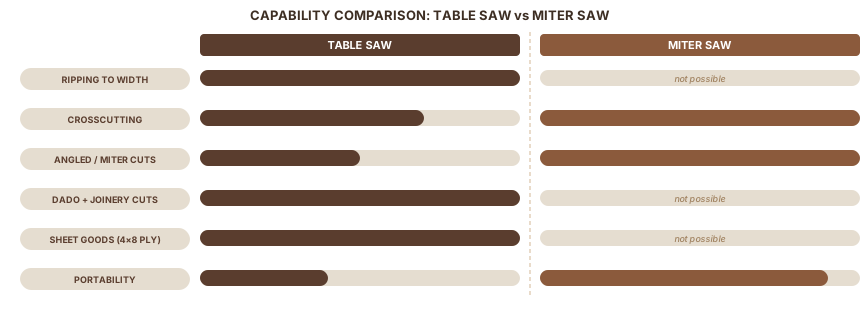
| Question | Table saw | Miter saw |
|---|---|---|
| Best at | Ripping boards lengthwise to a precise width | Chopping boards to length, with miter and bevel angles |
| Cut direction | Stock moves, blade stays | Stock stays, blade moves |
| Maximum rip width | 24-50" depending on model + fence extensions | n/a (not a ripping tool) |
| Maximum crosscut length | Limited by sled or miter gauge — usually 24-36" practical | 12-15" at 90°, less at angles |
| Joinery work | Dadoes, rabbets, tenons, finger joints, bevel cuts | Compound miter angles for trim and frames |
| Footprint | 4 × 6 ft minimum incl. infeed/outfeed | 3 × 4 ft incl. wing supports |
| Beginner price | $300 (jobsite) → $700 (contractor) | $200 (10" sliding compound) → $500 (12" SCMS) |
| Learning curve | Steep — kickback is real | Shallow — point and shoot |
Jump links: What each saw does best · Where they overlap · Which to buy first · The dado question · Stationary vs portable · FAQ
Part 1: What Each Saw Does Best
The table saw is for ripping. That's the cut every other power tool struggles with: taking a 12" wide board and cutting it down the length to make a 4" wide board. A circular saw can do it badly (with a straightedge guide, never quite straight). A bandsaw can do it slowly (with a fence and a sharp blade). The table saw does it fast, accurate, and repeatable.
The table saw also handles dadoes (cross-grain channels for shelves), rabbets (L-shaped edge cuts for cabinet backs), tenons (cheek cuts for mortise-and-tenon joinery), tapered cuts (with a taper jig), and bevel cuts (tilting the blade up to 45°). With a crosscut sled, it crosscuts as well as a miter saw — for stock that fits.
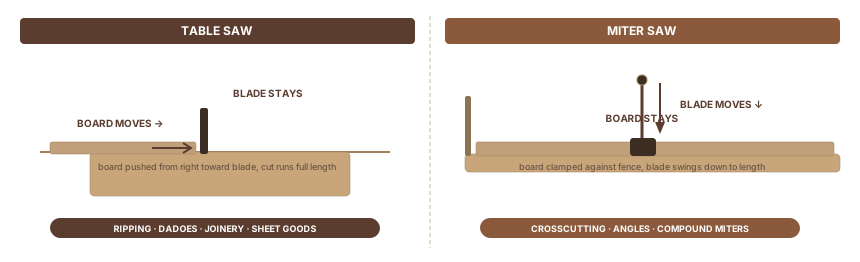
The miter saw is for crosscutting at length and angle. When you're cutting baseboard to fit a wall, picture frame mitres at 45°, or stair stringers with compound angles, a miter saw is faster and more accurate than any other tool. The blade pivots, slides, and bevels. The stock sits flat against a fence and gets clamped.
What the miter saw can't do: rip. It physically can't cut along the length of a board. It also can't do dadoes or tenons or any joinery that requires the blade to leave a controlled-depth channel.
Both saws crosscut. Only one rips. That's the asymmetry that decides everything.
Part 2: Where They Overlap
Both saws can crosscut a board to length. So if you only crosscut, you only need a miter saw. If you only rip, you only need a table saw. Most woodworkers do both. Here's what the overlap looks like:
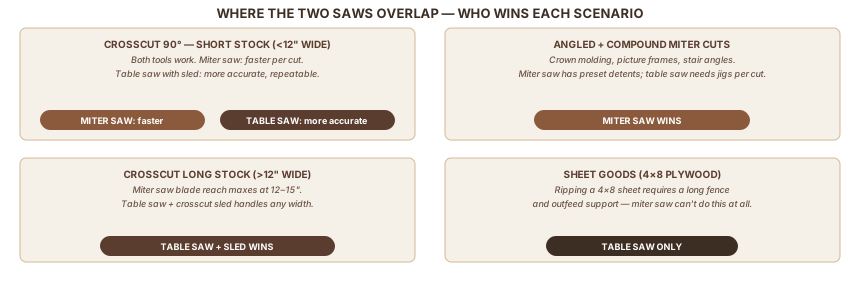
Crosscut at 90°, stock under 12" wide: The miter saw is faster — clamp, drop, done. The table saw with a miter gauge is more accurate (because the gauge slot is precision-machined; the miter saw fence has play), but slower because you have to back the cutoff away from the blade carefully.
Crosscut at angles: Miter saw wins for compound miters (45° miter + 30° bevel for crown molding, e.g.). The table saw can do these with a sled and a tilted blade, but the setup is per-cut and the safety margin is thinner.
Crosscut large stock (>12"): Table saw with a sled wins. A miter saw caps at the blade reach (12" for a 10" non-sliding model, 15" for a 12" sliding compound). For full-width plywood crosscuts, neither saw alone is enough — you'll want a track saw or circular saw with a guide.
Repeatability: Table saw with a stop block on the sled wins. Miter saws have stop blocks on extension wings, but they wander as the saw vibrates.
One thing the table saw absolutely owns: sheet goods. A 4×8 plywood sheet onto a table saw with a fence + outfeed support gives you precise, repeatable rips. A miter saw can't do this at all.
Part 3: Which to Buy First
The right answer depends on what you build.
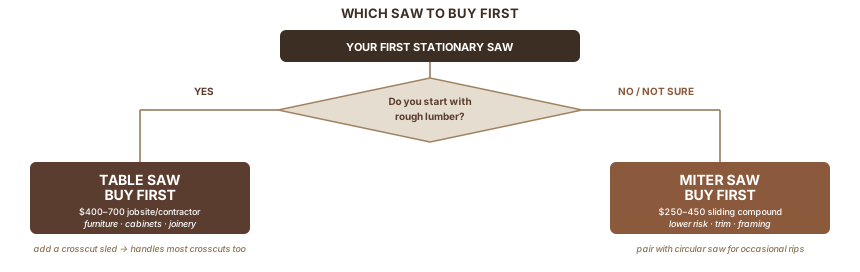
Buy the miter saw first if you build:
- Trim, picture frames, baseboard, crown molding (anything assembled from pre-dimensioned stock)
- Beds, tables, simple shelving (where you're cutting purchased boards to length)
- Construction work — decking, framing, fence boards
- Anything where "chop to length, square or angled" is the dominant cut
The miter saw at $250-400 is a cleaner first purchase here. You can pair it with a circular saw and a guide rail for the few rips you'll need.
Buy the table saw first if you build:
- Cabinets, drawers, boxes (anything where you mill rough lumber down to width)
- Joinery-heavy projects — dovetails, mortise-and-tenon, finger joints, tongue-and-groove
- Custom furniture from rough hardwood (where you control all the dimensions)
- Sheet-goods projects (cabinets, shelving systems, plywood case work)
The table saw at $400-700 (jobsite or contractor) is the foundation tool. With a crosscut sled, it covers most of the miter saw's job too — just slower per cut.
The deciding question: Do you start your projects with rough lumber or with pre-dimensioned boards?
Rough lumber → table saw first. You'll be ripping in the first hour. Pre-dimensioned → miter saw first. Your first cuts will be crosscuts to length.
If you're not sure, the miter saw is the lower-risk first purchase. It's cheaper, easier to learn, and you can supplement with a circular saw for occasional rips.
Part 4: The Dado Question
Dados — flat-bottomed cross-grain channels that hold shelf ends — are a table-saw specialty. The table saw with a dado stack cuts them in one pass. The miter saw can't cut dados at all (the blade rotation is wrong; you'd have to take 50 progressively-deeper cuts with a regular blade, and the result wouldn't be flat).
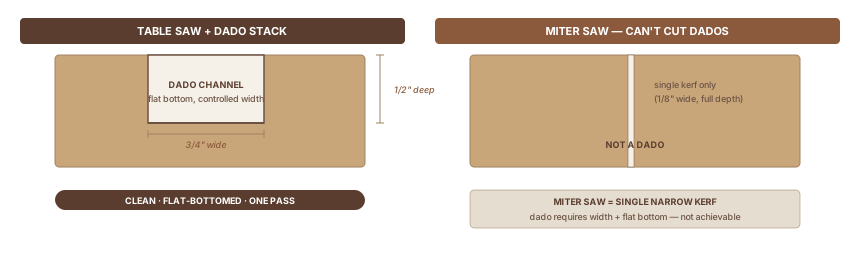
For cabinet and bookcase work, the dado is the joint that makes assembly fast and shelves rattle-free. Per Fine Woodworking's dado joinery primer, "the table saw with a stacked dado is the standard for casework dados over 1/4 inch wide."
A router with a straight bit does the same job, but at half the speed and with extra setup time. If you do casework regularly, a dado stack ($120-200) for the table saw pays back in the first project.
This is the project that forces the decision: if you build cabinets, you need a table saw + dado stack. The miter saw can't substitute.
Part 5: Stationary vs Portable
A miter saw is portable by default — most weigh 30-50 lbs and have carrying handles. You can take a jobsite miter saw to a remodel.
A table saw is portable in the jobsite class (40-60 lbs, foldable stand) and stationary in the contractor or cabinet class (300+ lbs, requires permanent shop space). For a small shop, the jobsite table saw is the right starting point — it tucks against a wall when not in use.
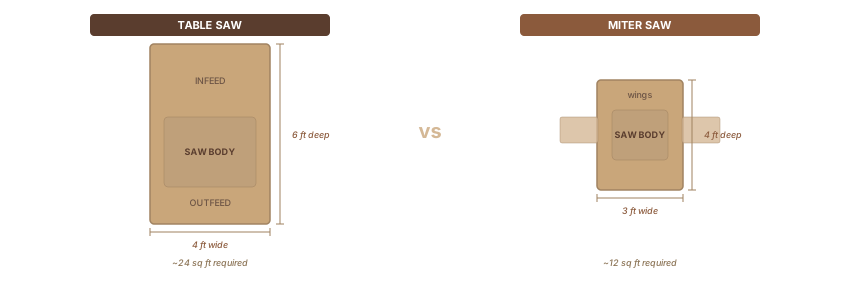
If shop space is tight (one-car garage), a folding-stand jobsite saw + a wall-mounted miter saw stand is a complete cutting setup that disappears between projects. Total footprint: zero when stowed.
FAQ
Can a miter saw replace a table saw?
No. A miter saw can't rip — it can only crosscut. If you ever need to take a 12" wide board and cut it down to a 4" wide board (which is essentially every furniture project), you need a table saw, a bandsaw, or a circular saw with a guide rail. The miter saw physically can't make that cut.
Can a table saw replace a miter saw?
Mostly. A table saw with a crosscut sled and a miter gauge handles 90% of what a miter saw does — crosscuts at 90°, miters at any angle, repeatable cuts via stop blocks. The table saw struggles with: very long stock (8-foot trim runs require infeed/outfeed support that miter saws don't), and quick repetitive chops (the sled is slower per cut than a drop-and-cut miter saw).
For trim work in particular, a miter saw is meaningfully faster.
Which saw is more dangerous?
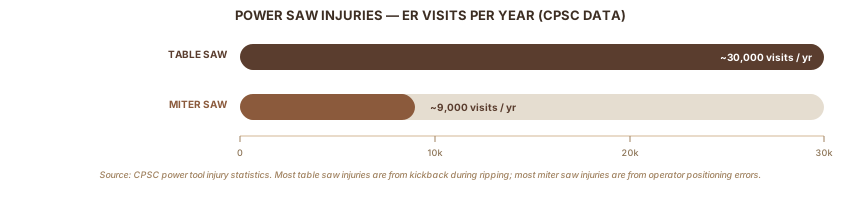
The table saw, by a margin. Table saw injuries account for about 30,000 ER visits per year in the US (USDA / CPSC injury data) — most from kickback or contact with the blade during ripping. The miter saw causes about 9,000 — usually from putting hands too close to the blade or from binding when stock isn't held flat.
The table saw's risk is the asymmetry of ripping (stock moves through a stationary blade, with the kerf closing behind it). The miter saw's risk is operator error (not respecting the swing path of the blade). Both are manageable with proper technique and safety hardware — riving knife, push blocks, hold-down clamps.
How much should a beginner spend on a first table saw or miter saw?
For a table saw: $400-700 covers a quality jobsite model (DeWalt DWE7491RS, Bosch GTS1031, SawStop CTS) with rip capacity for plywood. Below $300 you get sub-fence quality that won't hold tune; above $1,000 you're in cabinet-saw territory where the next $1,500 buys real performance gains.
For a miter saw: $200-450 covers a quality 10" or 12" sliding compound (Bosch GCM12SD, DeWalt DWS779, Hitachi C12RSH2). The differentiating feature at this price is the slide mechanism — direct-drive belt-rail beats geared-rack for noise and accuracy.
Should I buy used?
For miter saws: yes — they're hard to abuse, and a $250 saw used at $120 is a great deal.
For table saws: cautiously. Cast-iron saws (cabinet, contractor) hold up forever. Aluminum jobsite saws often have damaged fence rails that are expensive to replace. Inspect the fence parallelism with a feeler gauge before buying any used table saw.
What about a circular saw with a track or guide rail?
This is the third option for a small-shop start: a circular saw with a track-saw-style guide handles 60% of what a table saw rips for, and a circular saw with a Speed Square handles 80% of what a miter saw chops for. Total cost: $200-400 for a quality saw + rail.
The downside: every cut takes 3× longer to set up. For a beginner who builds 4-6 projects a year, this is fine. For a beginner planning 20+ projects, the dedicated saws pay for themselves quickly.
Sources
- USDA Forest Products Laboratory — Wood Handbook, Chapter 8 — fastener withdrawal data referenced in the dado-strength comparison
- Fine Woodworking — Cabinet Joinery Primer — dado conventions for casework
- Bosch Table Saw Specifications — jobsite saw rip capacity comparison
- DeWalt Miter Saw Specifications — sliding compound reach figures
- Consumer Product Safety Commission — power saw injury statistics — annual ER visit counts cited
- Sawmill Creek Forum — Table Saw vs Miter Saw threads (2018-2024) — community consensus on first-purchase decision
- Stumpy Nubs Workshop — Crosscut Sled vs Miter Saw video — speed comparison data
Also Referenced
Tagged
How We Research
We don't take affiliate revenue or accept review units. Picks come from multi-source research — manufacturer specs, OSHA / EPA / ASTM regs, and long-form practitioner threads — plus Ahmed's hands-on use where relevant. When we recommend something, we explain why.
Up Next
What Is a Jobsite Table Saw?
POWER TOOLS · Beginner