
Crosscut Sled at a Glance
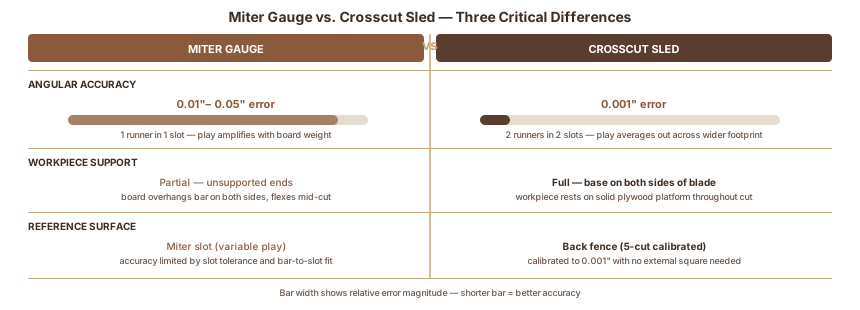
A crosscut sled rides both miter slots, supports your workpiece on both sides of the blade, and gives you a dead-square back fence to register against. A good sled gets you to 0.001" accuracy across 12–18 inches of cut. Your miter gauge, even a good one, tops out around 0.01" to 0.05" over the same span.
| Build time | 3–4 hours including calibration | | Materials cost | $30–50 (half-sheet Baltic birch + UHMW strip) | | Accuracy achievable | 0.001" over a 12–18" span | | Runner material | UHMW plastic (preferred) or hard maple | | Base size | 24"×30" covers most crosscut needs | | 5-cut formula | (front width − back width) ÷ 4 |
In this guide:
- Why a sled beats your miter gauge
- Materials and tools
- Building the sled
- The 5-cut method
- What goes wrong
- What to try next
Part 1: Why a Crosscut Sled Beats Your Miter Gauge
Your miter gauge has one runner in one slot. Any play in that slot translates directly to angular error in the cut. The contact area between the bar and the slot is small, so the weight of an 18-inch board can pivot the gauge mid-push. Stock extending unsupported past both ends of the bar also flexes and tears out on the back face.
A crosscut sled fixes all three problems. It rides in both miter slots, so the angular footprint is wider and any play averages out. The base supports the workpiece on both sides of the blade. The back fence, not the miter slot, is the reference surface. Calibrate that fence with the 5-cut method in Part 4 and you're at 0.001" accuracy.
Before you start this build, set your blade height correctly and check that the blade is parallel to the miter slots. A sled amplifies whatever accuracy your saw has. If the blade is out, the sled just makes wrong cuts more repeatably.
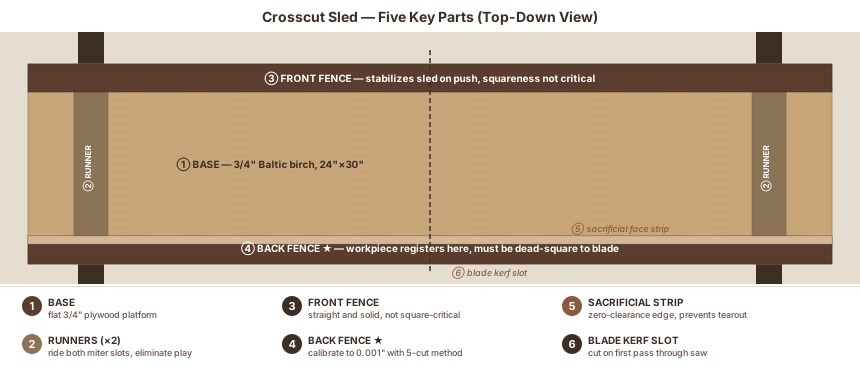
The five parts of a crosscut sled
Base — 3/4" Baltic birch, typically 24"×30". Has to be flat. Baltic birch plywood is better than MDF here: it handles humidity without warping, and the void-free core means screws hold reliably.
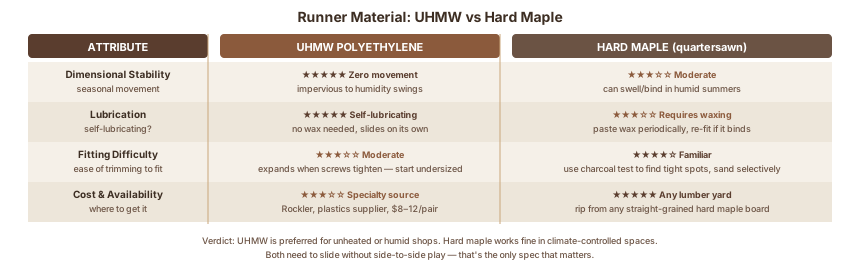
Runners — ride in the miter slots. UHMW plastic is the preferred material: dimensionally stable, self-lubricating, unaffected by humidity swings. Hard maple works in a climate-controlled shop but will bind in summer if it's not quartersawn.
Front fence — the piece closest to you. Stabilizes the sled on the push stroke. It doesn't need to be square to the blade; it just needs to be straight and solid.
Back fence — where your workpiece registers. This is the one that must be dead-square to the blade. Everything depends on this fence.
Sacrificial fence face — a thin scrap strip glued to the back fence's working surface. When the blade cuts through it, it creates a zero-clearance edge that eliminates tearout on your workpiece. Replace it when it gets chewed up.
Part 2: Materials and Tools
What you'll need
Materials:
- 3/4" Baltic birch plywood, approximately a half-sheet (48"×48")
- UHMW polyethylene strip: 3/4" wide × 3/8" thick × 36" long, two pieces (about $8–12 at a plastics supplier or Rockler)
- OR hard maple runners: 3/4" wide × 3/8" thick, quartersawn if your shop has humidity swings
- 1-5/8" coarse-thread wood screws
- Wood glue
- 80–120 grit sandpaper
- Paste wax or paraffin wax
- One square piece of scrap ≥12"×12" for the 5-cut calibration
Tools:
- Table saw
- Drill with pilot-hole bits
- 4–6 medium bar clamps
- Digital calipers — non-negotiable for the 5-cut measurement
- Combination square or framing square (rough initial alignment only)
- Tape measure and marking tools
- A shoulder plane or card scraper if fitting UHMW runners
You can use a push block or push stick to safely push the sled through the blade on the first few passes while you're testing fit.
Part 3: Building the Sled
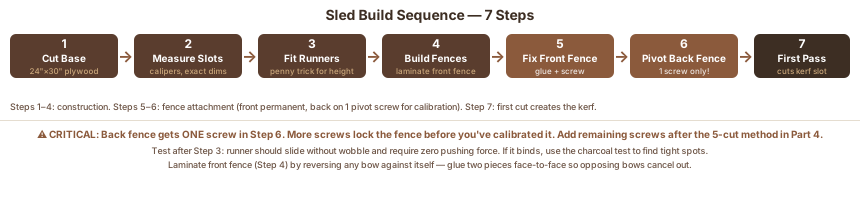
Step 1: Cut the base
Cut the base to roughly 24" wide × 30" deep from 3/4" Baltic birch. These aren't magic numbers. They're enough to cover most crosscut work without making the sled awkward to handle. Rip the front edge dead straight on the table saw. You'll attach the front fence to this edge.
Step 2: Measure your miter slots
Before cutting runners, measure your actual miter slots. US table saws typically use a 3/4"-wide × 3/8"-deep slot, but Powermatic, older Delta, and some import saws are different. Measure width and depth with calipers. Your runners need to match these dimensions.
Step 3: Fit the runners
If using UHMW:
Cut the strips to the full depth of the sled base, typically 29–30", and to a width slightly narrower than your miter slot. Start at the target width and test fit. UHMW expands when you drive screws through it, so start slightly undersized.
The penny trick makes installation cleaner: drop a row of pennies into each miter slot to elevate the runners about 1/16" above the table surface. Set the runners on the pennies. Lay the sled base face-down on top of the runners. Drive screws through the base into the runners. Remove the pennies. The runners now sit proud of the table surface by the thickness of the pennies, which is exactly right. Sand the bottom of the sled base lightly if the sled doesn't glide smoothly.
If the runners still feel tight after installation, trim them with a shoulder plane or card scraper. Work in thin passes and test frequently.
If using hard maple:
Rip runners to just over your target width. Use the charcoal test to find tight spots: rub a charcoal pencil along the miter slot walls, then slide the runner in and out. The charcoal transfers to the runner at any tight spot. Sand only those marked areas, not the whole runner. Wax the runners with paste wax when the fit is right.
Either way, the test is the same: the runner should slide without side-to-side wobble but require zero pushing force.
Step 4: Build the fences
Front fence: Cut two identical pieces of 3/4" Baltic birch, each about 3" tall × 24" wide. If either piece has any bow, reverse the bows against each other and glue them face-to-face. Clamp flat until cured. This creates a laminated fence that's straighter than either piece alone. Once dry, rip one edge straight on the table saw.
Back fence: Cut a single piece of 3/4" Baltic birch, about 5" tall × 24" wide. Use the flattest piece in your stock. The back fence face is where your workpiece registers. Any twist or bow becomes angular error in your cuts.
Step 5: Attach the front fence (permanent)
Position the front fence 1–2" from the near edge of the base. Glue and screw from below. Clamp until cured. Accuracy here doesn't matter. The front fence just keeps the sled from racking.
Step 6: Attach the back fence with a single pivot screw
Drive ONE screw through the base into the back fence, centered along the fence's length. Don't add more screws yet. This single screw is the pivot point for the 5-cut calibration in Part 4. Adding all screws now locks the fence before you've verified it's square.
Step 7: First pass through the saw
Raise the blade about 1" above the height of the sled base. Set the sled on the saw, push it through the blade. This cuts the kerf slot through both fences. You now have a working sled. The back fence isn't calibrated yet.
Part 4: The 5-Cut Method — Squaring the Fence
Most crosscut sled guides tell you to square the fence with a combination square. The problem: your combination square has its own error. You're transferring that error directly to the fence.
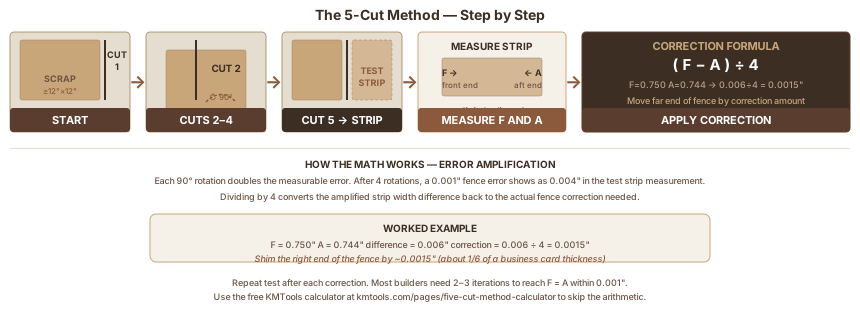
The 5-cut method uses the saw to check the saw: no external reference required. It works by compounding the fence's angular error across four 90° rotations of the same board. By the 5th cut, even 0.001" of misalignment shows up as 0.004" in your measurement. Detectable with cheap digital calipers.
William Ng first demonstrated this method on YouTube. Jonathan Katz-Moses at KMTools has the clearest written version plus a free calculator.
The 6-step procedure
Start with a square-edged piece of scrap at least 12"×12". Larger board = more measurable error. Label the right edge "A" and the front face with a mark.
- Cut 1: Place the right edge of the board against the back fence. Make a crosscut off the left end. Label the offcut "1."
- Rotate 90° clockwise. The newly-cut edge is now against the fence.
- Cut 2: Make a crosscut off the left end. Label the offcut "2." Rotate 90° clockwise.
- Cut 3: Crosscut. Rotate.
- Cut 4: Crosscut. Rotate. The board is now back to approximately its original orientation.
- Cut 5: Make a final crosscut off the left end. This small strip is your test piece.
Reading the test piece
Using digital calipers, measure the test strip at two points:
- F (front): the end closest to the blade
- A (aft): the far end
Write both measurements down.
The formula
Correction = (F − A) ÷ 4
Worked example:
- F = 0.750", A = 0.744"
- (0.750 − 0.744) = 0.006"
- 0.006 ÷ 4 = 0.0015"
The far end of the back fence needs to move 0.0015", about 1/64", toward or away from the blade depending on which end is wider.
If F > A (front wider): the right side of the fence angles away from you. Move the right end of the fence toward you by the correction amount.
If F < A (aft wider): move the right end of the fence away from you.
Applying the correction
A business card is about 0.010" thick, roughly 6–7× your typical correction. You can fold it, or use a feeler gauge for finer control. Slide the shim under the appropriate end of the fence. Drive two more screws through the base into the fence. Pull the shim out.
Re-run the 5-cut test. Most builders need two or three iterations to get F = A within 0.001". Once you're there, drive the remaining fence screws. The sled is ready to use.
You can use the free KMTools 5-cut calculator to skip the arithmetic and input your F and A readings directly.
Part 5: What Goes Wrong
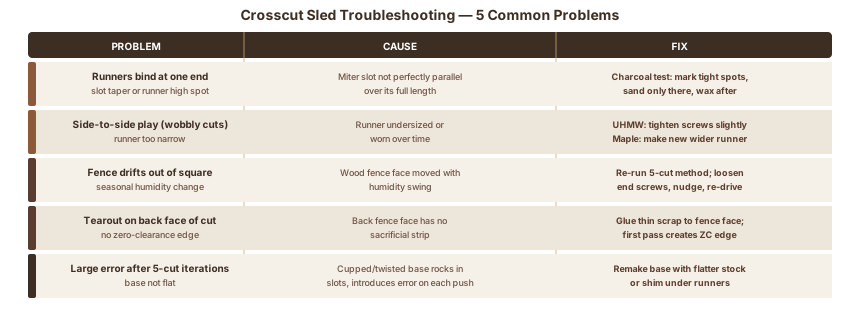
1. Runners bind at one end of the travel The miter slot isn't perfectly parallel over its length, or the runner has a high spot. Use the charcoal test: rub charcoal in the slot, slide the sled, sand only the marked spots. Wax after.
2. Sled has side-to-side play (wobbly cuts) Runner is too narrow. For UHMW: tighten the mounting screws slightly. This compresses and expands the runner. For hardwood: make a new runner cut to a slightly wider dimension.
3. Fence drifts out of square after a few months The wood fence moved with seasonal humidity. Run the 5-cut method again. Loosen the two end screws, nudge the fence to correct, re-drive. Plan on re-calibrating once or twice a year in shops with humidity swings. UHMW runners eliminate runner drift; wood fence drift is a separate issue.
4. Tearout on the back face of cuts The back fence face needs a sacrificial strip: a thin piece of scrap glued to the fence face. When the blade cuts through it on the first pass, it creates a zero-clearance edge. KMTools' 9-tip sled guide lists this first for a reason.
RELATED: What Is a Zero-Clearance Insert? The sacrificial fence face uses the same principle as a ZCI — fiber support right at the cut line. A zero-clearance throat plate extends the same benefit to every cut through the table.
5. Large remaining error after multiple 5-cut iterations Check the base itself. A cupped or twisted base rocks in the miter slots and introduces error on every push. If the base isn't flat, no amount of fence adjustment fixes the problem. Remake the base with flatter stock, or add leveling shims under the runners.
Part 6: What to Try Next
A few additions worth making while you're in build mode:
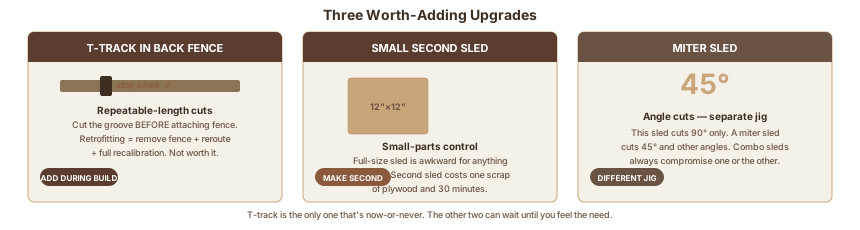
T-track in the back fence. Cut the T-track groove before you attach the fence. Retrofitting is a pain because you'd need to remove the fence, rout the groove, and recalibrate from scratch. T-track lets you add a stop block for repeatable-length cuts. Worth having.
A second small sled. A 12"×12" sled for small parts is as useful as the main sled. A full-size sled is awkward for small stock, and small stock on a full-size sled is harder to control safely.
Know what this sled doesn't do. A crosscut sled cuts 90° to the blade. A miter sled cuts 45° and other angles. They're different jigs. A combo sled that does both is always a compromise on one of them.
For more table saw technique, see table saw blade types and the full table saws topic page.
FAQ
How accurate can a crosscut sled get?
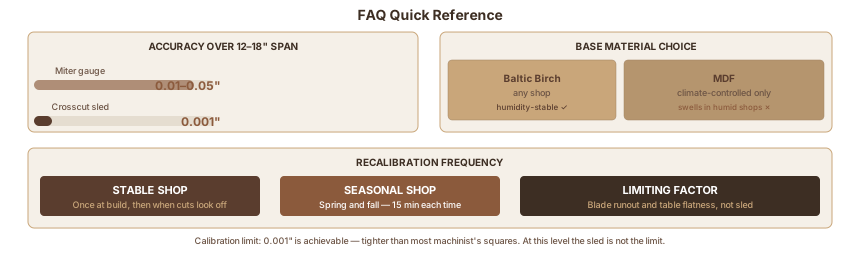
With the 5-cut method and digital calipers, 0.001" over a 12–18" span is achievable. That's tighter than most machinist's squares. In practical terms, it means two mating pieces cut on the sled close up with no gap. The limiting factor usually isn't the sled. It's blade runout and table flatness.
Can I use MDF instead of plywood for the sled base?
MDF is flatter out of the sheet and easier to surface, but it absorbs moisture and swells, which means your carefully fitted runners will bind in summer. If your shop is climate-controlled, MDF works fine. In an unheated garage or barn shop, use 3/4" Baltic birch.
How often should I redo the 5-cut calibration?
In a stable climate-controlled shop: once when you build it, then whenever cuts start looking off (usually every 1–2 years). In a shop with humidity swings: once in spring and once in fall. The calibration takes about 15 minutes once you know the procedure.
Sources
This guide draws on build plans, runner-fitting discussions, and documented 5-cut method explainers from woodworking makers and publications.
- KMTools — Make an Ultra-Square Crosscut Sled — 5-cut procedure, calculator, and design notes from Jonathan Katz-Moses
- KMTools — 5-Cut Method Calculator — free online calculator, inputs F and A directly
- KMTools — 9 Tips for a Better Crosscut Sled — sacrificial face, T-track, and stop-block tips
- SawStop — How to Build a Crosscut Sled — component overview from a table saw manufacturer
- Instructables — The 5-Cut Method Made Easy — step-by-step with photos
- Valley Woodworkers — 5-Cut Method to Square (PDF) — formula derivation
- FineWoodworking — Build a Super Precise Tablesaw Crosscut Sled — construction principles from a trade publication
Tools Used
Tagged
How We Research
We don't take affiliate revenue or accept review units. Picks come from multi-source research — manufacturer specs, OSHA / EPA / ASTM regs, and long-form practitioner threads — plus Ahmed's hands-on use where relevant. When we recommend something, we explain why.
Up Next
Table Saw Fence Alignment: Setting It Parallel to the Blade
POWER TOOLS · Intermediate