
2x3 Pressure Treated Lumber at a Glance
A 2x3 PT board is not code-approved for load-bearing or structural framing — that disqualifies it from deck joists, deck posts, and bearing walls regardless of how the wood is treated. What it CAN do is fence rails, furring strips, and non-bearing interior partitions, where it saves $1-2 a board over a 2x4. Compared head-to-head, a 2x4 has 40% more cross-section (5.25 vs. 3.75 square inches) and is the smallest size building codes allow for structural use; the 2x3 is the budget option for everything that doesn't carry a load. Before you finish a fresh 2x3 with stain or paint, plan on three to six months of drying time (or buy KDAT) — wet preservative rejects coatings and they peel within weeks.
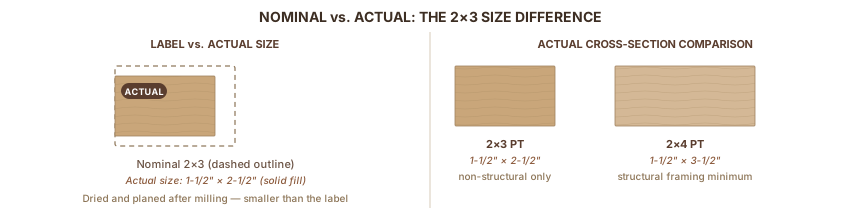
| Actual size | 1-1/2" × 2-1/2" |
| Standard length | 8 ft (most common) |
| Price range | $3-5 per 8 ft board |
| Common species | Southern Yellow Pine (SYP) |
| Best use | Fence rails, furring strips, non-structural outdoor framing |
| What to check | UC rating on the end tag: UC3B = above ground, UC4A = ground contact |
In this guide:
- Why it's 1-1/2" × 2-1/2" and what the end tag tells you
- Where to buy it and why stock is inconsistent
- What you can and can't build with it
- Fasteners, safety, and the six mistakes to avoid
Part 1: Actual Dimensions and What the End Tag Means
Why a 2x3 Isn't 2 Inches by 3 Inches
The "2x3" on the price tag is the nominal dimension. That's the rough size of the board before the mill finishes it. After kiln drying, the wood shrinks about 3/16 inch per face. After planing to smooth surfaces, it loses another 1/16 inch or so. The result: 1-1/2 inches thick by 2-1/2 inches wide. This has been the industry standard since the American Lumber Standard Committee set these sizes decades ago.
Freshly pressure treated boards may measure slightly larger. The treatment process forces preservative solution into the wood under pressure, raising its moisture content. As the board dries in your garage or on the project site, it shrinks to the standard actual dimensions. If precision matters for your project, grab a moisture meter. A board reading above 19% still has drying to do.
What's In the Wood
Modern pressure treated lumber uses copper-based preservatives. The old stuff, CCA (chromated copper arsenate), contained arsenic. The EPA phased it out for residential use in 2004. Three replacements are EPA-approved:
| Preservative | What's In It | Corrosion | Wood Color |
|---|---|---|---|
| ACQ | Copper + ammonium compounds | High | Green |
| CA-C | Copper + tebuconazole fungicide | Moderate | Green to brown |
| MCA | Micronized copper + tebuconazole | Lower | Natural/brown |
MCA (micronized copper azole) is what you'll find at most stores now. The copper is ground into microscopic particles instead of dissolved, which makes it less corrosive to fasteners. Koppers Performance Chemicals manufactures the MicroPro technology behind brands like YellaWood, ProWood, and AC2.
All three preservatives are EPA-registered for residential use including decks, playsets, and garden structures. Wear a dust mask when cutting. Wash your hands after handling. Don't burn the scraps.
Reading the End Tag
Every pressure treated board has a tag stapled to one end. This tag is more useful than the price sticker.
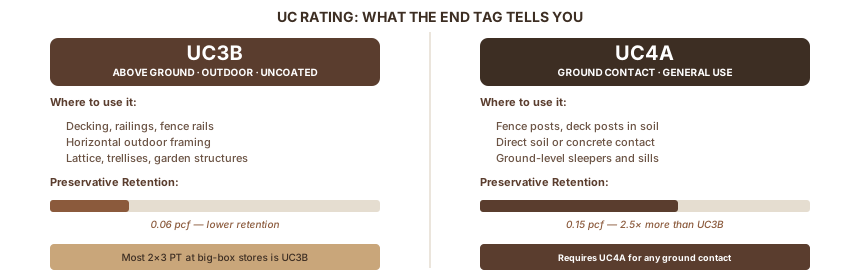
The UC rating is the number that matters most. UC stands for Use Category, set by the American Wood Protection Association:
| UC Rating | What It Means | Use It For |
|---|---|---|
| UC3B | Above ground, outdoor, uncoated | Decking, railings, fence rails |
| UC4A | Ground contact, general use | Fence posts, deck posts, anything touching soil |
Most 2x3 PT at big-box stores is rated UC3B (above ground). If your project puts wood in or on the ground, you need UC4A. The difference is preservative retention: UC4A boards have roughly 2.5x more preservative than UC3B boards. Using UC3B wood in ground contact is the single most common mistake DIYers make with treated lumber.
Brand colors on the end tag: Yellow = YellaWood, White = ProWood, Green = AC2 (Menards). The color identifies the brand, not the treatment level. YellaWood's end tag guide walks through every line if you want the full decoder.
Species
About 85% of pressure treated lumber in the U.S. is Southern Yellow Pine (SYP). The wide sapwood on SYP lets preservative penetrate deep and evenly without any special preparation. If you're on the East Coast or in the South, that's what you're getting.
West Coast buyers get Hem-Fir). Hem-Fir doesn't absorb preservative as easily as SYP, so the wood gets incised before treatment. That means small slits punched into the surface to let the chemicals in. You'll notice the texture difference. The protection is equivalent to SYP when properly treated.
Part 2: Where to Buy 2x3 Pressure Treated Lumber
All three big-box chains catalog 2x3 PT. Whether your local store actually has it on the shelf is a different question.
| Store | Brand | Preservative | ~Price (8 ft) | Notes |
|---|---|---|---|---|
| Home Depot | WeatherShield | MCA | $5-7 | Also sells appearance-grade ground contact |
| Lowe's | Severe Weather | Ecolife (DCOI) | $4-6 | Also sold as a dedicated fence rail |
| Menards | AC2 | MCA (MicroPro) | $4.98 | Midwest only; also in 3 ft and 4 ft lengths |
The brand you get depends on the store. These are retailer-exclusive private labels using different preservative chemistries. You don't choose between them on the same shelf.
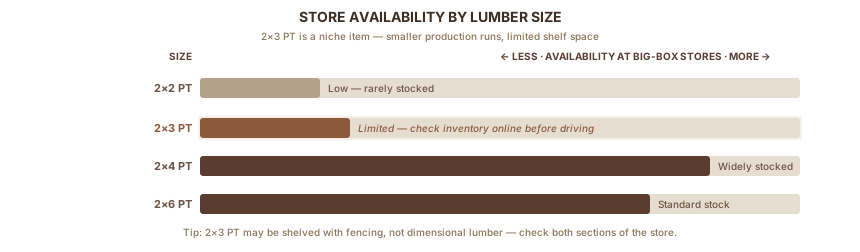
Why It's Harder to Find Than 2x4
The 2x3 sits in a gap nobody fills well. It's too small for structural framing (the International Residential Code requires minimum 2x4 for load-bearing walls) but larger and heavier than a furring strip. Sawmills optimize cutting patterns for 2x4 and 2x6 since those sizes make up the bulk of construction demand. The 2x3 is a secondary cut produced in smaller runs.
Retailers reflect this. Home Depot and Lowe's dedicate most of their lumber aisle to 2x4, 2x6, and 4x4. The 2x3 gets a small section, and some stores skip stocking it entirely. Independent lumber yards often jump straight from 2x2 to 2x4.
How to Find It
Check online inventory first. Home Depot, Lowe's, and Menards all show local store stock on their websites. Don't drive to the store assuming they have it.
Look in the fencing section. Both Home Depot and Lowe's sell 2x3 PT as "fence rails" in a different part of the store from dimensional lumber. Same board, different shelf.
If you can't find 2x3 PT, buy a 2x4 PT and rip it to 2-1/2 inches on a table saw. The treatment penetrates deep enough that the exposed face still has protection for above-ground use. This voids the treatment warranty on the cut edge, but for fence rails and furring it works fine.
Ask the lumber desk about special orders. Most stores can bring in 2x3 PT within a week even if they don't stock it on the floor.
Part 3: What You Can Build with 2x3 Pressure Treated Lumber
Good Uses
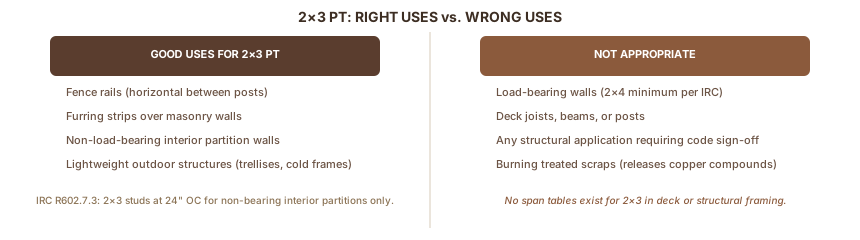
Fence rails. This is the primary retail application for 2x3 PT. The horizontal members between posts on a standard privacy or picket fence. Using 2x3 instead of 2x4 for rails saves about $1-2 per board. On a fence with 30-60 rails, that's $40-120 in materials.
Furring strips over masonry. Attach 2x3 PT to a basement concrete block wall to create a surface for drywall or paneling. The pressure treatment protects against moisture wicking through the masonry.
Non-load-bearing interior walls. IRC Section R602.7.3 allows 2x3 studs spaced 24 inches on center for interior partition walls that don't carry a load from above. Common in basement finishing where the thinner wall saves an inch of floor space.
Lightweight outdoor structures. Raised bed supports, lattice and trellis frames, cold frames, garden arbor bracing. Anything outdoor and non-structural where you want rot protection without the weight and cost of 2x4.
Don't Use For
Load-bearing walls. The IRC requires minimum 2x4 studs for exterior walls and interior bearing walls. No exceptions for 2x3.
Deck joists, beams, or posts. No span tables exist for 2x3. A 2x4 has 40% more cross-section area (5.25 vs. 3.75 square inches) and proportionally more bending strength. Deck framing starts at 2x6 minimum for joists.
Any application that requires code compliance for structural loads. If an inspector needs to sign off on it, the answer is 2x4 or larger.
Quick Comparison: 2x3 PT vs. Alternatives
| Material | Cost (8 ft) | Outdoor Lifespan | Maintenance | Strength |
|---|---|---|---|---|
| 2x3 PT | $3-5 | 25-40 years (above ground) | Seal every 1-2 years | Non-structural only |
| 2x4 PT | $5-8 | 25-40 years | Seal every 1-2 years | Structural (with code) |
| Cedar 2x4 | $8-15 | 15-25 years | Seal every 1-3 years | Moderate |
| Composite | $15-25+ | 25-50 years | None | Varies by product |
Pick 2x3 PT when you need rot protection on a budget and the application isn't structural. Pick 2x4 PT when strength or code compliance matters. Cedar is for visible surfaces where you want the look without the green tint. Composite is for decking and railing where you want zero maintenance.
Part 4: Safe Handling, Fasteners, and Common Mistakes
Cutting and Handling
Modern PT lumber is safe to handle with bare hands for normal use. When you cut it, the sawdust is the concern. The NPIC's treated wood fact sheet recommends:
- Wear an N95 dust mask, safety goggles, and gloves when sawing or sanding
- Work outdoors or with good ventilation
- Wash your hands and exposed skin before eating or drinking
- Never burn treated wood scraps (releases copper compounds). Bag them for regular trash pickup.
Drying Before You Finish
Pressure treated wood arrives wet. Moisture content can range from 30% to 75% depending on how recently it was treated. Paint, stain, or sealer applied to wet wood traps moisture underneath and peels within months.
Let the wood air dry for three to six months before applying any finish. Stack boards with spacers (stickers) between layers to allow airflow on all four faces. If you can't wait, look for KDAT lumber (kiln-dried after treatment), which ships ready to finish. KDAT isn't available in every size and store, but it's worth asking.
Test readiness with a moisture meter. Below 15% is safe for most finishes. For the full process — moisture testing, mill glaze removal, stain selection, and application — see how to stain pressure treated wood.
Fastener Rules
Copper-based preservatives corrode the wrong fasteners. You have two safe options, confirmed by the [USDA Forest Products Laboratory](https://www.fpl.fs.usda.gov/documnts/fplgtr/fpl_gtr220.pdf) and Simpson Strong-Tie:
| Fastener Type | Safe for PT? |
|---|---|
| Hot-dipped galvanized (HDG, ASTM A153) | Yes |
| Stainless steel (304/316) | Yes |
| Electro-galvanized | No |
| Mechanically galvanized | No |
| Standard zinc-plated | No |
| Bare steel | No |
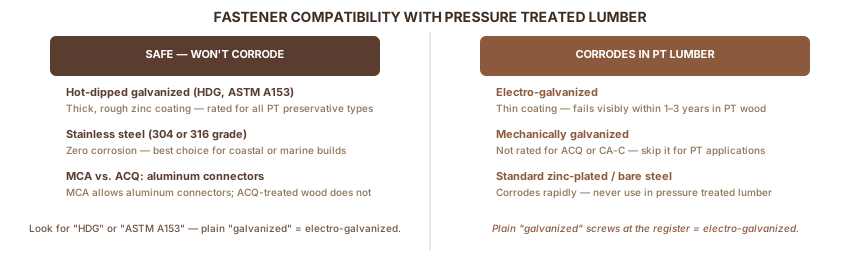
The "galvanized" screws in the cheap box at the hardware store are usually electro-galvanized, not hot-dipped. Check the label. Electro-galvanized fasteners in ACQ-treated wood corrode visibly within one to three years. Hot-dipped galvanized screws have a thicker, rougher zinc coating that holds up.
MCA-treated lumber (YellaWood, ProWood, AC2) is less corrosive than ACQ and is approved for direct contact with aluminum flashing and connectors. ACQ-treated lumber corrodes aluminum.
End-Grain Sealing
When you crosscut a treated board, the fresh end has less preservative than the factory-treated surfaces. Brush a copper naphthenate end-cut sealer (sold as "Cut-N-Seal" or equivalent) on all cut ends, especially for ground-contact or near-ground applications. Costs a few dollars a can and takes 30 seconds per cut.
Six Common Mistakes
- Wrong UC rating for the job. UC3B wood in ground contact rots. It has roughly 1/3 the preservative of UC4A. Check the end tag.
- Finishing too soon. Wet wood rejects paint and stain. Three to six months of drying, or buy KDAT.
- Wrong fasteners. Electro-galvanized screws corrode in PT lumber. Use hot-dipped galvanized or stainless steel.
- Not inspecting at the store. PT lumber sits wet on the shelf and warps. Sight down every board. Reject anything with a twist, cup, or bow you can't live with.
- Assuming 2x3 is structural. No building code allows 2x3 in load-bearing applications. The IRC stops at 2x4 for structural framing.
- Burning treated scraps. Releases copper and other preservative compounds. Bag the offcuts and put them in the trash.
FAQ
Can I use 2x3 pressure-treated lumber for a load-bearing wall?
No. The 2021 International Residential Code (IRC) section R602.3.1 sets the minimum stud size for bearing walls at 2x4 — 2x3 is not permitted in any load-bearing application. 2x3 is only legal for non-bearing partition walls under IRC R602.7.3, and even then there are height and stud-spacing limits. For any wall that supports a roof, ceiling, or upper floor, step up to 2x4.
Can 2x3 pressure-treated lumber be used for fence posts?
No, not as the post itself. A 2x3 PT board is too small in cross-section to resist the bending loads a fence post takes from wind and gate weight, and no code or fence-manufacturer spec lists 2x3 as an approved post size. Standard wood fence posts are 4x4 PT (or larger) rated UC4A for ground contact. The 2x3's actual role in fence construction is the horizontal rail between posts — that's the application big-box stores stock it for, often labeled "fence rail" rather than "2x3."
What's the difference between 2x3 and 2x4 pressure-treated lumber?
Both share the same 1-1/2" thickness — the difference is width. A 2x3 actual is 1-1/2" × 2-1/2"; a 2x4 actual is 1-1/2" × 3-1/2". That extra inch of width gives the 2x4 a 40% larger cross-section (5.25 vs. 3.75 square inches) and proportionally more bending strength. The 2x4 is the minimum size approved for load-bearing walls and any structural framing under the IRC, while the 2x3 is restricted to non-structural use — fence rails, furring strips, and non-bearing partition walls. The 2x3 typically runs $1-2 cheaper per 8 ft board; pick it when strength doesn't matter, the 2x4 when it does.
How long should pressure-treated 2x3 dry before staining or painting?
Three to six months for standard MCA-treated lumber, until moisture content drops below 19%. Wet PT lumber rejects paint and stain because the water in the wood blocks adhesion — you'll see the finish bead up or peel within weeks. The shortcut is to buy KDAT (Kiln-Dried After Treatment) lumber, which is dried at the mill to 19% or lower and ready to finish on day one. KDAT costs roughly 25% more.
What fasteners are safe to use with PT 2x3?
Hot-dipped galvanized or stainless steel only. The copper-based preservatives in modern PT lumber (MCA, ACQ, CA-B) corrode electro-galvanized and standard zinc fasteners within a year — sometimes within months in damp conditions. The USDA Forest Products Laboratory has documented this corrosion failure in detail. Stainless costs more but never reacts. For above-ground PT 2x3, hot-dipped galvanized is the practical default.
Can I burn pressure-treated 2x3 scraps in a fire pit?
Never. Burning PT lumber releases copper and other preservative compounds into the smoke and ash, which is a documented health hazard. The EPA, Forest Products Lab, and every PT manufacturer agree: bag the offcuts and put them in the trash. Don't compost the sawdust either — the preservatives leach into garden soil.
What's the difference between UC3B and UC4A pressure treatment?
UC3B (Use Category 3B) is rated for "above ground, exterior" use — fence rails, deck pickets, anything that gets wet but doesn't touch soil. UC4A is rated for ground contact, with roughly three times the preservative loading. If you bury the 2x3 or rest it on dirt or concrete, UC3B will rot within five years. The end tag printed on every PT board lists the UC rating — check it before you buy.
Sources
This guide draws on federal safety data, industry standards bodies, building codes, manufacturer documentation, and retailer product listings.
- Archtoolbox — Lumber Dimensions — nominal vs. actual size standards
- EPA — Overview of Wood Preservative Chemicals — CCA phase-out and approved replacements
- NPIC — Treated Wood Fact Sheet — safety handling, health risks, residential use
- Koppers Performance Chemicals — MicroPro FAQ — MCA technology and brand applications
- AWPA — For Homeowners — UC rating system and use categories
- YellaWood — How to Read an End Tag — end tag decoding
- SouthernPine.com — Pressure-Treated Southern Pine — SYP species and treatment properties
- WWPA — Hem-Fir) — western species for treated lumber
- Menards — AC2 2x3 Product Page — confirmed pricing and specs
- Home Depot — PT Pine Fence Rail — 2x3 fence rail availability
- UpCodes — IRC R602.7.3 — non-bearing wall framing with 2x3 studs
- ICC — IRC 2021 R602.3.1 — minimum stud sizes for bearing walls
- USDA Forest Products Laboratory — Fastener Corrosion in Treated Wood — fastener compatibility research
- Simpson Strong-Tie — Pressure-Treated Wood FAQ — fastener requirements and preservative corrosion
Wood Species
Also Referenced
Up Next
2x4 Calculator: How Many Boards Do You Need?
WOOD & MATERIALS · Beginner