
Ambrosia Maple at a Glance
Ambrosia maple isn't a tree species. It's soft maple — usually red maple — visited by ambrosia beetles while still standing. The beetles left small entry holes and triggered a chemical defense reaction in the tree that stained the surrounding wood gray, brown, and greenish. That discoloration is permanent, doesn't weaken the wood, and can't be replicated artificially. For decades it was sold below grade as a defect. Now it costs $6–10 per board foot and looks like figured wood three times the price.
| Base species | Soft maple (primarily red maple, Acer rubrum) |
| Other names | Wormy maple, ghost maple, soft maple WHND |
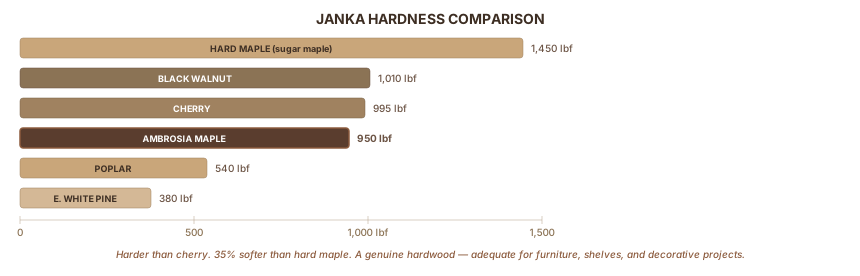
| Janka hardness | 950 lbf — harder than cherry, easier than hard maple |
| Price range | $6–10 per board foot (4/4 retail, online) |
| Best finish | Clear only — no stain |
| Beetle holes | Cosmetic; don't affect structural integrity |
In this guide:
- Why the streaks and holes are there — and why they stay
- How ambrosia maple works in the shop
- What to look for when buying
- Finishing — and what to do about the holes
- Best beginner projects
- Ambrosia vs. spalted vs. hard maple
Part 1: What Ambrosia Maple Is (and Isn't)
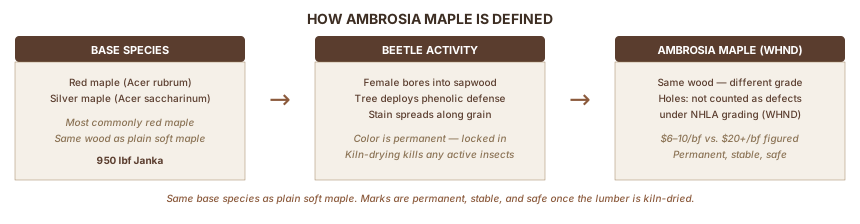
When you see boards at a lumber yard labeled "ambrosia maple" or "wormy maple," you're looking at soft maple — not a distinct tree species. The wood comes from red maple (Acer rubrum) or silver maple (Acer saccharinum) that happened to be visited by ambrosia beetles at some point while the tree was alive.
Same species. Different visual character.
The designation tells you something practical about the grading system: those beetle marks don't count as defects. In NHLA (National Hardwood Lumber Association) grading, boards sold as "WHND" (Worm Holes Not a Defect) treat the holes and streaks as decorative rather than subtracting from grade. A board that would grade "1 Common & Better WHND" is a quality piece of soft maple where the marks simply aren't held against it.
You'll see this wood under several names depending on the supplier: ambrosia maple, wormy maple, ghost maple, or just "soft maple WHND." They're all the same thing.
Ambrosia maple gives you the visual drama of figured wood at soft maple prices, and it works like soft maple in the shop. The marks are permanent, stable, and safe.
Part 2: Why It Looks That Way: Beetles, Defense Chemistry, and Permanent Marks
Most sources say ambrosia beetles carry fungus spores into maple trees and the fungus stains the wood. Ohio State University Extension (factsheet ANR-0108) is more precise.
When a maple tree is wounded by beetle boring, it produces phenolic compounds at the wound site — the tree's own defense chemistry, deployed to block fungal and bacterial infection from spreading. In red maple, those phenolics create the distinctive gray-to-brown-to-greenish coloration. The color comes from the tree fighting back, not just from the fungus.
Unlike blue stain in pine — which is actual fungal decay and can soften wood — the ambrosia coloration in maple "does not reduce physical wood properties, nor does it fade over time," per the OSU Extension research. Once the tree responds, the color is locked in.
What the beetles actually do:
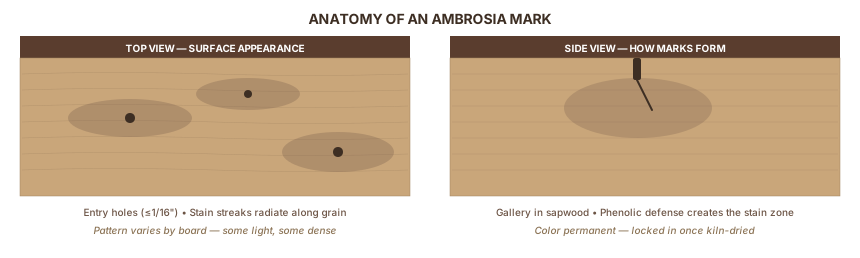
Ambrosia beetles (mostly Xylosandrus species — around 3,000 species worldwide) are farmers, not wood-eaters. The female bores a gallery into the sapwood and introduces a symbiotic fungus she carries in specialized pouches. Her larvae eat the fungus, not the wood. The entry hole is typically tiny — 1/16" or smaller, what lumber graders classify as a "pin hole."
The visible streaks in the lumber are the staining that radiates outward from that gallery, traveling along the grain as the phenolic response spreads. That's why the streaks follow the grain direction and often fan out from a small center point.
Once the tree is felled and kiln-dried, the beetles and any active fungus are dead. You can't re-infest kiln-dried lumber.
What the marks look like:
- Thin, tapering streaks in gray, warm brown, greenish-brown, and occasionally olive
- Small round entry holes, usually shallow — most just break the surface
- Streaks follow grain direction and often radiate from a visible hole
- Pattern varies by board — some lightly marked, some dense throughout
Part 3: How It Works: Properties and Workability
Hardness and what it means for your project
According to The Wood Database, ambrosia maple has a Janka hardness of 950 lbf. That's for red maple, the most common base species.
| Species | Janka (lbf) |
|---|---|
| Hard maple (sugar maple) | 1,450 |
| Black walnut | 1,010 |
| Cherry | 995 |
| Ambrosia maple (soft maple) | 950 |
| Poplar | 540 |
| Eastern white pine | 380 |
At 950, ambrosia maple is a true hardwood — harder than many woods beginners start with. It's about 35% softer than hard maple, which makes a real difference in how easy it is to work by hand and how quickly it shows wear in daily use. For furniture, shelves, boxes, and decorative projects, 950 is more than adequate. For a high-traffic floor, you'd want something harder.
Density and wood movement
Dried red maple weighs about 38 lbs per cubic foot — roughly 26% lighter than red oak — which makes it easy to handle for solo builds.
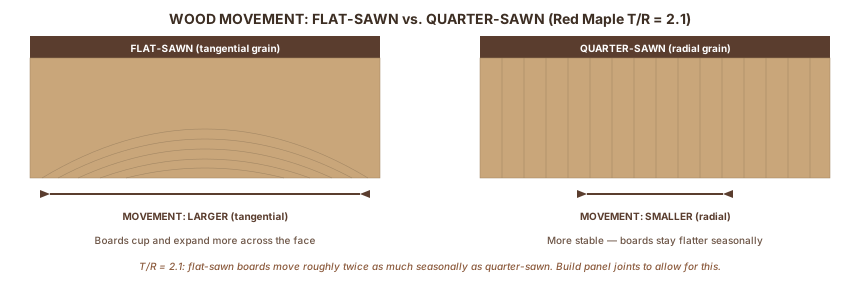
Red maple's tangential-to-radial shrinkage ratio (T/R ratio — a measure of how much a board moves across the grain versus with it) is 2.1, per The Wood Database. Flatsawn boards move noticeably more across the width than quartersawn boards. This is moderate movement, similar to cherry. For furniture, build your joinery to accommodate seasonal wood movement. For small projects like boxes, shelves, or turned bowls, it's not a concern.
For more on designing for wood movement, see Wood Movement in Practice.
Workability
Soft maple is forgiving. It machines cleanly and takes tool edges well. Four things to know before your first session with it:
It burns at the router and table saw. Maple in general burns easily if you stop mid-cut or feed too slowly. Keep your feed rate consistent and your blades sharp.
Tearout in figured areas. Where the beetle marks create irregular grain — especially near holes where grain may swirl — you can get tearout when planing or routing. Guitar makers who work with ambrosia maple report this is the main machining challenge. The fix is the same as for any figured wood: lighter passes, sharper tools, and sometimes reversing your feed direction. See Troubleshooting Tearout for the full diagnostic.
Silver maple tension wood. Silver maple can develop tension wood — a reaction wood that produces fine "peach fuzz" when machined that won't sand out easily. Sharp cutters and light finishing passes help. Red maple doesn't have this problem as often.
Gluing. Works fine with standard PVA wood glue. Some woodworkers add slightly more glue when bonding surfaces that run through beetle-affected areas.
Is it harder to work than plain soft maple? No. The marks don't change the base wood's working properties. You're machining the same species. The only added steps are filling holes if you want them filled, and being careful in heavily figured areas.
Part 4: Buying It: Grades, What to Look For, and Where to Find It
The WHND grading system
The NHLA defines insect holes by size: pin holes (1/16" or smaller), spot holes (1/16" to 1/8"), and shot holes (1/8" to 1/4"). Most ambrosia beetle entry holes fall into pin hole territory.
WoodWeb's lumber grading reference explains the WHND designation: those holes are excluded from the defect calculation. A board that would grade "1 Common & Better" with the holes counting still grades "1 Common & Better WHND" — the marks simply aren't held against it.
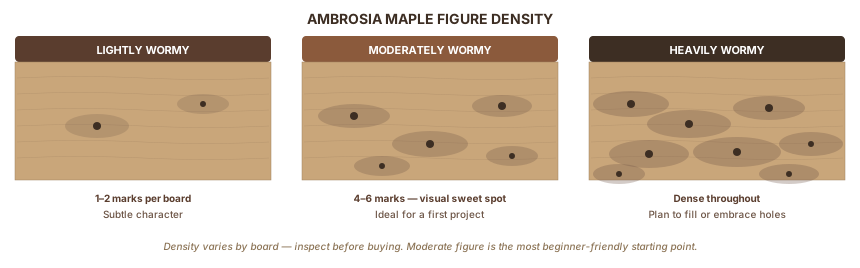
What varies between suppliers is the density of the figure. Some boards are lightly marked, others are dense throughout. Bell Forest Products uses the terms "lightly wormy" and "heavy wormy" to describe the range. For a first project, moderate figure is ideal — enough visual interest without so many holes that you're spending the whole project filling them.
What to look for when buying
Figure density. Decide what you want. More marks = more drama, but also more holes to potentially address. Most beginners find moderate figure the sweet spot.
Standard board issues. Check for the same things you'd look for in any soft maple board: cupping, bowing, twist, end checks. The beetle marks don't cause these problems — they're from drying or storage.
Hole depth. Most ambrosia beetle holes are shallow surface entries. Run a finger over the surface. If holes feel deep or irregular, factor in how much wood you'll remove in surfacing.
Kiln-dried. All indoor furniture lumber should be kiln-dried (KD). This kills any remaining insects and beetles, and locks in the coloration. Look for "KD" on the label.
Where to find it and what to pay
Major online hardwood retailers carry it: Woodworkers Source, Bell Forest Products, Advantage Lumber, KJP Select Hardwoods. If you're east of the Mississippi, local hardwood dealers often stock it. West Coast buyers may pay more due to shipping.
For turning projects, Craft Supplies USA and TurningBlanks.net carry kiln-dried blanks in pen and bowl blank sizes.
Pricing (2025–2026): Roughly $6–10 per board foot for 4/4 lumber at online retailers when buying 10+ board feet — Woodworkers Source and Bell Forest Products are both in this range. Compare that to hard maple at $10–15/bf and figured hard maple at $20+/bf. Ambrosia maple is genuinely affordable for a character wood.
Why is it cheaper than figured hard maple despite looking impressive? History. It was sold below grade for decades as a "defect" for upholstered furniture frames — where the figure was covered anyway. The market's perception hasn't fully caught up to the wood's actual visual value.
For more on buying hardwood lumber generally, see Buying Lumber.
Part 5: Finishing Ambrosia Maple
Skip the stain
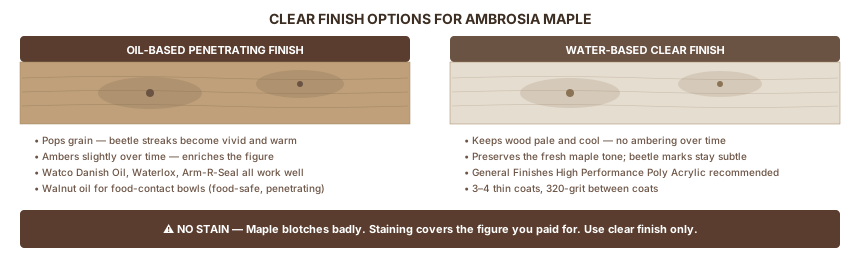
Maple is notoriously blotch-prone. Its grain is dense and irregular in ways that cause penetrating stains to absorb unevenly — dark patches next to light patches, the figure muddied rather than enhanced. The Wood Whisperer's guide to staining maple covers why pre-stain conditioner helps a little but doesn't solve it; it just makes the stain go on lighter and still blotchy.
More important: the whole point of ambrosia maple is its natural figure. Staining it covers what you paid for. Use a clear finish and let the wood speak. For more on this specific problem, see Troubleshooting Stain Problems.
Clear finish options
Oil-based penetrating finishes work well for most furniture and box projects. Watco Danish Oil, Waterlox, and Arm-R-Seal all penetrate the wood and pop the grain. The beetle streaks become more vivid. Oil finishes amber slightly over time, which enriches the warmth of the figure rather than washing it out.
Water-based clear finishes keep the wood looking pale and cool — closer to fresh maple. [General Finishes recommends their High Performance Poly Acrylic](https://generalfinishes.wordpress.com/2009/04/14/finishing-ambrosia-maple/) as a reliable water-based option for ambrosia maple specifically. Water-based finishes don't amber over time, so if you want to preserve the pale maple tone, go water-based. Apply in thin coats with light sanding between each (320 grit), 3–4 coats total.
For bowls and food-contact surfaces: walnut oil is the most popular choice among woodturners — food-safe, penetrating, with a mild darkening effect. The American Association of Woodturners forum has several threads on this specific wood confirming walnut oil and food-grade mineral oil as the go-to options. Reapply periodically with use. See Food-Safe Finishes for the full comparison.
For a broader introduction to finish types and when to use each, see Understanding Wood Finishes.
What to do about the beetle holes
Whether to fill the holes is a design decision, not a structural one. The holes are part of the character — many woodworkers leave them open, and a clear finish seals them adequately for most uses.
If you want a smooth flat surface (common for tabletops, cutting boards, and boxes), fill before the final finish coat.
CA glue method (fastest):
- Sand the surface to your target grit — typically 150 or 180
- Pack sanding dust from the same board into each hole
- Drop medium-viscosity CA glue (super glue) onto the dust-filled hole
- Let it cure fully — about 2–3 minutes for medium CA
- Sand flush with the surface
- Add a second drop of thick CA if needed for larger holes
Note: CA glue is not food-safe. For cutting boards or food-contact surfaces, use the epoxy method.
Epoxy method (most durable):
- Mix 5-minute epoxy and add a small amount of fine sanding dust from the board to match color
- Apply with the tip of an awl or toothpick; fill slightly proud of the surface
- Let cure fully — at least one hour to be safe, longer than the stated open time
- Level with a card scraper or sandpaper backed by a flat block
- Proceed with finishing
Leave open: Completely valid. The holes read as part of the character. For turned bowls especially, leaving them open is standard practice.
Five finishing mistakes beginners make with ambrosia maple
- Staining it. The streaks absorb color differently than the base wood. You'll get unpredictable results.
- Sanding past the marks. Sand too aggressively and you can reduce or erase the beetle streaks — they're in the surface layer. Stop before you erase the figure.
- Letting finish pool in holes. Finish pools inside holes and cures as a cloudy residue. Either fill holes first, or wipe out any pooling carefully before the finish cures.
- Applying oil to wood that hasn't acclimated. Oil finishes need dry wood. Kiln-dried lumber from a reputable supplier is fine. Wood from a sawyer or stored in a damp place needs time to reach equilibrium.
- Burning from slow router passes. Maple burns fast. Keep moving at a consistent feed rate. A stopped or slow pass leaves a burn mark that's genuinely hard to remove.
Part 6: Best Projects for Beginners
Ambrosia maple's figure makes even simple work look impressive. A single-board shelf finished with Danish oil looks like it belongs in a design magazine. A basic box looks like it was designed, not just built.
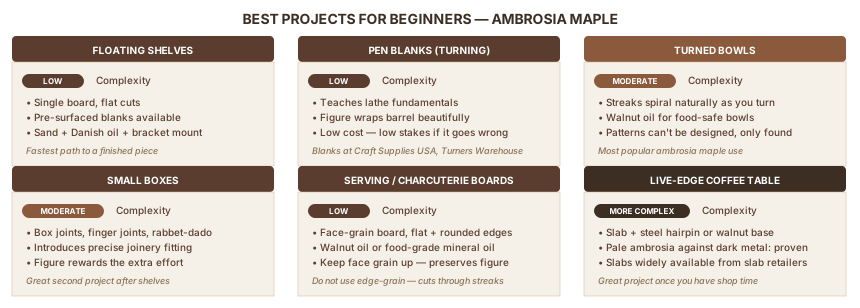
Floating shelves. A single board, flat cuts, a hidden bracket system. Pre-made ambrosia maple shelf blanks from suppliers like KJP Select Hardwoods come surfaced and ready to finish. Sand, apply a clear oil or water-based finish, mount on brackets. This is the fastest path to a finished piece that looks professional.
Pen blanks. Pen turning teaches lathe fundamentals, finishing, and how to read grain in a small format. The beetle figure wraps around the barrel in a finished pen. Low material cost means low stakes if something goes wrong. Turning blanks sized for pens are widely available from Craft Supplies USA and Turners Warehouse.
Turned bowls. The most popular use of ambrosia maple among hobbyists. The streaks spiral naturally around the bowl as you turn — patterns that can't be designed, only discovered. Finish with walnut oil for food-safe bowls. This is more involved than a shelf but well within reach once you have lathe access.
Small boxes. Box joints, finger joints, or simple rabbet-and-dado construction all work fine. Boxes are a good introduction to measuring and fitting precise joinery, and the ambrosia figure rewards the effort.
Serving boards and charcuterie boards. A face-grain board, surfaced flat, with rounded or chamfered edges, finished with walnut oil or food-grade mineral oil. Keep the face grain up — edge-grain cutting boards cut through the streaks and lose the figure.
Live-edge coffee tables. Ambrosia maple slabs are a popular choice for coffee tables, often paired with steel hairpin legs or a walnut base. The combination of pale ambrosia figure against dark metal or walnut is a proven pairing. More complex than the above projects, but ambrosia slabs are widely available from live-edge slab retailers.
What to avoid for a first project: Don't use ambrosia maple for projects that need staining to match other furniture — the blotching problem will make it difficult. For load-bearing structural components like table legs, clear-grain hard maple or oak is a safer choice where beetle holes, if clustered, could theoretically create a weak point.
Part 7: Ambrosia Maple vs. Spalted Maple vs. Hard Maple
These three names come up together whenever beginners are choosing figured or character maple. Here's how to keep them straight.
Ambrosia vs. spalted maple
Both have dramatic natural figure. Both come from maple. That's where the similarity ends.
| Ambrosia Maple | Spalted Maple | |
|---|---|---|
| When it forms | Living tree, beetle attack | Dead wood, fungal competition |
| Cause | Tree's phenolic defense + beetle galleries | Zone lines from competing fungi |
| Visual pattern | Thin worm-track streaks, small holes | Bold black zone lines, often angular |
| Colors | Gray, brown, greenish, olive | Black lines; yellow, purple, or pink areas |
| Structural integrity | Consistent — same as plain soft maple | Variable — heavy spalting can be soft or punky |
| Workability | Predictable | Requires checking for soft spots |
| Finish approach | Standard clear finish | May need epoxy resin for soft areas |
| Beginner-friendliness | Excellent | Moderate |
| Price (4/4 retail) | $6–10/bf | $10–25/bf |
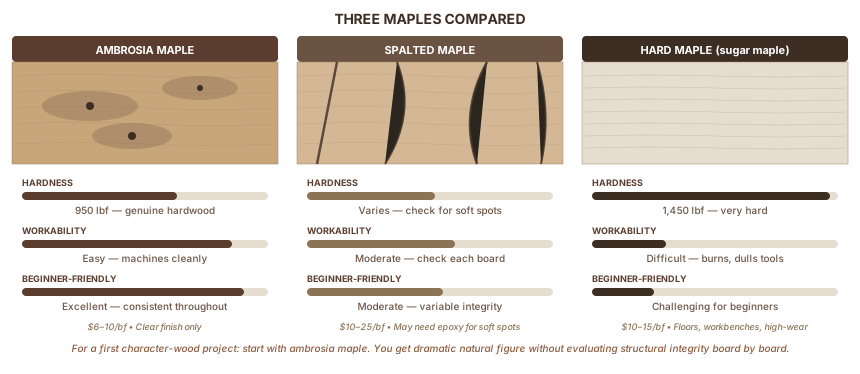
Spalting is a decay process. Ambrosia marking is a defense process. Ambrosia maple is structurally consistent throughout. Spalted maple varies — light spalting is fine, but heavily spalted sections can be soft or brittle.
For a first project, start with ambrosia maple. You get dramatic natural figure without needing to evaluate structural integrity board by board.
For more on figured maples in general, see Curly Maple.
Ambrosia vs. hard maple
Hard maple (sugar maple) and ambrosia maple (soft maple) share the same creamy white color but little else.
| Ambrosia Maple (soft maple) | Hard Maple (sugar maple) | |
|---|---|---|
| Janka hardness | 950 lbf | 1,450 lbf |
| Workability | Easy — machines cleanly, forgiving | Difficult — burns easily, dulls tools faster |
| Appearance | Creamy white + beetle figure | Creamy white, uniform grain |
| Price (4/4 retail) | $6–10/bf | $10–15/bf |
| Best uses | Furniture, bowls, shelves, boxes | Floors, workbench tops, kitchen surfaces |
Hard maple's hardness is its main selling point — it stands up to heavy wear like floor traffic, knife cuts, and workbench abuse. For decorative furniture, shelves, and beginner projects where wear isn't the primary concern, ambrosia maple is more forgiving to work, lower cost, and brings unique visual character that clear hard maple doesn't offer.
For a broader species comparison, see the Wood Species Quick Reference.
Sources
Research for this guide drew on university extension research, authoritative wood databases, NHLA grading references, finisher blogs, practitioner forums, and lumber supplier educational content — 32 sources consulted, 10 cited.
- Ohio State University Extension — ANR-0108: Ambrosia Coloration in Maple Trees — phenolic defense mechanism, structural integrity claim
- The Wood Database — Ambrosia Maple — Janka hardness, density, shrinkage values, workability notes
- Wikipedia — Ambrosia Beetle — beetle biology, species count, farming behavior
- WoodWeb — Worm Holes and Lumber Grading — NHLA WHND designation, hole size classifications
- Bell Forest Products — Ambrosia Maple Lumber — figure density terminology, pricing range
- Woodworkers Source — Ambrosia Maple Lumber — pricing and availability data
- Guitar Making Forum — Ambrosia Maple Tearout — tearout in figured areas, machining challenges
- The Wood Whisperer — Staining Maple — blotching mechanism, pre-stain conditioner limitations
- General Finishes Blog — Finishing Ambrosia Maple — water-based finish recommendation, finishing approach
- American Association of Woodturners Forum — Ambrosia Maple Finishing — walnut oil and mineral oil for turned bowls
Wood Species
Also Referenced