
2x6 Span Chart at a Glance
Douglas Fir-Larch #2 at 16 inches on center spans 9 feet 9 inches under standard residential loads. That's the most common floor joist combination. For deck joists, the same board spans 8 to 9 feet because outdoor lumber carries a wet-service penalty. For shelving, the structural table doesn't apply; a 2x6 lying flat sags well before it fails.
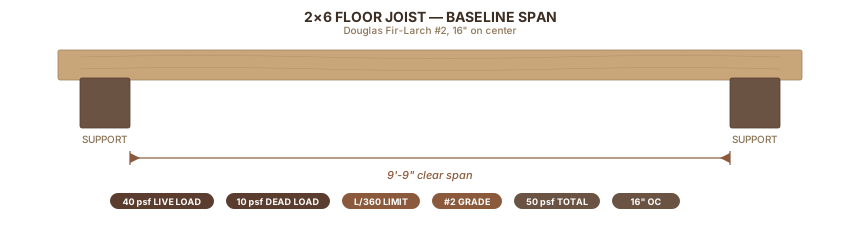
| Floor joist (DF-L #2, 16" OC) | 9'-9" maximum clear span |
| Load assumption | 40 psf live + 10 psf dead |
| Deflection limit | L/360 (~5/16" sag on a 9-foot span) |
| Most common spacing | 16" on center |
| Deck joist (same lumber, 16" OC) | ~8'-8" (shorter due to wet-service factor) |
| Shelf target (pine, books) | 24"-28" without center support |
In this guide:
- Floor joist span chart by species and spacing
- What loads and deflection limits actually mean
- How grade and species change your span
- Shelves, benches, and countertops
Part 1: 2x6 Floor Joist Span Chart by Species
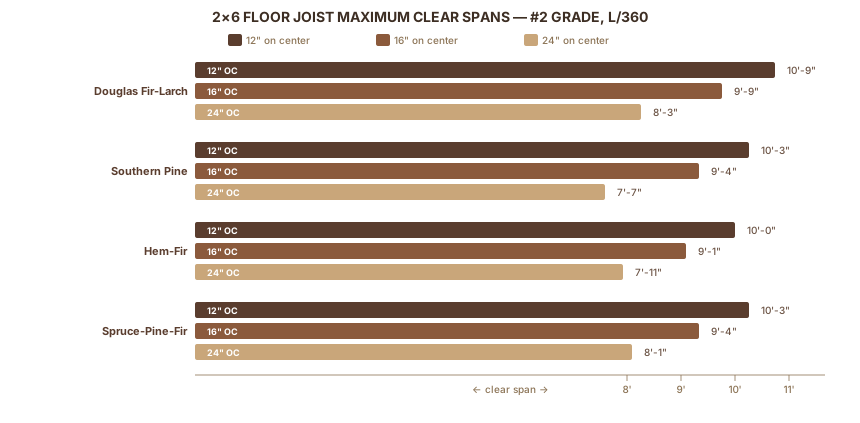
These are maximum clear spans — the distance between supports, not the total joist length — based on AWC Span Tables for Joists and Rafters (2021) and IRC requirements. All values assume #2 grade lumber, 40 psf live load, 10 psf dead load, and L/360 deflection limit.
| Species | 12" on center | 16" on center | 24" on center |
|---|---|---|---|
| Douglas Fir-Larch | 10'-9" | 9'-9" | 8'-3" |
| Southern Pine | 10'-3" | 9'-4" | 7'-7" |
| Hem-Fir | 10'-0" | 9'-1" | 7'-11" |
| Spruce-Pine-Fir (SPF) | 10'-3" | 9'-4" | 8'-1" |
#2 is what most lumberyards sell. Check the grade stamp on the board before you frame. If your lumber is marked differently, see the grade section below.
If your required span falls between two rows: use the more conservative (shorter) value.
For spans outside these conditions — heavier loads, different deflection limits, unusual species — use the AWC Span Options Calculator to get exact numbers for your project.
Part 2: What the Numbers Actually Mean
Two things confuse most people: what the loads mean in real terms, and what L/360 looks like physically.
Live Load, Dead Load, and 40 psf
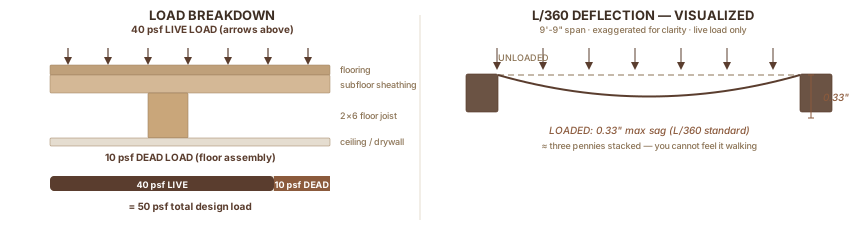
Live load (40 psf) is everything that moves on the floor: people, furniture, boxes of books, holiday gatherings. The 40 psf standard accounts for a fully occupied room. Most bedrooms see 20–30 psf in practice; the table uses 40 for margin.
Dead load (10 psf) is the floor assembly itself: subfloor sheathing, the joists, any ceiling attached below. A typical wood-frame floor runs 8–12 psf.
Combined: 50 psf total design load. That's what the table is built around.
Decks use the same load totals in most cases, but the IRC separates deck and floor tables because outdoor lumber gets a wet-service penalty.
What L/360 Looks Like
L/360 means the maximum sag under live load equals the span divided by 360.
For a 9'-9" span (117 inches): 117 ÷ 360 = 0.33 inches. That's about the thickness of three pennies stacked. You can't feel it walking across the floor.
| Deflection limit | 9-ft span sag | Where it's used |
|---|---|---|
| L/240 | 0.45" | Decks, roofs, basement floors with no plaster ceiling |
| L/360 | 0.30" | Standard residential floors |
| L/480 | 0.23" | Floors with tile directly applied |
L/360 is the standard. Use it unless your application specifically requires something different.
Safety Factors Are Already In the Table
AWC's span table tutorial explains that the lumber design values used in span calculations already include safety factors of 2.0 to 3.0. The number on the table is not the point where the joist fails. It's the serviceability limit, with substantial margin above it.
That said, stay within 90% of the table maximum. A 9'-9" allowable span means 8'-10" is your practical working span. The 10% buffer handles lumber variation, future loads, and the natural creep that occurs as wood carries load over years.
Part 3: How Grade and Species Change Your Span
Grade Makes a Real Difference
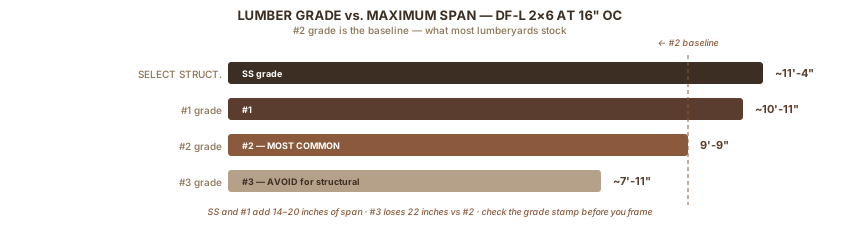
Using Douglas Fir-Larch at 16" on center as the comparison:
| Grade | Maximum span | Vs. #2 |
|---|---|---|
| Select Structural (SS) | ~11'-4" | +16% |
| #1 | ~10'-11" | +12% |
| #2 | 9'-9" | baseline |
| #3 | ~7'-11" | −19% |
Going from #2 to #1 adds about 14 inches of span. Going to Select Structural adds roughly 20 inches. Those are meaningful gains when your project is right at the edge of a #2 limit.
Cost vs. gain: #1 costs about 20% more than #2 per board foot at most lumberyards. Upgrade only when the span requires it.
Never use #3 or Stud grade for structural floor joists. Both are sold at most yards and look identical to #2 without checking the stamp. They span nearly 2 feet less than #2 under the same conditions.
Southern Pine by Grade
Southern Forest Products Association span tables show 2x6 floor joists at 12" on center, 40 psf live + 10 psf dead:
| Grade | 12" OC | Est. 16" OC |
|---|---|---|
| Dense Select Structural | 11'-4" | ~10'-4" |
| Select Structural | 11'-2" | ~10'-2" |
| #1 | 10'-9" | ~9'-9" |
| #2 | 10'-3" | ~9'-4" |
Southern Pine is the dominant framing species in the Southeast. For SYP users, these SFPA tables are the authoritative reference.
Species Stiffness by Region
| Region | Common framing species | 2x6 #2 at 16" OC |
|---|---|---|
| Pacific Northwest | Douglas Fir-Larch | 9'-9" |
| Southeast | Southern Pine | 9'-4" |
| Northeast/Midwest | Spruce-Pine-Fir | 9'-4" |
| Pacific Northwest/North | Hem-Fir | 9'-1" |
Douglas Fir-Larch spans farthest because of its high modulus of elasticity (stiffness). But the difference between DF-L and SPF at 16" OC is 5 inches. For most projects, that gap doesn't justify special-ordering a different species if your yard doesn't stock it.
Buy what your lumberyard carries. Verify the grade stamp, confirm the species group, and check the span table for that combination. The grade stamp looks like "DF #2" or "SPF No. 2" stamped in ink on the face of the board.
Part 4: Deck Joist Spans for 2x6
Why Deck Joists Span Less
Outdoor lumber exposed to weather is weaker than the same board kept dry. The IRC accounts for this with a wet-service factor that reduces allowable stresses by roughly 15–20%. That's why deck joists get their own table (Table R507.6 in the 2021 IRC) rather than using the floor joist table.
Pressure-treated lumber is required for deck joists. Most deck builders use pressure-treated Southern Pine, which matches the SYP spans in the floor table for dry conditions. The outdoor exposure adjustment brings the deck span down from floor joist values.
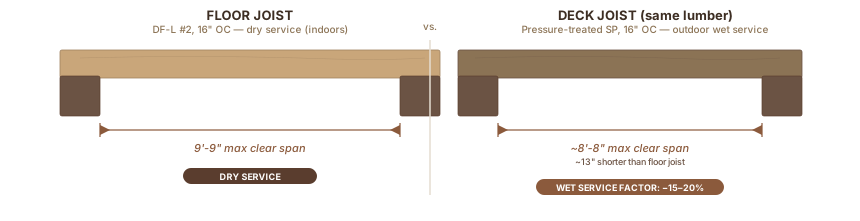
2x6 Deck Joist Spans (2021 IRC, 0–10 psf Ground Snow Load)
These apply to most of the US South and coastal areas. High snow zones reduce allowable spans further.
| Species group | 12" OC | 16" OC | 24" OC |
|---|---|---|---|
| Southern Pine | ~9'-11" | ~9'-0" | ~7'-4" |
| Douglas Fir / Hem-Fir / SPF | ~9'-6" | ~8'-8" | ~7'-0" |
As JLC Online's deck joist sizing guide explains, the 2021 IRC added snow load columns that earlier code editions lacked. If you're in a snow zone above 10 psf, use those columns. The spans get meaningfully shorter.
These are approximate values. The 2021 IRC may not be the version your jurisdiction has adopted, and local amendments can change the numbers. Before you frame a deck, confirm with your local building department.
Part 5: Woodworking Applications: Shelves, Benches, and Counters
The structural span tables above don't apply to shelving and furniture. They assume joists placed on edge — standing tall, 5.5 inches deep. A shelf lies flat, only 1.5 inches thick. That's a completely different deflection problem.
Shelves Sag Well Before They Fail
The Sagulator calculator at WoodBin is the standard tool for shelf span design. The target they recommend: 0.02 inches of sag per foot of span. For a 36-inch shelf, that's 0.06 inches maximum.
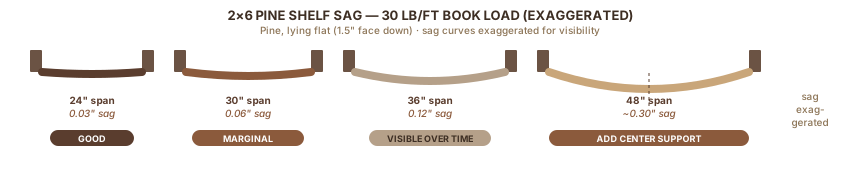
Under heavy book loads (30 lbs per running foot — paperbacks and hardcovers mixed), a 2x6 pine shelf performs like this:
| Shelf span | Sag (pine, 30 lbs/ft) | Status |
|---|---|---|
| 24" | ~0.03" | Good |
| 30" | ~0.06" | Marginal |
| 36" | ~0.12" | Will sag visibly over time |
| 48" | ~0.30" | Needs a center support |
The practical limit for a pine 2x6 shelf under books: 24–28 inches. At 36 inches, add a center support, a full-height back panel, or switch to oak or maple, which are roughly 40–50% stiffer.
The physics: doubling a shelf's thickness reduces sag to one-eighth. A 1.5-inch board sags 8 times more than a 3-inch board of the same width and span. Depth (front to back) also matters: doubling depth cuts sag in half.
Workbench Tops
A single 2x6 spanning 6+ feet flat will spring and bounce under hand plane work or mallet use. For a shop bench top, laminate at minimum four to five 2x6s glued up, and add a wooden apron fastened beneath the top near each end. That apron resists deflection when you're planing against the grain.
An 8-foot laminated top with legs set 3–4 inches from each end is stiff enough for serious shop work. The Sagulator can confirm this for your specific species and load.
Countertops
Same physics as shelves. A single 2x6 spanning 36 inches will deflect under the weight of dishes, a stand mixer, or a heavy vise. Laminate two to three 2x6s or use solid lumber planks at least 1.5 inches thick for spans over 32 inches.
Part 6: Using These Tables Safely
Apply the 90% Rule
Span table maximums have safety factors built in, but stay within 90% of the listed number. If the table says 9'-9", use 8'-10" as your working span. That 10% buffer covers lumber that falls at the low end of its grade range, higher-than-expected loads, and the long-term creep that occurs as wood carries weight over years.
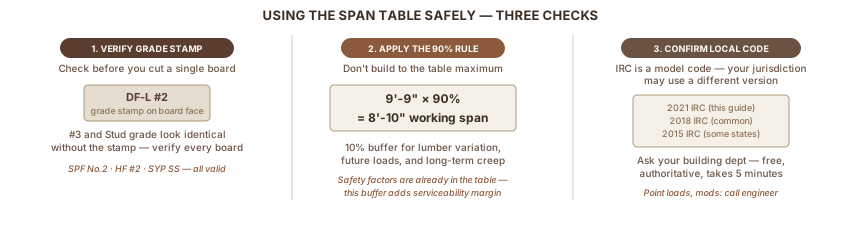
Your Local Code May Not Match This Table
The IRC is a model code. States and municipalities adopt specific versions — many still use 2015 or 2018 IRC — with local amendments. Snow loads, wind zones, and other regional factors can change allowable spans.
Before you pull a permit or frame a floor:
- Ask your local building department (free and authoritative)
- Use the AWC Span Options Calculator to verify with your actual conditions
Call a structural engineer when: your span exceeds all table options, you're adding concentrated point loads (hot tubs, safes, grand pianos), or you're modifying an existing structure. For a new deck or floor framing a standard room, the tables handle it.
Part 7: When 2x6 Isn't Enough
When 9'-9" isn't enough, here are the options in order of cost:
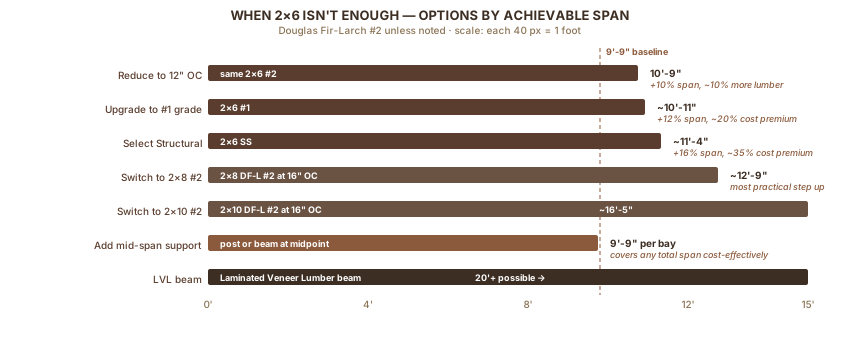
| Option | Effect on span | Cost impact | Best for |
|---|---|---|---|
| Reduce spacing to 12" OC | +10–12% | More lumber, more labor | When you're just over the limit |
| Upgrade to #1 grade | +12% | ~20% more per board | One grade step over the limit |
| Upgrade to Select Structural | +16–20% | ~30–40% more per board | Maximum span from 2x6 |
| Switch to 2x8 #2 DF-L, 16" OC | ~12'-9" | ~40% more lumber | The most practical step up |
| Switch to 2x10 #2 DF-L, 16" OC | ~16'-5" | ~80% more lumber | Long residential spans |
| Add a mid-span support | Cuts effective span in half | Post + beam cost | Best cost-to-benefit ratio |
| LVL beam | 20+ feet possible | Significantly more expensive | Beams, not joists |
The most common answer: go up to a 2x8 at 16" on center. It solves most floor framing situations under 12 feet and doesn't require special ordering.
For shelving: adding a vertical divider every 24–30 inches beats any material upgrade for cost and simplicity.
Where This Fits
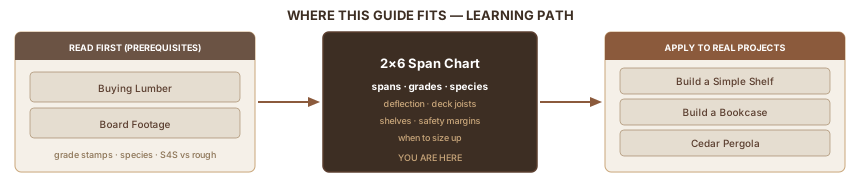
Before using this guide:
If you're new to lumber grades and species, read Buying Lumber first — it covers what grade stamps mean, how to evaluate lumber at the yard, and S4S vs. rough stock. For understanding how to calculate how much lumber a project needs, see Board Footage.
Apply this data to a real project:
- Build a Simple Shelf — shelf span data in a complete first project
- Build a Bookcase — span and material selection for a full casework project
- Cedar Pergola — outdoor framing using the same span principles
Related reference:
- Hardwood Species Guide — species properties including stiffness, hardness, and workability beyond span
- Hardwood Expansion Rate Reference — wood movement data by species
Sources
Span data and load assumptions in this guide come from code-referenced structural engineering sources and woodworking tools verified against published tables.
- AWC Tutorial for Understanding Loads and Using Span Tables — load assumptions, safety factors, how to read span tables
- AWC Span Options Calculator — official free calculator for custom span conditions
- Southern Forest Products Association: Joists & Rafters Span Tables — Southern Pine grade-by-grade span data
- SFPA Maximum Spans Southern Pine — official SFPA span tables PDF
- mycarpentry.com Joist Span Table — 4-species, #2 grade, interactive span table
- Sagulator — WoodBin — shelf sag calculator (input species, load, span)
- WoodBin Shelf Design Reference — sag targets and shelf span guidance
- Fine Homebuilding: What Does L/360 Deflection Mean? — plain-language deflection explanation
- JLC Online: Right-Sizing Deck Joists — 2021 IRC deck joist analysis
- Fine Homebuilding: How Far Can a Deck Joist Span? — deck joist span chart
- decks.com: Deck Joist Sizing and Spacing — deck joist practical guide
- Anthony Forest: Maximum Span Comparisons by Species — species stiffness and span comparison
Up Next
How to Buy Lumber by the Board Foot
WOOD & MATERIALS · Beginner