
Black Walnut Price at a Glance
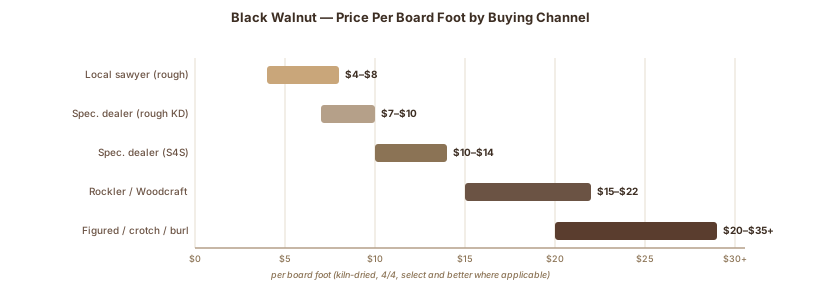
Kiln-dried 4/4 black walnut from a specialty hardwood dealer runs $10–$13 per board foot. Rockler and Woodcraft charge $15–$22 per board foot — that's the convenience premium for S4S lumber sold by the piece. A local sawyer in the Midwest sells rough walnut for $4–$8 per board foot, but that lumber usually isn't kiln-dried.
| Specialty dealer (4/4 KD, Select & Better) | $10–$13/bf |
| Rockler / Woodcraft (S4S, by the piece) | $15–$22/bf |
| Local sawyer (rough, Midwest) | $4–$8/bf |
| Figured / curly / crotch walnut | $20–$35+/bf |
| Live-edge slabs | $15–$35+/bf (by piece or bf equivalent) |
In this guide:
- Current prices by grade and surfacing
- Where to buy — five channels compared
- How to tell if a price is fair
- Live-edge slab pricing
- Why walnut costs more than oak or cherry
Part 1: Black Walnut Prices by Grade and Surfacing
Grade and surfacing are the two biggest variables in walnut pricing. Together they can swing the price by $10 per board foot on the same species.
Prices by Format
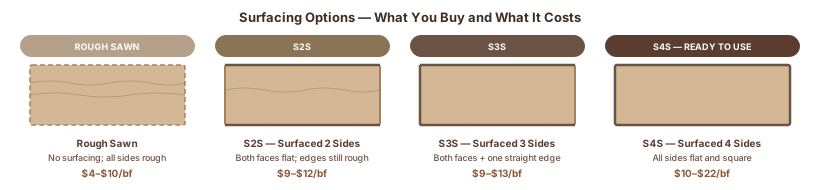
| Format | Typical Price Range | Notes |
|---|---|---|
| Rough sawn — local sawyer | $4–$8/bf | Often air-dried or green; needs a planer |
| Rough sawn — specialty dealer | $7–$10/bf | Kiln-dried; still needs surfacing |
| S2S (surfaced 2 sides) | $9–$12/bf | Both faces flat; rip to final width yourself |
| S4S — specialty dealer | $10–$14/bf | All four sides square; ready to use |
| S4S — Rockler, Woodcraft | $15–$22/bf | Retail premium; convenient for small projects |
| Figured (curly, crotch, burl) | $20–$35+/bf | Sold by the piece; price reflects uniqueness |
Own a thickness planer? Buy rough or S2S. You'll pay $3–$5 less per board foot and choose your final thickness. No planer? S4S is worth the premium — cut and glue immediately without milling.
Prices by Grade
According to McIlvain Lumber's walnut grading guide, walnut's FAS grade only requires 67% clear wood — compared to 83% for most other hardwoods. Walnut trees branch lower to the ground than other species, creating more natural knots. So even top-grade walnut has more character than top-grade maple or cherry.
| Grade | Min. Clear Wood | Typical Price (4/4 KD) | Best For |
|---|---|---|---|
| FAS (First and Seconds) | 67%+ | $12–$18/bf | Wide tabletops, matched panels |
| Select & Better | Same as FAS, one face | $10–$14/bf | Most furniture projects |
| #1 Common | 66.7% clear | $7–$10/bf | Smaller parts, character marks acceptable |
| #2 Common | 50% clear | $5–$8/bf | Small components, hobby use |
For most furniture, Select & Better is the right grade. FAS is overkill unless you're making grain-matched panels where every board foot must be clear. #1 Common works well for projects where knots and mineral streaks add character rather than create waste.
See Black Walnut Lumber for a full explanation of grades and what they mean for your project.
How Black Walnut Compares to Other Species
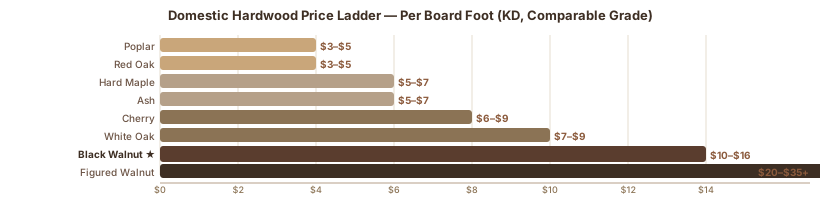
Walnut is the most expensive common domestic hardwood. These ranges are for kiln-dried lumber at comparable grade.
| Species | Price Range (per BF) | vs. Black Walnut |
|---|---|---|
| Poplar | $3–$5 | 60–80% cheaper |
| Red oak | $3–$5 | 60–80% cheaper |
| Hard maple | $5–$7 | 40–60% cheaper |
| Ash | $5–$7 | 40–60% cheaper |
| Cherry | $6–$9 | 25–50% cheaper |
| White oak | $7–$9 | 20–40% cheaper |
| Black walnut | $10–$16 | — |
| Figured walnut | $20–$35+ | 2–3× more |
Cherry and white oak are the closest premium alternatives at a lower price point. Cherry gives you a warm reddish-brown that deepens over time. White oak has pronounced ray fleck and handles darker stains well. Neither gives you walnut's natural chocolate-brown color without staining.
Part 2: Where to Buy Black Walnut
Your best deal depends on three things: your tools, your project scale, and where you live.
Channel Comparison
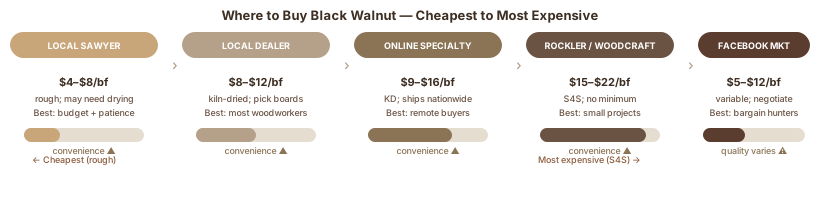
| Source | Price Range | Pros | Cons |
|---|---|---|---|
| Local sawyer | $4–$8/bf rough | Cheapest; possible relationship | Often green; no surfacing; local species only |
| Local hardwood dealer | $8–$12/bf | Pick your boards; expert staff; can custom-mill | Varies widely; smaller cities may have few options |
| Online specialty retailer | $9–$16/bf + shipping | Consistent quality; full grade selection; ships nationwide | Can't hand-select boards; shipping adds cost |
| Rockler / Woodcraft | $15–$22/bf S4S | Convenient; small quantities; no milling needed | Most expensive per BF; limited selection |
| Facebook Marketplace / Craigslist | $5–$12/bf | Can find bargains; local | Inconsistent quality; unknown drying; no grade guarantee |
Online Retailers
These retailers carry black walnut and ship nationwide. Pricing data from 2025–2026.
Woodworkers Source — Reliable kiln-dried walnut in 4/4, 5/4, 6/4, and 8/4. S2S is their standard. Good for orders over 20 board feet where shipping pencils out.
Wood Vendors — Northern Midwest-sourced walnut starting around $8.20/bf. Good for rough or lightly surfaced stock if you have a planer.
Hearne Hardwoods — Premium specialty dealer in Pennsylvania. Stocks both steamed and unsteamed walnut. Worth it for figured stock or if you want to hand-pick exceptional boards.
Rockler — $17–$22/bf for S4S walnut by the piece. Use this when you need one board for a small project and don't want to calculate shipping.
Woodcraft — Similar to Rockler. S4S, $15–$18/bf, sold in standard dimensions.
Finding a Local Hardwood Dealer
Search "[your city] hardwood lumber" — look for specialty hardwood dealers, not big-box stores. Home Depot and Lowe's don't carry walnut consistently.
Black walnut grows in the eastern US. Missouri, Indiana, Ohio, Illinois, Kentucky, Tennessee, and Pennsylvania have the most local supply and the lowest prices. Ohio Timber Works notes that buyers in walnut's native range pay less at every step in the supply chain. On the West Coast, plan on adding $2–$5/bf to any online order for shipping.
To calculate how many board feet a project needs, use the formula: (thickness × width × length) ÷ 12, where thickness and width are in inches and length is in feet. See How to Calculate Board Feet for worked examples.
Part 3: Is This Price Fair?
You see a listing for walnut on Facebook Marketplace or at an unfamiliar lumber yard. Here's how to evaluate it.
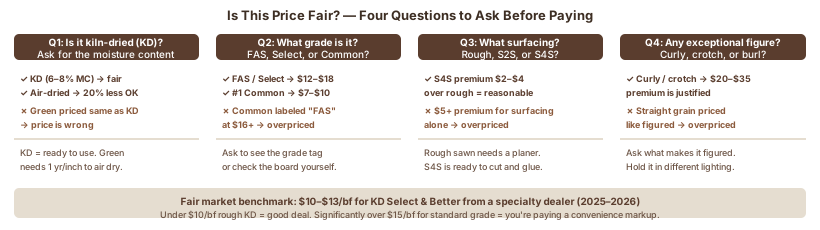
The market benchmark: Hearne Hardwoods' current price list puts 4/4 select and better walnut in the $10–$14/bf range. Woodshop News reported in early 2026 that the market is stable. Under $10/bf for rough kiln-dried walnut is a good deal. $12–$15/bf for surfaced Select & Better is fair market. Significantly above that and you're paying a retail markup or a figure premium.
Four questions before paying:
-
Is it kiln-dried? Green or air-dried lumber needs 20–30% less than KD prices. If a seller prices green walnut the same as kiln-dried, the price is wrong.
-
What grade? "Select & Better" and "FAS" are worth $10–$14/bf. "#1 Common" with knots should be $7–$10/bf. A listing calling #1 Common "premium quality" at $16/bf is stretching the truth.
-
What surfacing? Rough sawn is cheapest. S4S adds $2–$4/bf in legitimate processing cost. More than $5/bf premium for surfacing alone is high.
-
Does it have exceptional figure? Curly grain, crotch figure, or burl warrants a premium. Straight grain on a standard board does not.
Deals worth finding:
- Shorts — boards under 6–8 feet sell at 20–30% off. If your project has shorter parts (chair legs, drawer fronts, box sides), ask specifically for shorts.
- Odd-lot boards — specialty dealers occasionally sell boards outside their standard stock (unusual widths, mixed grades) at reduced rates.
- Local sawyers in the Midwest — someone who milled walnut from a tree on their property often prices at $4–$6/bf for rough air-dried. With a planer and patience, this is the best value available.
Red flags:
- #1 Common lumber labeled as "FAS quality" and priced accordingly
- Green lumber priced the same as kiln-dried
- Live-edge slabs over $40/bf equivalent without exceptional figure or rare width
- "Walnut" that lacks the characteristic chocolate heartwood — ask to see the end grain
Part 4: Live-Edge Slab Pricing
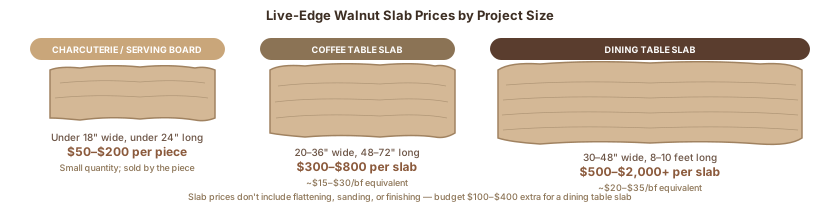
Slab pricing works differently from dimensional lumber. Most dealers sell slabs by the piece, not by the board foot, and prices reflect uniqueness as much as volume.
Slab Prices by Project Size
| Project | Typical Slab Dimensions | Price Range |
|---|---|---|
| Charcuterie / serving board | Under 18" wide, under 24" long | $50–$200 per piece |
| Coffee table | 20–36" wide, 48–72" long | $300–$800 per slab |
| Dining table | 30–48" wide, 96–120" long | $500–$2,000+ per slab |
| Exceptional figured slab | Wide, thick, rare grain | $2,000–$10,000+ per piece |
As a board-foot equivalent, most walnut slabs work out to $15–$35/bf. Bulk rough slabs from wholesale dealers come in closer to $7/bf when bought in 50-board-foot lots.
What the slab price doesn't include: Flattening, sanding, and finishing. A dining table slab needs a router sled or wide drum sander to flatten, plus several finish coats. Budget $100–$400 extra for this work if you're paying someone else to do it. If you're doing it yourself, budget your time.
Steamed vs. unsteamed: Most commercial walnut is steamed after kiln drying. Steaming darkens the pale sapwood to match the heartwood, creating a more uniform color. Unsteamed walnut has richer heartwood tones — chocolate brown to purplish — but sharp contrast between heartwood and sapwood. Specialty dealers like Hearne Hardwoods stock both. For most slab projects, steamed is fine.
Part 5: Why Black Walnut Costs What It Does
Black walnut (Juglans nigra) grows in the eastern US, concentrated in the Ohio River Basin — Indiana, Ohio, Missouri, Kentucky. The USDA Forest Service Silvics Manual traces its commercial range and growth habit. It's been commercially harvested for over a century, and that history matters.
Old-growth walnut grew tall with long, clear trunks. Modern walnut trees branch lower, creating more knots and less clear lumber per tree. The grading standards relaxed in response — which is why walnut's FAS grade allows boards with less clear wood than other species.
Export demand compounds the supply constraint. European and Asian markets prize American black walnut for custom furniture, gunstocks, and luxury veneer. That competition keeps domestic prices elevated.
Grade Timber's 2025 Illinois market analysis found that medium-quality walnut logs rose over 50% in value from 2023 to 2024, then stabilized. Prices remain at historically high levels. They're not coming down significantly — the supply constraints are structural.
If you're on the West Coast, the math often pushes toward cherry or white oak as practical alternatives. Both give you a premium domestic hardwood at a lower per-board-foot cost, with shipping that doesn't penalize distance from the growing region.
Sources
Pricing data sourced from specialty hardwood retailers, industry publications, and woodworker communities. Prices are from 2025–2026 and reflect standard kiln-dried dimensional lumber unless noted.
- Hearne Hardwoods walnut pricing — pricing benchmark for Select & Better and premium grades
- Hearne Hardwoods price list — current multi-species price list
- Woodshop News — black walnut market update — February 2026 market stability report
- McIlvain Lumber — walnut grades explained — FAS 67% clear rule for walnut
- Wood Vendors — walnut lumber — Northern Midwest sourcing and pricing
- Woodworkers Source — walnut lumber — S2S product range and pricing
- Ohio Timber Works — black walnut overview — regional availability and pricing context
- Grade Timber — Illinois 2025 walnut market — price trends and market stabilization data
- WunderWoods — kiln-dried vs. steamed walnut — steaming process and color effect
- Walnut Outlet — grading guide — grade definitions and pricing impact
Wood Species
Up Next
What Is Ambrosia Maple?
WOOD & MATERIALS · Beginner