
2x4 Calculator at a Glance
Buy short and you're making another store trip. Buy long and you're spending $30–$50 on boards that end up behind the garage. The formulas below cover three common 2x4 use cases: wall studs, deck surface boards, and shelving. Worked examples let you map the math directly to your project.
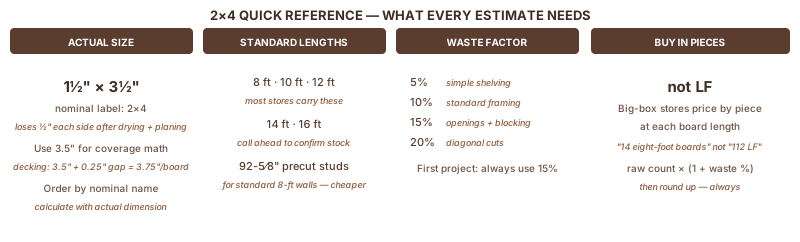
| Actual 2x4 size | 1-1/2" × 3-1/2" (not 2" × 4") |
| Standard lengths | 8', 10', 12', 14', 16' (precut studs: 92-5/8") |
| Joist/rafter formula | (span in inches ÷ spacing) + 1 |
| Wall stud formula | (wall in inches ÷ 16) + 1 + corner studs |
| Wall plates | wall length × 3 = total linear feet |
| Standard waste | 10% framing, 5% simple shelving, 15% first project |
In this guide:
- The three formulas you actually need
- How much to add for waste
- Three worked examples: shelving, wall, deck
- What to check before you go to the store
Part 1: Getting the Number Right
Two store trips cost more than two extra boards. But over-ordering on a 100-board project wastes $50–$100 and leaves you stacking lumber you'll never use. Getting the count right saves money either way.
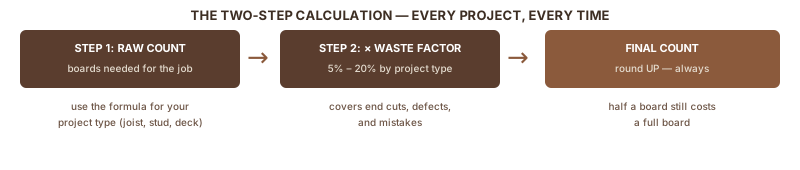
The calculation is two steps: count the boards you need for the job, then add a waste factor to cover end cuts, defects, and mistakes.
You don't need an app. The formulas work on a notepad.
At big-box stores, 2x4s are priced by the piece at each length. Estimate in piece count: "how many 8-foot boards." Not linear feet, not board feet. That's how the store sells them, and it's how you should plan.
Part 2: What a 2x4 Actually Measures
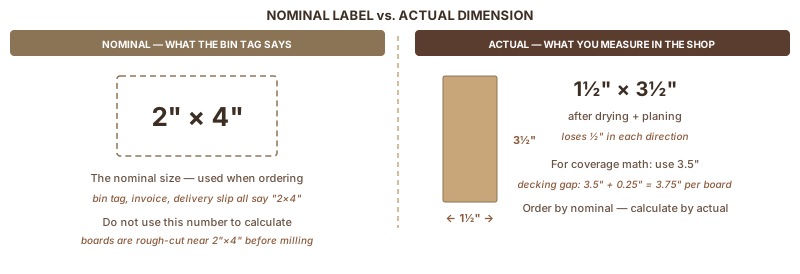
Every 2x4 has two sizes: the name on the label (nominal) and the actual dimension after kiln-drying and planing. Family Handyman's lumber dimensions guide confirms the actual size is 1-1/2" wide by 3-1/2" deep. The board starts rough-cut near 2"×4", loses material as it dries, then loses more as it gets surfaced smooth. By the time it hits the store, you've lost half an inch in each dimension.
This matters most for decking and shelving calculations, where boards lay side by side. Use 3.5" as your coverage width, not 4". Use the nominal name when ordering; use the actual dimension when calculating.
Standard lengths at most hardware stores: 8', 10', 12', 14', 16'. Precut studs (92-5/8") come in the stud bin next to dimensional lumber — they're cut specifically for 8-foot wall construction and slightly cheaper than cutting 8-footers yourself. Before you plan around 14' or 16' boards, call ahead. Not every store stocks them.
For a full dimensional table covering every lumber size from 1×2 to 6×6, see Nominal Wood Sizes.
Part 3: The Three Formulas You Actually Need
Joists and rafters (boards spaced at intervals)
Use this when boards are spaced at regular intervals — deck joists, floor joists, ceiling joists, roof rafters.
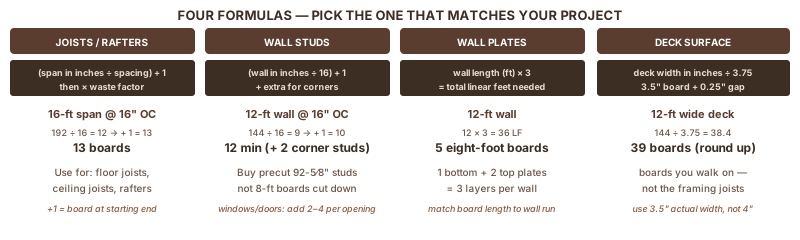
Number of boards = (span length in inches ÷ spacing in inches) + 1
The "+1" accounts for the board at the starting end of the run.
16-foot span at 16" on center:
- 16 ft × 12 = 192 inches
- 192 ÷ 16 = 12
- 12 + 1 = 13 boards
12-foot span at 24" on center:
- 12 ft × 12 = 144 inches
- 144 ÷ 24 = 6
- 6 + 1 = 7 boards
One note: deck framing (joists and beams) typically uses 2x6, 2x8, or 2x10 lumber because of span requirements. Decks.com's joist span calculator shows the maximum spans for each size. 2x4s work for spans under about 6 feet and are the standard choice for deck surface boards (the boards you walk on).
Wall studs
Studs = (wall length in inches ÷ 16) + 1 + extra for corners
12-foot wall at 16" OC:
- 144 ÷ 16 = 9
- 9 + 1 = 10 field studs
- Add 2 corner studs = 12 studs minimum
For 24" OC (non-load-bearing partitions or some engineered designs), per BuildCalculate's wall framing guide:
- 144 ÷ 24 = 6
- 6 + 1 = 7 field studs + corners
Buy precut 92-5/8" studs from the stud section. They're precision-cut for standard wall height and cheaper than cutting 8-footers. Don't cut your own unless you have no other option.
For walls with windows or doors, add 2–4 studs per opening for headers, king studs, and trimmers.
Wall plates
Standard framing uses 3 layers of plate per wall: one bottom plate and a double top plate. I AM Builders' framing quantity guide confirms this is standard across residential construction. Multiply wall length by 3.
Total plate lumber = wall length (ft) × 3
12-foot wall:
- 12 × 3 = 36 linear feet
- From 8-foot boards: 36 ÷ 8 = 4.5 → 5 boards
Buy plate lumber in the same length as your wall run to minimize joints. If your wall is 12 feet and you use 12-foot boards, two boards cover one layer with no joint.
Decking surface boards
When 2x4s run across a deck as the walking surface:
Number of boards = deck width in inches ÷ 3.75"
Use 3.75" per board: 3.5" actual width + 0.25" gap. Decks.com's decking calculator confirms this standard gap.
12-foot-wide deck:
- 12 ft × 12 = 144 inches
- 144 ÷ 3.75 = 38.4 → 39 boards at whatever length your deck runs
Formula Quick Reference
| Use this for | Formula | 12-ft example |
|---|---|---|
| Joists/rafters at 16" OC | (span in" ÷ 16) + 1 | 16-ft span = 13 |
| Wall studs at 16" OC | (wall in" ÷ 16) + 1 + corners | 12-ft wall = 12 min |
| Wall plates | wall LF × 3 = total LF | 12-ft wall = 36 LF = 5 boards |
| Deck surface boards | deck width in" ÷ 3.75 | 12-ft wide = 39 boards |
If you're buying from a hardwood dealer rather than a big-box store, you'll work in board feet instead — How to Calculate Board Feet covers that conversion.
Part 4: How Much to Add for Waste
Every estimate needs a waste factor. End cuts waste the first and last inch of every board. One board in twelve has a knot or check in a spot that forces you to work around it. Mistakes happen. Add the factor, round up to whole boards, and you'll have what you need.
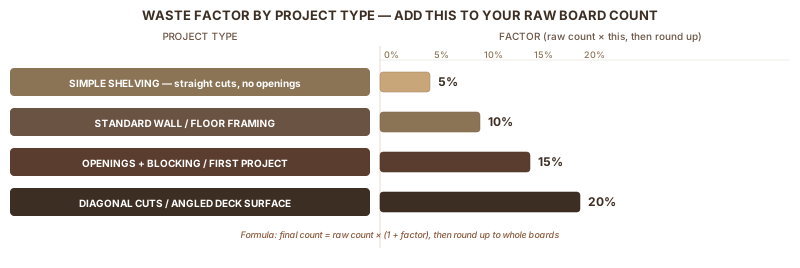
| Project type | Waste factor | Use when |
|---|---|---|
| Simple shelving, straight cuts | 5% | Experienced builder, no complex cuts |
| Standard wall or floor framing | 10% | Normal framing, few openings |
| Framing with openings and blocking | 15% | Several windows/doors, cripple studs |
| Diagonal cuts or angled decking | 20% | Angled deck surface, hip rafters |
| Your first project | 15% | Any project — more margin, less stress |
According to Janss Lumber's waste factor guidance, 10% is the industry standard for normal framing conditions, with 15% recommended when the wall has several openings or lots of short blocking pieces.
How to apply it:
Final count = raw board count × (1 + waste factor), rounded up
13 joists × 1.10 = 14.3 → 15 joists
Always round up. Half a board still costs a full board, and running short costs more in time than the extra wood costs in money.
For a first project: use 15% no matter what. The difference between 10% and 15% on a 20-board project is 1 extra board. The second store trip costs that much in gas.
Part 5: Three Worked Examples
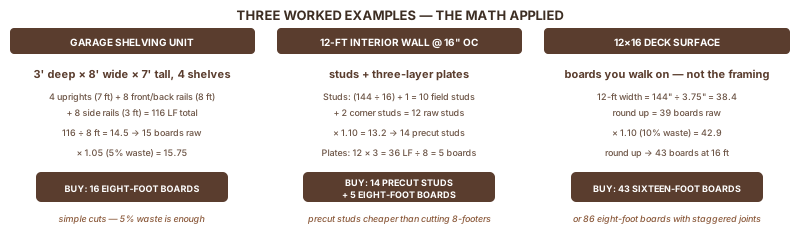
Garage shelving unit (3' deep × 8' wide × 7' tall, 4 shelf levels)
You need: 16 eight-foot 2x4s.
| Piece | Count | Each | Total LF |
|---|---|---|---|
| Vertical uprights | 4 | 7 ft | 28 LF |
| Front/back shelf rails | 8 | 8 ft | 64 LF |
| Side shelf rails | 8 | 3 ft | 24 LF |
| Total | 116 LF |
116 LF ÷ 8 ft = 14.5 → 15 boards before waste Add 5% (simple cuts): 15 × 1.05 = 15.75 → 16 boards
For project plans and finishing ideas for this type of unit, see 2x4 Woodworking Projects.
12-foot interior wall at 16" OC
You need: 14 precut studs + 5 eight-foot boards for plates.
Studs:
- (144 ÷ 16) + 1 = 10 field studs
- Add 2 corner studs = 12 studs
- Add 10% waste: 12 × 1.10 = 13.2 → 14 precut studs (92-5/8")
Plates:
- 12 ft × 3 = 36 LF
- 36 ÷ 8 = 4.5 → 5 eight-foot boards
Note: buy precut studs for this, not 8-foot boards cut to length. They're cheaper and already at the right height.
12×16 deck surface boards
You need: 43 boards at 16 feet.
- 144 inches (12' deck width) ÷ 3.75" per board = 38.4 → 39 boards
- Add 10% waste: 39 × 1.10 = 42.9 → 43 boards at 16 feet
If your vehicle won't carry 16-foot lumber, use 8-foot boards with staggered joints landing over joists. You'd need 43 × 2 = 86 eight-foot boards.
According to LumberCalculators' 12×16 deck guide, staggered joints over joists maintain structural integrity without needing longer boards.
Part 6: Before You Go to the Store
Stewart Lumber's estimating guide puts it plainly: heading to the store without a list is the most expensive mistake a DIYer makes.
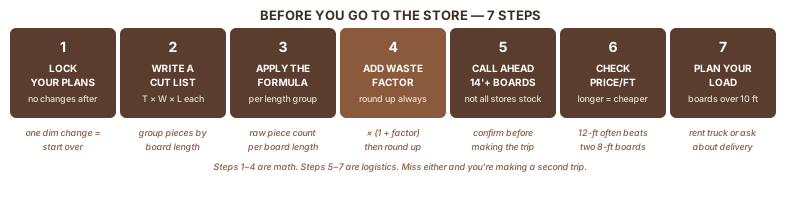
- Lock your plans. No changes after you calculate. A single dimension change means starting over.
- Write a cut list. Every piece: thickness × width × length. Group by board length.
- Apply the formula to each group. Get a raw piece count per length.
- Add your waste factor. Round up.
- Call ahead if you need 14' or 16' boards. Not all stores keep them in stock.
- Check if a longer board costs less per foot. A 12-footer is often cheaper per linear foot than two 8-footers.
- Plan your load. Boards over 10 feet won't fit in most cars. Rent a truck or ask the store about delivery.
When you're at the store picking boards, see Buying Lumber for how to check for twist, bow, and moisture problems.
Where This Fits
This calculator is the second stop in the 2x4 learning path. Read Nominal Wood Sizes first if you don't already know that a 2x4 actually measures 1½" by 3½" — every formula on this page depends on the actual dimension, not the nominal one. After you've used this guide to build a material list, 2x4 Woodworking Projects gives eight specific builds — sawhorses, workbenches, platform beds, garage shelving — with cut lists you can drop straight into the formulas above. If you ever buy from a hardwood dealer instead of a big-box store, switch to the Board Feet calculator, which uses volume instead of piece count.
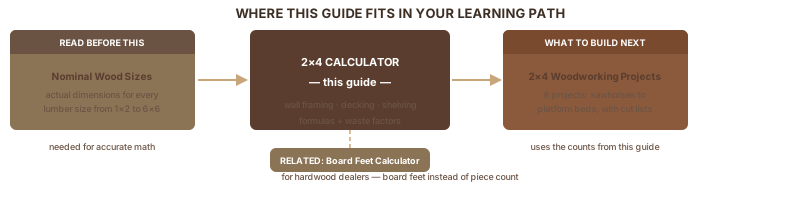
Before this: Nominal Wood Sizes — the actual dimensions for every common lumber size, not just 2x4s.
Related: How to Calculate Board Feet — if you're buying from a hardwood dealer instead of a big-box store, you'll need this unit instead.
What to build: 2x4 Woodworking Projects — eight specific projects from sawhorses to platform beds, with material lists.
FAQ
Why do I round up to whole boards instead of buying the exact count?
Big-box stores sell 2x4s by the piece, not by the linear foot. Half a board still costs the price of a whole 8-foot 2x4 — typically $4–$7. Rounding up means you have spare material if you mis-cut, and the 5–15% waste factor already accounts for end-cut losses. Lumber dealers will sometimes sell precise board-feet for hardwood, but for dimensional softwood lumber at Home Depot or Lowe's, always count whole pieces.
What's the actual dimension of a 2x4?
A 2x4 actually measures 1½ inches by 3½ inches. The nominal "2x4" name refers to the rough dimensions of the green board before drying and surfacing. The mill loses ½ inch on each width and depth direction during the planing process. This is critical for your math — use 3.5 inches as the actual width when calculating deck-board coverage or stud-to-stud framing.
How much waste should I add to a 2x4 estimate?
Use 5% for simple shelving, 10% for standard wall framing, and 15% for first projects or jobs with lots of openings (windows, doors, alcoves). For diagonal cuts (rafters, stair stringers), use 20% — angle cuts waste more material than straight ones. If you're a beginner regardless of project type, default to 15%. The cost of an extra board is much less than a return trip to the store.
Can I substitute 2x4 for 2x6 in floor joists or rafters?
Almost never. Span tables published by the IRC (International Residential Code) and Decks.com show that 2x4 maxes out at roughly 6-foot spans for most joist applications. 2x6, 2x8, and 2x10 are the standard floor and rafter sizes for residential framing. 2x4 works for short structural runs (interior wall studs, deck surface boards) but not for spanning joist or rafter loads.
Are precut studs really cheaper than 8-foot boards?
Yes. Precut studs measure 92-5/8 inches — exactly the right length for a standard 8-foot finished wall once you account for the bottom plate and double top plate. Home Depot and Lowe's price them around 10–15% below the equivalent 8-foot 2x4. They're also straighter on average because they're milled in higher volumes for the framing trade. Don't cut your own from 8-footers unless your stud length is non-standard.
Sources
This guide draws on construction framing references, lumber dealer estimating guides, and deck-building resources.
- Family Handyman — Nominal vs. Actual Lumber Dimensions — explains the nominal/actual gap for all standard lumber sizes
- Decks.com — Joist Span Calculator — span limits by joist size and spacing
- Decks.com — Decking Calculator — deck board quantity and gap standards
- Janss Lumber — Adding Waste Factors — waste percentages by project type
- I AM Builders — Lumber Quantities for Residential Framing — professional framing estimating methodology
- BuildCalculate — Wall Framing Stud Spacing — 16" vs 24" OC stud spacing guide
- Stewart Lumber — Estimating Tips — common DIY estimation mistakes
- LumberCalculators — 12×16 Deck — deck-specific material example
Up Next
2x4 Woodworking: Projects, Dimensions & Building Guide
WOOD & MATERIALS · Beginner