
Acacia Wood at a Glance
Acacia is a genus of more than 1,300 species sold under a single trade label, not a single wood — what you actually buy varies by retailer and country of origin. The dominant variety in US lumberyards is plantation-grown A. mangium from Vietnam, with a Janka hardness of 1,430 lbf — harder than red oak (1,290 lbf) and cheaper than walnut. Two boards labeled "acacia" at the same store can be entirely different species with different hardness, color, and machining behavior, so confirm the species before you commit your tools and finishes.
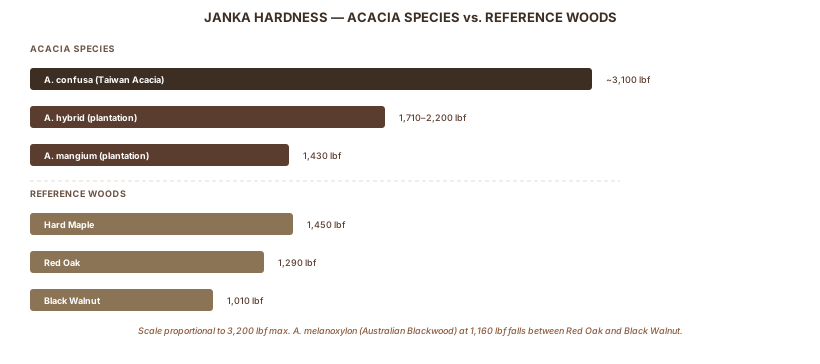
| Janka hardness | 1,430–2,200 lbf depending on species (red oak: 1,290). Full species comparison → |
| Density | 35–42 lbs/ft³ (lighter than red oak at 45 lbs/ft³) |
| Origin | SE Asian plantations, mostly Vietnam; 5–10 year harvest cycles |
| Price range | $5–6/bf consumer grade; $11–16/bf specialty (Australian Blackwood) |
| Best for | Cutting boards, outdoor furniture, butcher block countertops, workbench surfaces |
| Watch out for | Interlocked grain tearout, species inconsistency, stain blotching, short board lengths |
In this guide:
- What species you're actually buying and why it matters
- How acacia compares to oak and walnut for furniture projects
- Finishing acacia without blotching or adhesion problems
- Where to buy acacia and what forms are available
Part 1: What You're Actually Buying
Here's the problem nobody tells you at the lumber yard: "acacia" isn't a species. It's a genus containing over 1,300 species. Calling something "acacia" is like calling it "oak" without specifying whether you mean red oak, white oak, or live oak. Except with acacia, the variation is worse. Janka hardness ranges from 1,160 lbf to over 3,100 lbf across commercially sold species.
A World Resources Institute study found 62% of wood products in the US carry inaccurate species labels. Acacia is one of the worst offenders. Retailers almost never specify which species you're getting.
Three market streams
What you're buying depends entirely on where you're shopping.
Asian plantation acacia is the mass-market material. It shows up as butcher block countertops at Home Depot, hardwood flooring at Lumber Liquidators, and pre-made furniture at IKEA. The dominant species:
- A. mangium — Janka 1,430 lbf. Golden-brown heartwood. The workhorse of Vietnamese plantation forestry.
- A. auriculiformis and the mangium-auriculiformis hybrid — Janka 1,710–2,200 lbf. Harder, denser. What most retail spec sheets are actually describing when they cite "acacia hardness."
- A. confusa (Taiwan Acacia) — Janka ~3,100 lbf. Extremely hard. Found in some flooring products. Hardwood Floors Magazine calls it "small-leaf acacia."
Australian Blackwood (A. melanoxylon) is sold through specialty dealers like Bell Forest Products and Rare Woods USA at $11–16 per board foot. It's a different wood in every practical sense. Janka 1,160 lbf (actually softer than red oak). Golden to reddish-brown with frequent curly and fiddleback figure. Prized for fine furniture and musical instruments. This is what you get when you buy "acacia" from a specialty lumber dealer.
Hawaiian Koa (A. koa) is the luxury end. $30–150+ per board foot. Strikingly figured, endemic to Hawaii, and used for ukuleles and high-end guitars. Functionally a different market entirely.
The species confusion matters
Two boards from the same big-box bin can be A. mangium (1,430 lbf) and A. confusa (3,100 lbf). Your tool setup for one won't work for the other. Your stain will absorb differently. Your joints will behave differently. Treat any unlabeled "acacia" purchase as an unidentified species until you can confirm what you have.
Monkey pod (Samanea saman) also gets sold as "acacia" despite being a different genus. Common in live-edge slabs. If you're buying a slab labeled "acacia," ask the dealer for the species.
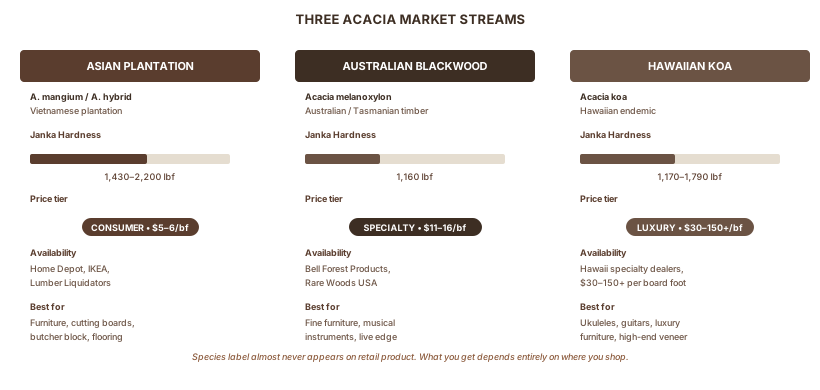
| Species | Janka (lbf) | Color | Typical source | Price tier |
|---|---|---|---|---|
| A. mangium | 1,430 | Golden-brown | Vietnamese plantation | Consumer ($5–6/bf) |
| A. hybrid | 1,750–2,200 | Golden to reddish-brown | Vietnamese plantation | Consumer |
| A. confusa | ~3,100 | Dark reddish-brown | Taiwan, Philippines | Consumer (flooring) |
| A. melanoxylon | 1,160 | Golden-brown, often figured | Australia, Tasmania | Specialty ($11–16/bf) |
| A. koa | 1,170–1,790 | Golden to reddish-brown, highly figured | Hawaii | Luxury ($30–150+/bf) |
Part 2: Properties That Matter for Furniture Makers
Acacia Wood Janka Hardness
Acacia wood (A. mangium, the dominant variety in US lumberyards) rates 1,430 lbf on the Janka hardness scale, placing it harder than red oak (1,290 lbf) and slightly softer than hard maple (1,450 lbf). Hardness varies significantly by species — from 1,160 lbf for some plantation varieties to 3,100 lbf for Australian blackwood. Always confirm species before specifying acacia for high-wear applications.
Hardness and strength
Plantation acacia (A. mangium) has a Janka hardness of 1,430 lbf. That's harder than red oak (1,290) and close to hard maple (1,450). The hybrid and A. auriculiformis run 1,710–2,200 lbf, which is harder than hard maple and approaching hickory (1,820).
Bending strength (MOR) is about 14,230 psi per the Wood Database, on par with red oak. Stiffness (MOE) is lower at 1,605,000 psi versus red oak's 1,820,000 psi. In practice: acacia deflects a bit more under load than oak at the same dimensions. For a shelf or table top, size your pieces the same as you would for oak and you'll be fine.
One surprise: plantation acacia is lighter than you'd expect. At 35–42 lbs/ft³, it weighs less than red oak (45 lbs/ft³) or hard maple (44 lbs/ft³). Fast plantation growth produces wider rings and lower-density wood compared to old-growth specimens.
Dimensional stability
Acacia mangium shrinks 3.1% radially and 6.7% tangentially (green to oven-dry), with a T/R ratio (tangential-to-radial shrinkage) of 2.1. Lower is more stable; hard maple is also 2.1. The absolute shrinkage values are actually favorable compared to red oak (4.0% radial, 8.6% tangential).
But the numbers don't tell the whole story. Plantation-grown acacia is prone to cupping and warping. Variable density from fast growth means one part of a board moves differently than another. Keep indoor acacia furniture in climate-controlled rooms at 40–55% relative humidity. In dry winter climates with central heating, surface checking is a real risk.
Appearance
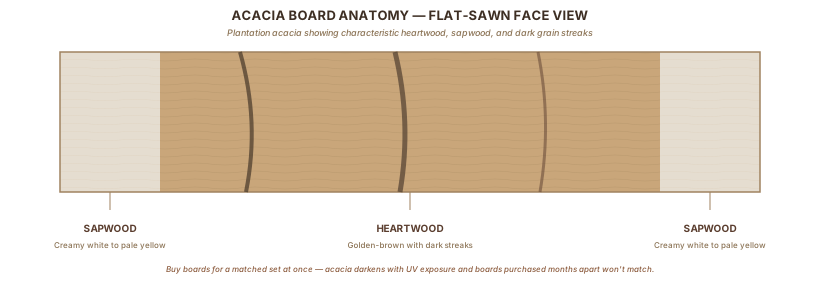
Acacia heartwood ranges from golden-brown to medium reddish-brown, typically with darker chocolate-brown streaks running along the grain. Those streaks are the visual signature of acacia. Sapwood is creamy white to pale yellow, and the contrast between the two is sharp. Plantation trees harvested young (5–10 years) have wide sapwood bands, creating the two-toned look that defines most retail acacia products.
Grain runs straight to interlocked. When interlocked grain is present, quartersawn faces show a ribbon-stripe figure where light and dark bands shift as you move the board. The texture is medium to coarse with visible pores, though finer than ring-porous oak. Natural luster takes oil finishes well.
Acacia darkens over time with UV exposure. Fresh-cut boards start golden-amber and deepen to a richer reddish-brown over months. Boards purchased at different times won't match without aging together. If you're building a matched set, buy all your lumber at once.
Part 3: How Acacia Compares to Oak and Walnut
This is the comparison most furniture makers need. All three woods are readily available, and each has clear strengths.
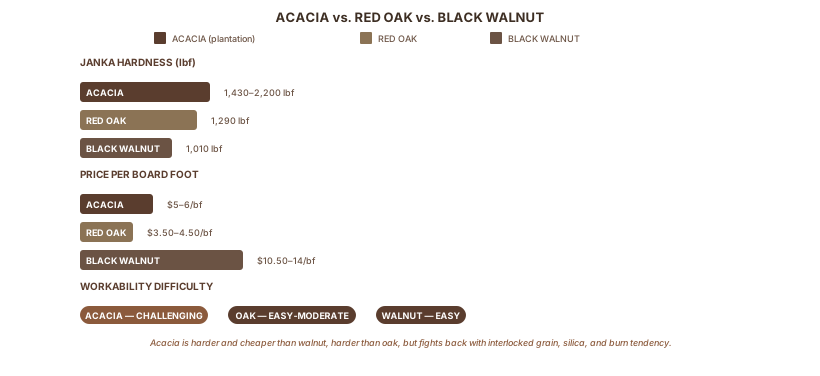
| Factor | Acacia (plantation) | Red Oak | Black Walnut |
|---|---|---|---|
| Janka hardness | 1,430–2,200 lbf | 1,290 lbf | 1,010 lbf |
| Density | 35–42 lbs/ft³ | 45 lbs/ft³ | 38 lbs/ft³ |
| Price | $5–6/bf (consumer) | $3.50–4.50/bf | $10.50–14/bf |
| Board length | Max ~4 ft typical | 8–12 ft common | 6–10 ft common |
| Workability | Challenging (interlocked grain, burns) | Easy to moderate | Easy (forgiving) |
| Staining | Blotches; gel stain recommended | Takes stain predictably | Takes finish beautifully |
| Gluing | Needs acetone wipe or epoxy | Standard PVA works | Standard PVA works |
| Outdoor use | Good (10–20 yr maintained) | Poor | Poor |
When acacia is the better choice
Cutting boards. Acacia's closed grain and hardness resist knife grooves better than oak (open grain harbors bacteria) and walnut (softer). There's a reason acacia dominates the retail cutting board market.
Outdoor furniture. Acacia heartwood has natural decay resistance (Class II durability under European EN 350 standard). It handles weather better than any common domestic hardwood. With oiling every 6–12 months, expect 10–20 years of outdoor service. Still well below teak (50+ years) but at a fraction of the cost.
Budget furniture with visual impact. Plantation acacia delivers an exotic look at near-domestic prices. The dramatic heartwood-sapwood contrast and dark streaking give it visual character that plain oak can't match.
Workbench surfaces. The hardness resists denting. A workbench made from acacia butcher block (sold cheaply at hardware stores) will outperform most softwood tops.
When oak or walnut wins
Long boards. Acacia trees grow more like large shrubs than timber trees. Boards max out around 4 feet, rarely reaching 6. Table aprons, long shelf spans, and benchtop planks require multiple glue-ups. Oak and walnut are available in 8–12 foot lengths.
Predictable machining. Oak machines cleanly with standard tools. Walnut is one of the most forgiving hardwoods for hand tools. Acacia fights you on interlocked grain, burns at slow feed rates, and dulls blades faster.
Staining to a target color. Oak and walnut take stain predictably. Acacia blotches because variable grain density absorbs stain unevenly. If your project depends on a specific color match, use oak or walnut.
Matching sets over time. Oak and walnut color is consistent board to board. Acacia varies between boards, between species, and between heartwood and sapwood. Building a matching dining set from acacia requires careful board selection.
Part 4: Working with Acacia in the Shop
Machining
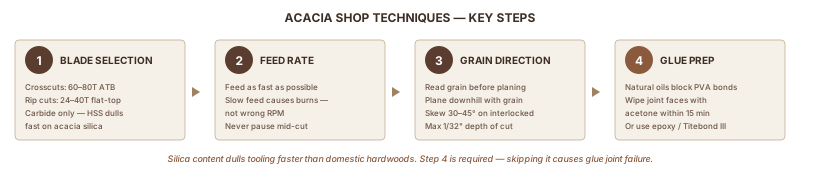
Carbide tooling is required. Acacia contains silica (like teak), which dulls high-speed steel fast. For table saw crosscuts, use a 60–80 tooth ATB blade. For ripping, a 24–40 tooth flat-top or combination blade works.
Burn marks are the most common machining complaint. They're caused by feeding too slowly, not by wrong speed. The wood's density and silica generate more friction than domestic hardwoods. Feed as fast as your tool handles without chatter. Never pause mid-cut on the table saw. Never dwell in one spot with the router.
Interlocked grain is acacia's biggest machining challenge. Read the grain direction on the board edge before planing or routing. Plane "downhill," with the grain diving away from the surface. On interlocked sections, reduce your depth of cut to 1/32 inch. Skew the hand plane 30–45 degrees. Tighten the mouth. Quartersawn stock planes more predictably than flat-sawn.
For routing, use carbide spiral bits at 16,000–18,000 RPM for bits over 1/2 inch diameter. Take a maximum of 1/8 inch per pass. A final cleanup pass at the same setting removes burn marks from the main passes.
Gluing
Like teak and rosewood, acacia's natural oils interfere with PVA adhesive bonds. The standard fix: wipe glue surfaces with acetone immediately before the glue-up, within 15 minutes. The acetone removes surface oil without penetrating deeply. Alternatively, glue immediately after cutting or planing, before oils migrate back to the surface.
For the strongest bond, use epoxy (West System G/flex is made for oily species) or polyurethane glue like Titebond III, which outperforms standard PVA on oily exotics.
Sanding
Start at 120 grit for a well-prepared surface (80 or 100 only if you need to remove mill marks). Progress through 150, 180, and 220. For fine furniture, continue to 320 before finishing.
One tip specific to acacia: use fresh sandpaper for your final grits. The wood's density means it burnishes easily. Dull paper glazes the surface instead of cutting, and a glazed surface rejects finish. If your oil finish isn't penetrating evenly, a burnished surface is likely the cause.
Dust
A 2025 systematic review in the Journal of Occupational and Environmental Hygiene found acacia dust causes skin and respiratory sensitization in less than 10% of exposed workers, lower than many exotics. Standard precautions apply: N95 dust mask, dust collection at the source. Acacia is not classified as a known human carcinogen.
Part 5: Finishing Acacia
Finishing is where acacia trips up most woodworkers. The combination of dense grain and natural oils creates two linked problems: stain won't penetrate evenly, and film finishes can have adhesion issues if you skip surface prep.
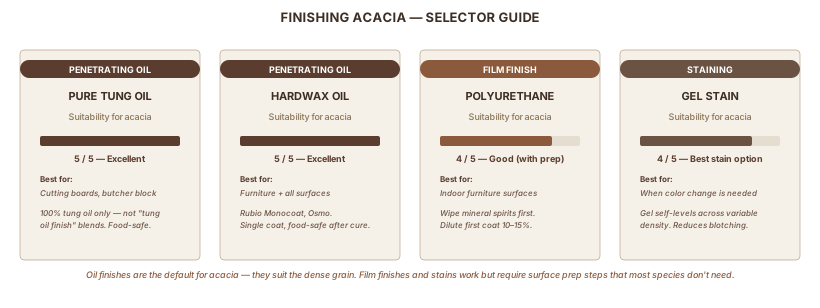
Oil finishes work best
Acacia's density and natural oils make it a strong candidate for penetrating finishes that enhance the grain instead of sitting on top:
Pure tung oil penetrates well and adds a warm golden tint. Food-safe after full cure (72+ hours). Make sure you're buying 100% pure tung oil, not "tung oil finish" products like Minwax Tung Oil Finish, which are thinned varnishes with different properties.
Hardwax oils (Rubio Monocoat, Osmo) are an excellent fit. They penetrate rather than build a film, which suits acacia's dense grain. Single-coat application. Food-safe after cure.
Danish oil works for furniture but is not food-safe due to chemical driers. Boiled linseed oil (BLO) is commonly recommended for outdoor acacia maintenance but is also not food-safe.
Film finishes need prep
Polyurethane works well on acacia when you do the surface prep right. The critical step: wipe the surface with mineral spirits before the first coat to remove surface oils that cause beading or delamination. Dilute the first coat 10–15% for better penetration into the dense grain. Build 3–5 thin coats, sanding lightly at 320 grit between each.
Spar urethane is better than interior poly for outdoor acacia pieces. It's formulated to flex with wood movement, which matters for a species that responds to humidity changes.
For lacquer, seal the bare wood first with dewaxed shellac (1-lb cut). The shellac creates a compatibility layer between the oily wood and the lacquer topcoat.
Staining: proceed with caution
Acacia blotches when stained. Variable grain density absorbs stain unevenly, creating a streaky, splotchy result. If you need to stain acacia, ranked by effectiveness:
- Gel stains. The gel consistency limits penetration depth and self-levels across areas of varying density. Best option.
- Pre-stain wood conditioner. Apply 5–15 minutes before stain. Reduces blotching but doesn't eliminate it.
- Raise the grain first. Sand to 180 grit, mist with water, let dry completely, then re-sand at 180–220 before staining.
- Wipe stain off quickly. One to three minutes of dwell time maximum.
Many woodworkers skip stain entirely and use a clear oil or film finish. Acacia's natural color variation is attractive on its own. See troubleshooting stain problems for more on blotching.
Tannin bleed
Acacia is a high-tannin wood. (Acacia bark is commercially harvested for tannin extraction.) Water-based finishes applied directly to bare wood can activate tannin migration, producing brown or yellowish bleed-through in the topcoat. Prevention: seal bare acacia with dewaxed shellac or an oil-based primer before applying any water-based finish.
Food-safe options for cutting boards
For cutting boards and butcher blocks, in order of recommendation:
- Food-grade mineral oil. Safest, most available. Apply liberally, let absorb, wipe excess. Repeat 3–5 times to season the board.
- Mineral oil plus beeswax blend. More durable surface barrier than oil alone. Most commercial "board cream" products use this formula.
- 100% pure tung oil. Food-safe after full cure. Builds a slightly harder surface than mineral oil. Note: derived from a nut, so allergy risk exists.
Avoid Danish oil, BLO, tung oil varnish, or any finish with solvents or chemical driers on food-contact surfaces. See food-safe finishes for the complete list.
Part 6: Where to Buy Acacia
Available forms
| Form | Where to find it | Price range | Notes |
|---|---|---|---|
| Butcher block countertops | Home Depot, Lumber Liquidators | ~$540 for 12 ft slab | Most available form; species not specified |
| Hardwood flooring | Lumber Liquidators, Home Depot | $3.99–$9.99/sq ft | Solid and engineered; generic "acacia" |
| Specialty lumber | Bell Forest Products, Rare Woods USA | $11.65–$15.50/bf | Australian Blackwood; species identified |
| Turning blanks | Online specialty, Amazon, Etsy | Varies | Sometimes species-identified |
| Live edge slabs | Specialty slab yards | $195–$660+ per slab | Usually Australian Blackwood |
| Pre-made furniture | IKEA, Ashley, Williams-Sonoma | Varies | Vietnamese origin; generic "acacia" |
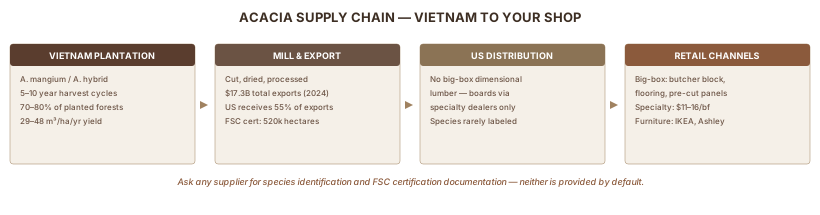
Big-box stores don't carry acacia as dimensional lumber (boards you'd resaw or joint yourself). For that, you need a specialty dealer.
The supply chain story
Vietnam dominates the global acacia market. Acacia covers 70–80% of Vietnam's 3.5 million hectares of planted production forest, per Cosmo Sourcing's analysis. The country's total wood exports hit $17.3 billion in 2024, with the US taking over 55%.
Why acacia is cheap: it reaches harvest in 5–10 years. Vietnamese plantations produce 29–48 cubic meters per hectare per year. European oak manages 4–8. That productivity difference, combined with lower manufacturing costs, explains why an acacia butcher block costs less than a comparable domestic hardwood slab.
About 520,000 hectares (13%) of Vietnam's planted forest are FSC-certified, and 98% of certified timber harvested in Vietnam is acacia. IKEA names Vietnam as an important sourcing market for acacia, specifically for outdoor furniture.
Sustainability is complicated
In favor: acacia is a fast-growing nitrogen-fixing legume that restores soil fertility. FSC certification is available and expanding. Plantations can be established on degraded land.
Against: Vietnam lost 289,762 hectares of natural forest between 2012 and 2022 while acacia plantation area expanded by 1.2 million hectares. Not all new plantations replaced degraded land. Monoculture plantations have minimal biodiversity value. Second-rotation trees show reduced wood quality from disease (Ganoderma root rot).
For buyers: FSC-certified product has better chain-of-custody documentation. Ask suppliers about species and certification.
Part 7: Where Acacia Fits
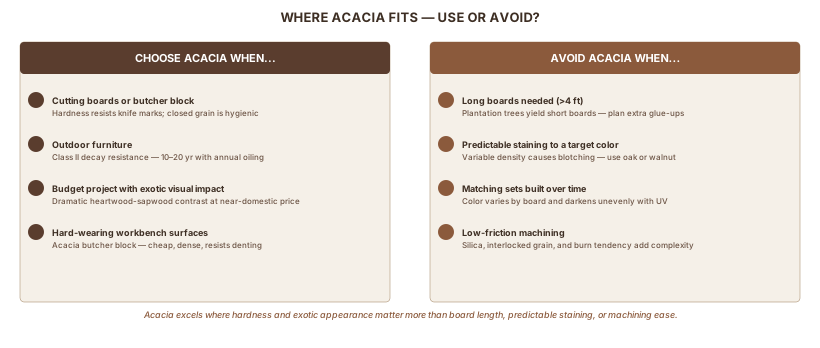
Acacia is a strong choice for cutting boards, outdoor furniture, and projects where you want an exotic look at a domestic price. It's a poor choice when you need long boards, predictable staining, or consistent color matching across a set. If you want a sustainable tropical alternative that's easier to work, better for carving and turning, and doesn't require acetone prep before gluing, see Mango Wood — a byproduct of fruit orchards that shares acacia's price range but has a very different working character.
If you're evaluating wood species for a specific project, our hardwood species guide and wood species quick-reference cover the most common options side by side. For related species profiles, see cherry wood and rubberwood.
For finishing guidance on the specific types mentioned in this guide:
- Understanding Wood Finishes covers the four finish families
- Applying Polyurethane covers film finish application in depth
- Oil and Wax Finishes covers penetrating finish options
- Food-Safe Finishes covers cutting board and kitchen applications
For understanding wood movement and grain behavior:
- Understanding Wood Grain and Movement covers the principles
- Reading Grain Direction covers the practical skill for avoiding tearout
Frequently Asked Questions
What is acacia wood Janka hardness?
The most common acacia in US stores — plantation-grown A. mangium from Vietnam — rates 1,430 lbf on the Janka scale, harder than red oak (1,290 lbf) and just under hard maple (1,450 lbf). Hardness varies widely across the genus: Australian blackwood is 1,160 lbf, the A. mangium-auriculiformis hybrid runs 1,710–2,200 lbf, and Taiwan acacia (A. confusa) reaches roughly 3,100 lbf. Confirm the species before you trust a single hardness number.
Is acacia wood good for furniture?
Acacia works well for cutting boards, butcher block tops, outdoor furniture, and budget pieces with visual impact, where hardness and the dramatic streaked grain earn their keep. It's a poor fit when you need long boards (plantation acacia rarely runs past four feet), predictable stain color, or matching boards across a dining set. Plan around board length, accept blotchy stain behavior or stick to oils, and acacia delivers exotic looks at near-domestic prices.
Is acacia wood the same as koa?
Hawaiian koa (A. koa) is botanically an acacia — same genus, different species, completely different market. Plantation acacia from Vietnam runs $5 to $6 per board foot at big-box stores. Koa is endemic to Hawaii, sold by specialty dealers at $30 to $150-plus per board foot, and used for ukuleles, high-end guitars, and luxury furniture. They share a genus name and not much else. If a guitar maker says "acacia," ask whether they mean koa or plantation lumber.
Why are there so many different colors of acacia wood?
The "acacia" label covers more than 1,300 species, each with its own heartwood color — ranging from the pale golden-brown of A. mangium through reddish-brown Australian blackwood to the deep orange-red of figured koa. Within a single board you'll also see strong heartwood-to-sapwood contrast (creamy sapwood against golden heartwood) and dark chocolate streaks running along the grain. Acacia also darkens noticeably with UV exposure, so boards bought months apart won't match unless they age together.
Is red acacia wood different from regular acacia?
"Red acacia" is a marketing term, not a species — usually applied to the A. mangium-auriculiformis hybrid or older heartwood that has darkened with UV exposure to a redder reddish-brown. "Regular acacia" at retail typically means younger plantation A. mangium, which starts more golden-amber. Both are the same general category, but the hybrid runs harder (1,710–2,200 lbf vs. 1,430 lbf) and the color shift between fresh and aged stock means boards bought at different times rarely match.
Sources
This guide draws on botanical references, forestry research, trade publications, wood science databases, and woodworker experience.
- Wood Database — Mangium — species properties, Janka hardness, strength data
- World Resources Institute — Wood Product Mislabeling — 62% mislabeling finding
- Hardwood Floors Magazine — "Confucius or Confusion?" — US trade species identification
- Wood Database — Australian Blackwood — A. melanoxylon species properties
- Bell Forest Products — Acacia Lumber — US retail pricing, species identification
- ResearchGate — A. mangium Shrinkage Data — dimensional stability research
- Tandfonline — Acacia Dust Health Effects (2025) — systematic review of occupational health
- Cosmo Sourcing — Vietnam Wood Types — supply chain and plantation data
- Springer — Successive Rotations of A. mangium — plantation productivity data
- Vietnam Wood — FSC/PEFC Certification — certification coverage
- IKEA — Wood from Vietnam — supply chain sourcing
- Mongabay — Vietnam Forests and Acacia Plantations — sustainability analysis
- CIFOR-ICRAF — A. mangium Monograph — ecology and silviculture
- Wood Database — Koa — Hawaiian Koa species properties
- Wood Database — Earpod Wattle — A. auriculiformis properties
How We Research
We don't take affiliate revenue or accept review units. Picks come from multi-source research — manufacturer specs, OSHA / EPA / ASTM regs, and long-form practitioner threads — plus Ahmed's hands-on use where relevant. When we recommend something, we explain why.
Up Next
Birch vs Maple Plywood for Cabinets: Which to Choose
WOOD & MATERIALS · Beginner