
Half Inch Plywood at a Glance
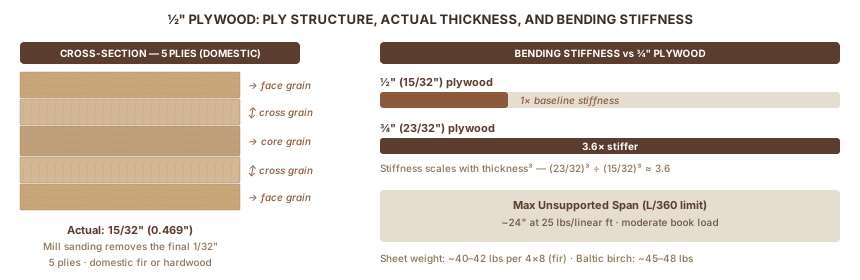
Half inch plywood is a sheet panel that actually measures 15/32" after factory sanding removes the final 1/32" from the nominal thickness — a distinction that disappears on most builds but becomes critical the moment you're routing dadoes or rabbets meant to capture it. A dado dialed to 1/2" will leave a sloppy 1/32" gap; set your stack or router to 15/32" and the joint closes tight. Keep a dial caliper at the bench and measure every sheet before layout, since actual thickness can vary slightly by mill and species.
The structural question most people are asking: can it hold what I need it to hold? The short answer is yes, up to a 24-inch unsupported span under a moderate book load. Past that, it sags. Knowing that limit, and three ways to push it, makes the 1/2" versus 3/4" decision straightforward.
| Actual thickness | 15/32" (0.469") — 1/32" less than nominal |
| Max unsupported shelf span | ~24" at 25 lbs/linear ft (moderate book load) |
| Stiffness vs. 3/4" | About 28% as stiff — stiffness scales with thickness cubed |
| Baltic birch ply count | 13 plies vs. 5–7 in domestic fir plywood |
| Sheet weight (4×8, fir) | ~40–42 lbs |
In this guide:
- What 15/32" means and how cross-lamination works
- Span limits, L/360, and the edge nosing trick
- Where 1/2" belongs and where it fails
- Fastening into 1/2" plywood without splitting it
Part 1: Actual Thickness and How Plywood Is Made
The 1/32" gap and when it matters
According to APA — The Engineered Wood Association, sanded plywood panels are within +0.032"/-0.000" of nominal after milling. In practice, most domestic half inch plywood lands at 15/32" (0.469"). Some imported Baltic birch panels come in at 12mm (0.472"). These are metric, not nominal inch. The 3/4 plywood story is identical: nominal 3/4" measures 23/32" (0.719") after sanding.
For rough shelving, cabinet backs, or any application where one piece doesn't slot into another, the 1/32" difference is irrelevant. It matters in two situations:
Dado joinery. A standard 1/2" dado bit cuts exactly 0.500". A 15/32" panel rattles loose inside that groove. Measure the actual panel with calipers and cut the dado to match, or use a router and sneak up on the fit. Never assume nominal.
Jig setups. Any stop or fence calibrated for 0.500" will be off by 1/32". For router templates, CNC fixtures, and stacked drawer configurations where precision matters, measure the actual panel first.
How cross-lamination works
Plywood is thin wood veneers bonded with alternating grain directions. Face plies run lengthwise; core plies run crosswise. That 90° rotation between layers is cross-lamination, and it gives plywood three properties solid wood doesn't have:
- Resists splitting along the grain (no single continuous grain line runs the full length)
- Holds face screws better than solid wood at equivalent thickness
- Stays flat. Seasonal movement across the panel face is far lower than solid lumber
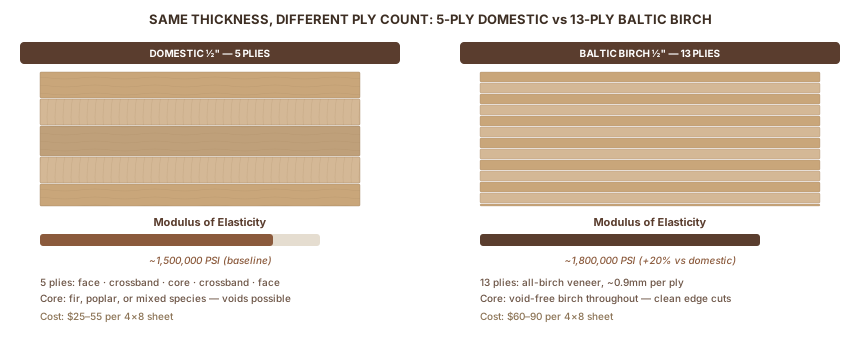
A standard domestic 1/2" panel has 5 plies. A Baltic birch panel at the same nominal thickness has 13 plies, each about 0.9mm thick. More plies means more cross-lamination events: more uniform strength in all directions, cleaner cut edges, and fewer internal voids.
Part 2: Strength and Span Limits
Why thickness controls everything
Bending stiffness scales with the cube of thickness. That relationship isn't linear: doubling thickness makes a shelf 8× stiffer. Going from 1/2" to 3/4" makes it about 3.6× stiffer. The sheets look close in thickness at the store; their structural performance is not close at all.
Per the USDA Wood Handbook's panel data, softwood plywood has a face-grain modulus of elasticity around 1,500,000 PSI. The moment of inertia calculation does the rest:
| Property | 1/2" Fir Plywood | 3/4" Fir Plywood |
|---|---|---|
| Actual thickness | 15/32" (0.469") | 23/32" (0.719") |
| Moment of inertia (12" wide) | 0.086 in⁴ | 0.312 in⁴ |
| Relative bending stiffness | 1× | 3.6× |
| Sheet weight (4×8) | ~40–42 lbs | ~60–65 lbs |
The 24-inch rule
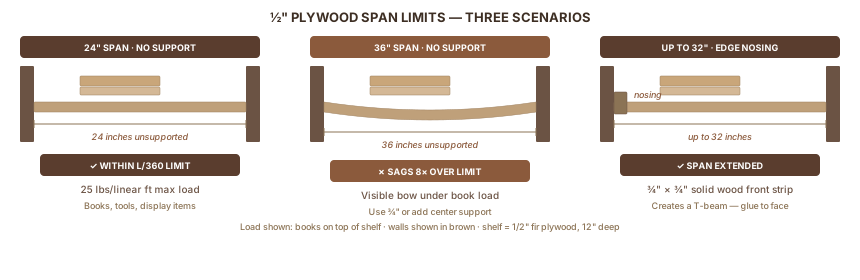
Residential shelving targets L/360 deflection: the shelf bends no more than 1/360th of its span under load. For a 24" shelf, that's about 1/16". For a 36" shelf, about 3/32". Past L/360, the sag is visible from across the room.
For 1/2" fir plywood, 12" deep, loaded at 25 lbs per linear foot (a moderate book load), The Sagulator puts the L/360 limit at approximately 24 inches unsupported span. At 36" unsupported, deflection is roughly 8× the acceptable limit. That shelf will bow visibly under book loads within months.
Three ways to extend the span:
| 1/2" Plywood Configuration | Max Span (Moderate Load) | Notes |
|---|---|---|
| Unsupported, no edge treatment | ~24" | Books, tools, moderate weight |
| With solid wood front nosing | ~30–32" | 3/4" × 3/4" strip glued to front edge |
| Center support added | 48"+ | Support halves the effective span |
| 3/4" plywood, no edge treatment | ~36" | For comparison |
The edge nosing trick. Gluing a 3/4"-thick solid wood strip to the front edge of a 1/2" shelf converts it from a flat plate to a T-beam. The strip works in compression along the shelf's length. A 3/4" × 3/4" nosing extends usable span from 24" to around 30–32" without adding much weight. For bookshelves at 36" spans, 3/4" plywood is the cleaner answer.
Baltic birch vs. domestic plywood
Most product guides treat all 1/2" plywood as equivalent. Columbia Forest Products' Baltic birch specifications show Baltic birch at 1/2" runs about 20% stiffer than domestic fir plywood, with a void-free core and better edge screw-holding due to the higher ply count.
| Property | Baltic Birch | Domestic Fir/Hardwood Ply |
|---|---|---|
| Ply count at 1/2" | 13 plies | 5–7 plies |
| Core material | All-birch veneer | Fir, poplar, or mixed |
| Core voids | None | Occasional gaps |
| Modulus of elasticity | ~1,800,000 PSI | ~1,500,000 PSI |
| Edge quality at cut | Clean | May show gaps |
| Typical price (4×8) | $60–90 | $25–55 |
The 20% stiffness improvement shifts the span limit from roughly 24" to 25–26" before hitting L/360. Not a game-changer for shelving, but meaningful for jigs and drawer boxes where edge precision and screw-holding matter. For cabinet backs, rough shelving, and construction, domestic plywood does the job at a third of the price.
Part 3: When to Use 1/2 Inch Plywood and When to Use 3/4 Inch
Where 1/2" belongs
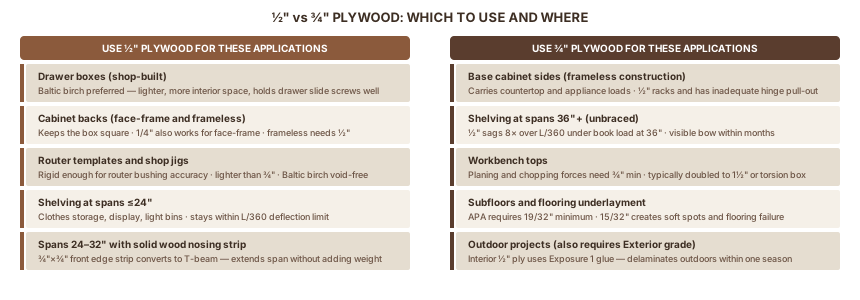
Drawer boxes. The standard for shop-built drawer boxes is 1/2" Baltic birch plywood. Lighter than 3/4" (drawers you open all day should move easily), it leaves more usable interior space, and the void-free core holds drawer slide screws without splitting. This is the single most common use of Baltic birch in fine woodworking.
Cabinet backs in frameless (European-style) cabinets. Frameless cabinets use 1/2" backs for rigidity: the back keeps the box square and provides fastening surface for wall mounting. Traditional face-frame cabinets can use 1/4" backs because the face frame carries the structural load.
Router templates and shop jigs. 1/2" plywood is the standard for router templates, CNC fixtures, and shop jigs. Rigid enough to guide a router bushing accurately, lighter than 3/4", and Baltic birch's void-free core won't telegraph gaps into the cut line.
Shelving under 24" spans. Clothes storage, lightweight bins, display shelves with items under 15 lbs per linear foot — 1/2" plywood handles these without issue at spans under 24".
Where 1/2" fails
Subfloors. APA structural panel ratings require a minimum of 19/32" for subfloor applications. Standard 15/32" plywood is not structurally rated for floor loads. A 1/2" subfloor creates soft spots and flex that lead to flooring failures.
Base cabinet sides in frameless construction. Base cabinets carry countertops, appliances, and daily impact loads through the sides. The industry standard is 3/4" for frameless base cabinet sides. At 1/2", fastener pull-out for hinges and hardware becomes inadequate, and the sides rack over time.
Shelving at 36" spans with books or tools. The span data is clear: 1/2" plywood without edge reinforcement will visibly sag at 36" under book loads within months. Add a nosing, add a center support, or switch to 3/4".
Workbench tops. Hand planing, chopping, and clamping forces require 3/4" minimum, typically doubled to 1-1/2" or built as a torsion box. A 1/2" benchtop deflects under a hand plane and won't survive shop use.
Outdoor use without an Exterior rating. Standard interior plywood uses Exposure 1 glue. It handles occasional moisture but not repeated wetting and drying cycles. For outdoor projects, specify Exterior-rated plywood or marine-grade plywood. Interior-grade 1/2" plywood outdoors will delaminate within a season.
Application quick reference
| Application | 1/2" Works? | Notes |
|---|---|---|
| Drawer boxes (shop-built) | Yes — preferred | Use Baltic birch |
| Cabinet backs, face-frame | Yes — preferred | 1/4" also works |
| Cabinet backs, frameless | Yes | Standard choice |
| Upper cabinet sides | Yes (face-frame) | Use 3/4" for frameless |
| Base cabinet sides, frameless | No | Use 3/4" |
| Shelving, spans ≤24" | Yes | Light-to-moderate loads |
| Shelving, spans 24–32" | With nosing only | 3/4" solid wood front edge |
| Shelving, spans 36"+ | No | Use 3/4" or add center support |
| Subfloor / flooring | No | Needs 19/32" minimum, APA-rated |
| Workbench top | No | Use 3/4" doubled or torsion box |
| Router templates, jigs | Yes — preferred | Baltic birch for cleaner edges |
| Outdoor, unprotected | No | Use Exterior-rated plywood |
RELATED: Sheet Goods for Cabinets A full breakdown of plywood cores, surfaces, and the brands that matter for cabinet work.
Part 4: Fastening Into 1/2 Inch Plywood
Face fastening
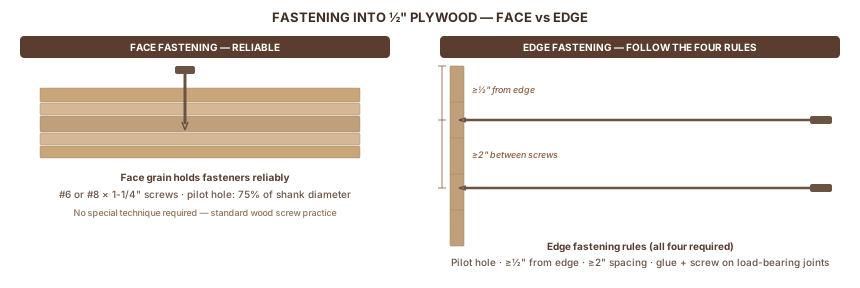
Driving screws into the face of 1/2" plywood is straightforward. Use #6 or #8 × 1-1/4" wood screws with a pilot hole at 75% of the screw shank diameter. Face grain holds fasteners reliably.
Edge fastening
Fastening into the panel edge is where beginners split plywood. The plies separate when screws are too close to the edge or driven without a pilot hole.
Four rules that prevent splits:
- Drill a pilot hole before every edge screw
- Stay at least 1/2" from the panel edge
- Space edge screws at least 2" apart
- Pair glue with screws on any load-bearing joint. Glue carries the load; screws hold during cure
For pocket screws, Kreg's screw size guide specifies 1-1/4" pocket screws for 1/2" material at the 1" jig setting. Pocket joints in 1/2" plywood are reliable for cabinet face frame attachment and drawer front mounting.
Nails and brads
18-gauge brads or 16-gauge finish nails work for assembly. Brads into the face hold well. Brads into the edge pull out easily. Pair edge brad nailing with glue. Crown staples (1/2" to 5/8") are standard for fastening 1/4" and 1/2" cabinet backs.
If you're working MDF into the same project, note that MDF holds face screws well but edge screws poorly. The same pilot hole discipline applies, and MDF's edge crumbles under impact in ways plywood doesn't.
Sources
Research for this guide drew on APA panel standards, USDA engineering data, and manufacturer specifications for plywood structural properties and fastening guidance.
- APA – The Engineered Wood Association — panel grades, structural ratings, span data, and application guidance
- USDA Forest Products Laboratory — Wood Handbook Chapter 11, plywood modulus of elasticity and deflection formulas
- The Sagulator — shelf deflection calculator used to verify span limits
- Columbia Forest Products Baltic Birch specifications — ply count, MOE, and technical data
- Kreg Tool Pocket Hole Screw Guide — screw size recommendations by material thickness
Also Referenced
How We Research
We don't take affiliate revenue or accept review units. Picks come from multi-source research — manufacturer specs, OSHA / EPA / ASTM regs, and long-form practitioner threads — plus Ahmed's hands-on use where relevant. When we recommend something, we explain why.
Up Next
What Is MDF? Properties, Uses, and When to Choose It
WOOD & MATERIALS · Beginner