
Oak Burl at a Glance
Oak burl is figured wood cut from an abnormal, rounded growth on an oak tree, produced when a bacterial, viral, or fungal infection disrupts normal cell division and forces cells to multiply in every direction at once. That chaotic growth is what creates the swirling, interlocked grain — and why the surface shifts and shimmers as your viewing angle changes. No plain-sawn lumber can replicate it; the depth and movement are structural, baked into the wood at the cellular level.
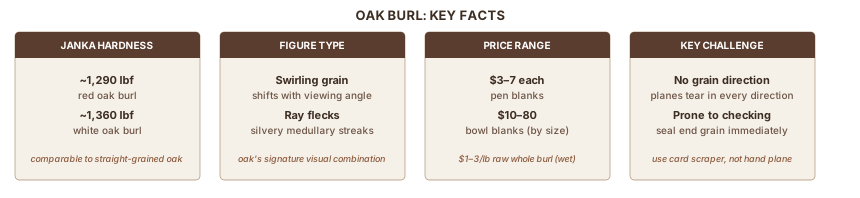
| Janka hardness (red oak burl) | ~1,290 lbf | | Janka hardness (white oak burl) | ~1,360 lbf | | Primary figure type | Swirling grain; occasional eyes | | Common forms | Pen blanks, turning blanks, veneer sheets, slabs | | Pen blank price | $3–7 each | | Bowl blank price | $10–80 depending on size and figure | | Key working challenge | No consistent grain direction; prone to checking when drying | | Best finishes | Oil-based wipe-on, lacquer, shellac as sealer |
In this guide:
- How burls form — the biology behind the figure
- What oak burl looks like — grain, color, and how it compares
- Forms and applications — what to buy and what to make
- Working, drying, and finishing — the practical details
- Sourcing and pricing — where to find it and what to pay
Part 1: How Burls Form
A burl is a rounded, tumor-like growth on a tree's trunk, roots, or major limbs. The wood inside isn't diseased or weak. It's denser than the surrounding trunk. But its grain structure is radically different, and that difference is what makes it worth money.
The infection behind the figure
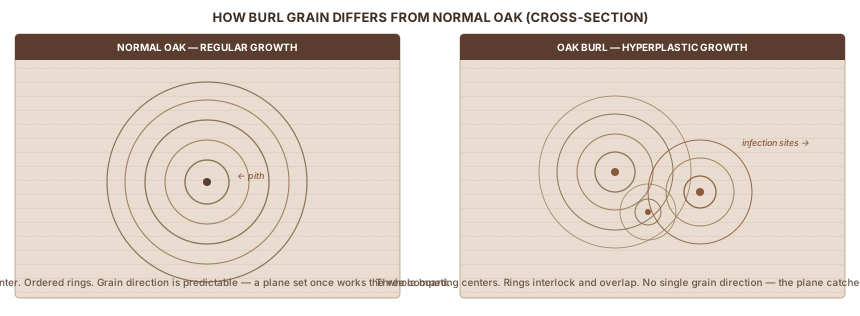
Burls form when something disrupts a tree's normal cell division. According to UNH Extension's burl research, the disruption comes from an outside agent: a bacterium, virus, fungus, or insect infestation. The tree responds by creating a protective mass around the infected tissue, and that mass grows with the tree, year after year, building its own concentric growth rings.
One well-documented cause is Agrobacterium tumefaciens, the crown gall bacterium. It inserts a piece of its own genetic material (a Ti plasmid) directly into the tree's DNA, reprogramming the cells to divide and multiply without the normal stop signal. The result is hyperplasia: an abnormal proliferation of xylem cells that grow outward in all directions simultaneously.
When you look at swirling grain in an oak burl, you're seeing the record of cells that grew in every direction at once, each year's layer curling and folding around the competing growth centers.
Penn State Extension's tree burl research puts it plainly: the density of wood inside a burl is measurably greater than the density of wood in the surrounding trunk. The cells pack more tightly because they're proliferating rapidly, not growing in orderly, spaced rows.
How a burl grows over decades
Once a burl starts, it doesn't stop. The tree adds a new growth ring to the burl each year, just as it adds one to the trunk. The burl's rings trace back and connect to normal rings on the unaffected trunk at the point where the infection first took hold.
Large burls are usually the most figured for this reason. Decades of interlocked, multidirectional growth stack up, each layer adding depth and complexity.
Removing a burl from a living tree creates a wound far larger than the burl itself. The tree faces greater risk from the cut than it ever did from the burl. Most responsible harvesting happens on trees already slated for removal, on fallen timber, or from root systems being cleared during construction.
Part 2: What Oak Burl Looks Like
Oak burl has specific visual character. Know it before you buy.
Grain patterns and the oak difference
The defining feature of oak burl is swirling interlocked figure. Wood fibers curl and fold around multiple growth centers simultaneously, rather than running parallel to the tree's axis. Hold a burl blank up to a raking light and you'll see the figure shift. That's what you're evaluating.
Swirls are the dominant pattern. Flowing arcs and spirals radiate outward from points of intense growth. Under a clear finish, these swirls produce chatoyance: the figure appears to shift and move as you change viewing angle.
Eyes (burl eyes) are small circular figures caused by dormant buds encapsulated as the burl grew. Oak burl shows fewer eyes than maple or walnut burl. The practitioner community is direct about this: oak burl typically shows "just swirls" rather than the dense eye patterns those species produce.
Ray flecks are oak's characteristic medullary rays: silvery, shimmer-catching streaks that run perpendicular to the growth rings. They still appear in burl, within and between the swirling grain. This is what separates oak burl aesthetically from other domestic burls: you get the burl figure and the ray pattern together.
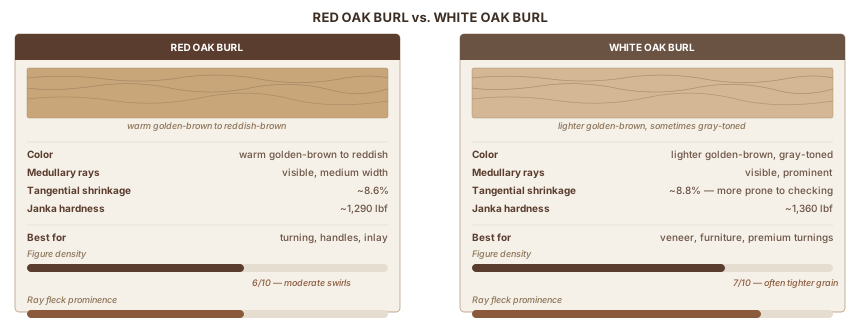
| Feature | Red oak burl | White oak burl |
|---|---|---|
| Color | Warm golden-brown to reddish-brown | Lighter golden-brown, sometimes gray-toned |
| Figure density | Moderate swirls | Moderate swirls; often tighter grain |
| Medullary rays | Visible, medium width | Visible, prominent |
| Tangential shrinkage | ~8.6% | ~8.8% — very prone to checking |
| Best use | Turning, knife handles, inlay | Veneer, furniture, premium turnings |
Where oak burl sits among burl species
Oak burl is mid-tier for decorative figure. Walnut burl commands the highest prices for its dense eyes and rich chocolate color. Maple and buckeye burl produce tight, complex figure. Oak burl's specific strength is the combination of swirling figure with oak's ray flecks. No other domestic species replicates that pairing.
Live oak (Quercus virginiana) produces burls, but the wood is extremely dense. Janka hardness runs around 2,680 lbf, nearly twice that of red or white oak. Most woodworkers find live oak burl impractical for hand tool work and difficult even on machines. Its commercial market is limited.
RELATED: Curly maple is another domestic species where abnormal grain structure produces dramatic figure, worth comparing if you're choosing between figured woods for a project.
Part 3: Forms and Applications
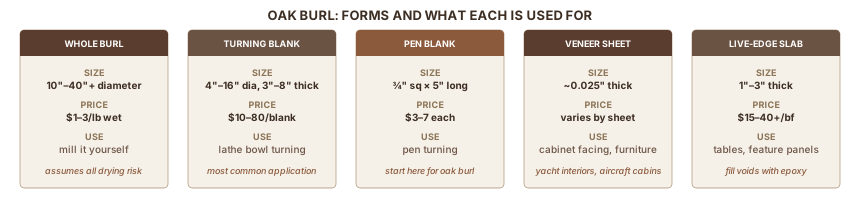
| Form | Typical dimensions | Primary use | Price range |
|---|---|---|---|
| Raw whole burl | 10"–40"+ diameter | Turning blanks, milling, resale | $1–3/lb wet |
| Live-edge slab | 1"–3" thick, 12"–36"+ wide | Tables, furniture tops | $15–40+/bf |
| Bowl/turning blank | 4"–16" dia, 3"–8" thick | Lathe turning | $10–80/blank |
| Pen blank | ¾"–1" sq × 5"–6" long | Pen turning | $3–7 each |
| Veneer sheet | ~0.025" thick | Cabinet facing, furniture | Varies by sheet |
| Block or chunk | Variable | Carving, inlay, knife handles | $5–30/piece |
Turning blanks — bowls and vessels
Woodturning is the most common application for oak burl. A blank cut from the burl reveals the swirling figure across the entire face, and as you remove material on the lathe, successive layers of figure expose themselves. The cross-section of the burl is what the finished bowl will look like.
Bowl turning suits burl's unpredictable grain because it removes material evenly in all directions. Turning a burl blank is actually more predictable than trying to plane or route it flat. Sharp tools, light cuts.
Use a bowl saver to preserve interior material when hollowing. The core has just as much figure as the exterior, and burl blanks are expensive enough to justify the extra setup.
Pen blanks
A pen blank — typically ¾" square by 5" long — is the entry point for oak burl at $3–7. The cross-cut orientation puts the full figure on display. Stabilized oak burl pen blanks (vacuum-impregnated with resin) are easier to finish and more forgiving to turn than raw dried material.
Veneer sheets
The largest commercial application. Burl is sliced into sheets roughly 0.025" thick, then applied over MDF or Baltic birch plywood for cabinet doors, drawer fronts, tabletops, and architectural panels. Walnut veneer works the same way with different source material.
Book-matched veneer (two mirror-image sheets placed side by side) creates symmetrical focal points where the grain reflects across a seam. According to Oakwood Veneer's product documentation, oak burl veneer shows up in yacht interiors, aircraft cabins, and executive furniture because it delivers dramatic figure at a fraction of the material cost of solid burl.
Live-edge slabs
Large oak burls milled into slabs make dramatic tabletops with natural outer edges. Voids and bark inclusions get filled with clear or tinted epoxy rather than removed. The inclusions become part of the surface design.
Inlay, handles, and small decorative work
Thin slices of oak burl serve as accent panels in solid-wood furniture: a drawer front framed in straight-grained oak with a burl center panel, for instance. Dried burl also makes dense, figured knife and chisel handles, though resin stabilization (covered in Part 4) is recommended for anything that needs to hold up under wet conditions.
Part 4: Working, Drying, and Finishing
Oak burl's working difficulty comes from the same place as its beauty.
No grain direction — what that means for your tools
Normal lumber has a grain direction you orient your tools to follow. Set a hand plane, read the grain, and you can produce a glassy surface without tearout. Burl gives you no such orientation. The grain runs in every direction simultaneously. A cut that rides clean one inch tears out on the next.
- Hand planes are mostly ineffective on burl. Use a card scraper for final surface work instead.
- Routers need climb cuts and light passes. Downspiral bits reduce tearout.
- Sanding works well — burl sands beautifully past 120 grit.
- On the lathe, chipping shows up instead of tearout. Sharp tools and very light finishing cuts solve it.
- Sharp tools are mandatory — sharper than for straight-grained oak. A slightly dull chisel that gets by on regular oak will chip and bruise burl.
Before mounting a blank on the lathe: probe for hidden voids. Bark inclusions and internal cavities are common in burls. An unexpected void mid-cut causes a tool catch.
Drying raw burl — the oak problem
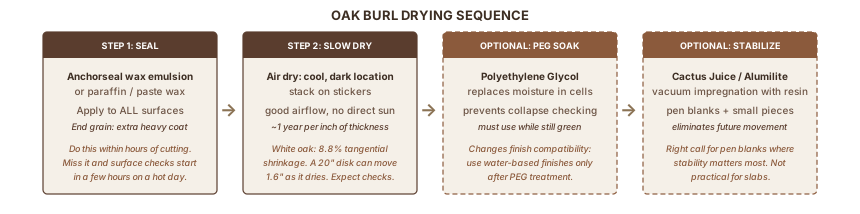
White oak's tangential shrinkage is around 8%. On a 20" disk, that's about 1.6" of potential diameter change as the wood dries. According to Woodweb's knowledge base on drying burly slabs, "expect a crack with oak." The goal is minimizing and controlling checks, not eliminating them.
Seal immediately after cutting. Anchorseal wax emulsion, Johnson's Paste Wax, or melted paraffin. Apply to all surfaces, and coat end grain especially heavily. End grain dries ten times faster than face grain. Miss this step by a few hours on a hot day and surface checking starts. WWGOA's green wood drying guide makes Anchorseal the first recommendation for a reason.
Slow air dry. Store in a cool, dark spot with good airflow but no direct wind or sun. Stack on stickers. Allow roughly one year per inch of thickness.
PEG soak. Polyethylene Glycol replaces moisture in cells and prevents the collapse that causes checking. Must be done while the wood is still green. Changes finish compatibility. Use water-based finishes afterward. Available from Lee Valley and Woodcraft.
Resin stabilization. Vacuum-impregnating pen blanks and small turning blanks with Cactus Juice or Alumilite produces material that won't move. Impractical for slabs, but the right call for small pieces where maximum stability matters.
Filling voids
Burls have bark inclusions, natural voids, and small cracks. These aren't failures. Filled voids are a design choice in contemporary woodworking.
Fine Woodworking's technique for filling voids with epoxy calls for low-viscosity formulation for best penetration. Warm the wood slightly before pouring to reduce the epoxy's viscosity and eliminate air bubbles. Fill deep voids in multiple thin pours rather than one thick pour, which can overheat and trap bubbles.
Clear epoxy lets you see through to the wood structure below. Tinted epoxy blends in; mix in pigment or coffee grounds for a natural-looking fill.
One rule: do not apply oil-based finish over cured epoxy. Oil doesn't bond to epoxy. Use water-based polyurethane, lacquer, or shellac over any epoxy-filled surface.
Finishing
Oak is ring-porous: large earlywood vessels and dense latewood mean uneven finish absorption even in straight-grained form. In burl, where grain runs every direction, this is more pronounced. A sealer coat prevents blotching.
Apply a thin coat of shellac (1 lb cut or lighter), let it dry fully, then sand lightly with 320 grit. This equalizes surface absorption before the top coat goes on. Skip it and you get patchy, uneven color in the first coat.
Best finishes for oak burl:
- Oil-based wipe-ons (Waterlox, pure tung oil, Rubio Monocoat) — penetrate deeply, enhance chatoyance, easy to apply; not the most durable
- Lacquer — fast-drying, excellent clarity, very good at enhancing figured grain; spray lacquer is the standard for turned objects
- Water-based polyurethane — good clarity; use after epoxy fills; requires the sealer coat step
- Shellac alone — traditional, easy to repair, beautiful on figured wood; not waterproof or heat-resistant
For a full coat schedule, see the guide to applying polyurethane. The sealer step is non-negotiable on burl.
Part 5: Sourcing and Pricing
Where to buy
Online specialty dealers:
- Oregon Burls — among the best-regarded burl dealers in North America; Grants Pass, OR
- Global Wood Source — full burls through pen blanks; custom milling available
- Collector's Specialty Woods — includes oak burl slabs
- CAG Specialty Wood — specifically carries white oak burls
- Exotic Wood Zone — broad species selection including figured and burl stock
- Oakwood Veneer — veneer sheets specifically
Other channels:
- AAW events and wood shows — American Association of Woodturners gatherings have burl vendors; you inspect material in person before buying
- Local sawmills — ask what comes through; when an old oak gets removed and the stump shows a burl, some mills hold it
- Craigslist / Facebook Marketplace — landowners sometimes post burls from removed trees at low prices; inspect before buying raw material sight-unseen
Pricing
| Form | Price range | Notes |
|---|---|---|
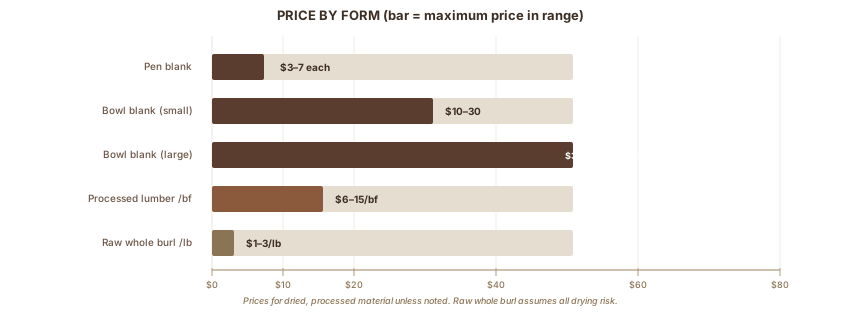
| Pen blank | $3–7 | Dried, cut, ready to turn |
| Small bowl blank (4–6") | $10–30 | Varies by figure density |
| Large bowl blank (10–14") | $30–80 | Premium for figured material |
| Processed red oak burl lumber | ~$6–15/bf | Dried, surfaced |
| Raw whole burl (wet, per pound) | $1–3 | Buyer assumes all drying risk |
| Raw whole burl (18–20" log, uncut) | $25–50 | Appropriate offer for unseen material |
The IAP Penturners community offers a useful calibration: "I bought an oak burl awhile back that weighed 100 pounds wet for $100." After drying, expect 20–30% of the original wet weight in usable material. The rest goes to moisture loss, surface checking, bark inclusions, and internal voids.
How to evaluate before buying
Ask for a photo of a cut face before committing to a raw whole burl. A reputable seller cuts a small window to show the interior. Look for figure density: tighter, more complex swirls mean higher quality. Avoid pieces with large soft or punky sections; small fillable voids are fine.
Smell it. Decay has a distinctive odor even in cold wood.
Bark inclusions reduce usable yield significantly. A 10-pound burl with heavy bark inclusions might yield 3 pounds of clean turning material.
For decorative drama per dollar, walnut burl and maple burl command more and produce denser eye patterns. Oak burl's value is specific: the combination of swirling figure with oak's ray-fleck character, a look that no other domestic burl species matches.
Sources
Research for this guide draws on university extension publications, practitioner community forums, specialty dealer educational content, and Fine Woodworking.
- Penn State Extension: Tree Burl Breakdown — burl formation biology and density
- UNH Extension: Mystery of Tree Burls — causes and growth mechanics
- Wikipedia: Burl — hyperplasia definition, crown gall bacterium
- Oakwood Veneer: What is Oak Burl Wood — visual characteristics, red vs. white oak
- Oakwood Veneer: The Beauty in the Burl — comparative species characterization
- Carved.com: What are Wood Burls — physical properties overview
- Global Wood Source: Burl Bowl Turning Guide — turning technique and safety
- Woodweb: Drying Burly Slabs — oak shrinkage data and drying methods
- WWGOA: How to Stop Green Wood from Cracking — Anchorseal and crack prevention
- Fine Woodworking: Use Epoxy to Fill Voids — void-filling technique
- Sawmill Creek: Epoxy and Resin for Voids — epoxy product selection
- IAP Penturners: How much does Oak Burl cost — pricing, yield, and buying guidance
- LumberJocks: What is this burl worth — raw burl valuation from community
- Oakwood Veneer: Oak Burl Veneer — veneer applications and commercial uses
Tools Used
Also Referenced