
White Oak Dresser at a Glance
White oak is one of the best choices for a dresser: hard enough to last generations, beautiful enough to stop people in their tracks, and available in quartersawn form that shows off dramatic ray fleck most hardwoods can't match. Three things will trip you up if you don't plan for them: it moves more seasonally than most builders expect, it stains permanently if iron touches a wet surface, and grain-matching the drawer fronts requires decisions you make at the lumber yard, not at the bench.
Know those three things going in and white oak is a deeply satisfying material to build with.
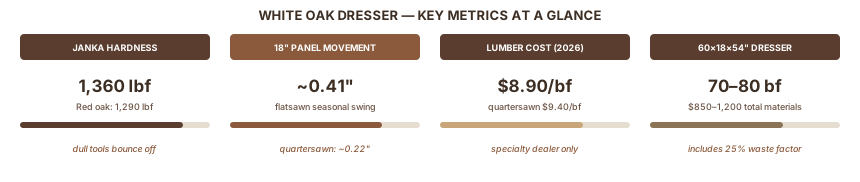
| Janka hardness | 1,360 lbf (red oak: 1,290) |
| Seasonal movement, 18" flatsawn panel | ~0.41" — must design for this |
| Lumber cost (specialty dealer, 2026) | $8.90/bf flatsawn · $9.40/bf quartersawn |
| Board feet for 60"W × 18"D × 54"H dresser | ~70–80 bf |
| Total materials estimate | $850–1,200 |
| Difficulty | Intermediate (power tools required) |
In this guide:
- Why white oak beats other options for a dresser
- Working characteristics: hardness, movement, weight, and the iron hazard
- Sourcing and cost: what grade, how much, where to buy
- Designing for wood movement so panels don't crack
- Grain matching drawer fronts: the visual differentiator
- Joinery matched to skill level
- Finishing: grain filling and product selection
- Common mistakes and how to avoid them
Part 1: Why White Oak for a Dresser
White oak earns its place as the default hardwood for heirloom furniture on three counts: durability, stability, and looks.
At 1,360 lbf on the Janka scale — a number consistent with the [USDA Forest Products Lab Wood Handbook](https://www.fpl.fs.usda.gov/documnts/fplgtr/fpl_gtr190.pdf) species data — it shrugs off daily dents and dings. Quartersawn white oak, sliced so the growth rings run perpendicular to the face, produces large reflective medullary rays that appear as silver-gold platelets across the surface. This ray fleck made white oak the signature material of the Arts & Crafts movement. Gustav Stickley built his reputation on it.
White oak also has tyloses, balloon-like cell outgrowths that seal the large heartwood pores. That's why white oak holds liquid (barrel makers use it for whiskey barrels) and takes oil finishes more evenly than red oak.
White Oak vs. Red Oak
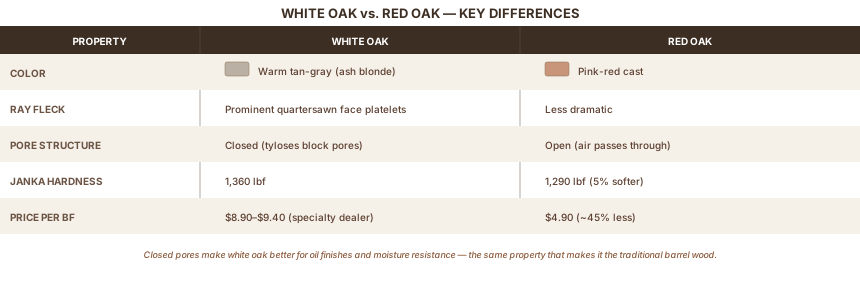
Both are abundant and machine well, but they're not interchangeable.
Color: White oak runs warm tan-gray, what woodworkers often call "ash blonde" before finishing. Red oak has a distinctly pink-red cast. Once you know what to look for, you can tell them apart across a lumber yard.
Ray fleck: Both species have medullary rays. White oak's are wider and more prominent; the fleck is more dramatic on quartersawn boards. If you want the quartersawn look, white oak delivers it more convincingly.
Pore structure: White oak pores are closed (tyloses block them); red oak pores are open. Hold white oak heartwood to your lips and blow. Air won't pass. Red oak lets it through. This affects both finishing and moisture resistance.
Price: At a specialty dealer in 2026, white oak runs about $8.90/bf, roughly 82% more than red oak at $4.90/bf. For a 75 bf dresser project, that's a $300 premium over red oak.
Is White Oak Beginner-Appropriate?
It's intermediate territory. A dedicated beginner with power tools and a few months of woodworking experience can succeed, but the species plus dresser complexity together add more variables than a first project in pine or poplar.
The species itself isn't the hard part. A dresser, with fitted drawers, wood movement design, and grain-matched fronts, is what makes it intermediate. White oak adds the iron-tannin hazard and grain-matching layers on top of that. Build one simpler case project first if you haven't yet.
Part 2: White Oak's Working Characteristics
Hardness and Tool Requirements
At 1,360 lbf, white oak is hard enough that dull tools bounce off rather than cut. Blades and router bits dull faster than with softer species. Keep everything sharp. The difference between a crisp white oak edge and a torn one is almost entirely blade sharpness.
White oak splits easily near edges. Always pre-drill for screws and nails. Use pilot holes even for finish nails close to an edge.
White oak has more tearout tendency than red oak, especially when routed against the grain. Make a light climb cut first to score the fibers, then a full-depth pass with the grain. Use sharp carbide bits and take lighter passes than you would with pine or poplar.
Hand tool work is genuinely difficult. White oak at 1,360 Janka requires a sharper iron than most hobbyist sharpening setups produce. Learn hand planes on softer species first.
Wood Movement
According to USDA Wood Handbook data via WoodBin, white oak has radial shrinkage of 5.6% and tangential shrinkage of 10.5% (green to ovendry). Flatsawn boards use the tangential value; quartersawn boards use the radial.
Movement per 1% MC change: flatsawn moves 0.375% per inch of width; quartersawn moves 0.200% per inch.
For a typical heated North American home with a 6% seasonal moisture swing:
| Panel Width | Flatsawn Movement | Quartersawn Movement |
|---|---|---|
| 12" | ~0.27" | ~0.14" |
| 18" | ~0.41" | ~0.22" |
| 24" | ~0.54" | ~0.29" |
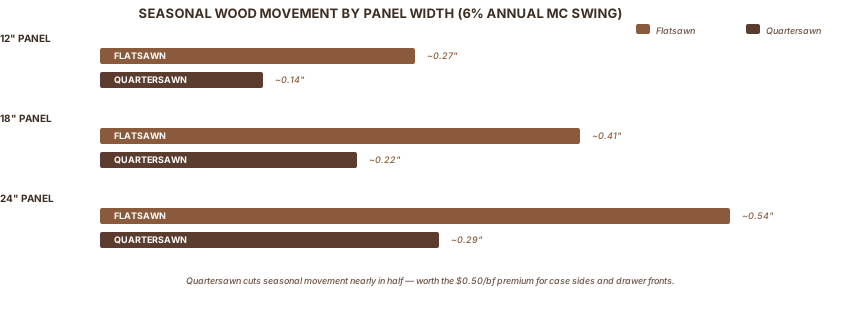
An 18" wide solid flatsawn white oak panel will expand and contract about 13/32" over a year. Glue it solidly into a case and it will crack or blow a joint. White oak moves more than red oak (tangential 10.5% vs 8.6%), which is one reason quartersawn white oak is often worth the $0.50/bf premium even before considering aesthetics.
The Iron-Tannin Hazard
White oak's high tannin content creates a permanent blue-black stain when it contacts iron compounds in the presence of moisture. This catches builders off guard. Even briefly setting a piece of steel wool on a damp white oak surface leaves a mark within hours.
What causes it: steel wool on a damp surface; wet iron clamp jaws against fresh glue joints; iron screws driven into damp wood; iron hardware on unfinished wood that gets damp.
Prevention: No steel wool near white oak, ever. Use gray synthetic Scotch-Brite pads for rubbing between coats. Use stainless steel screws throughout. Put wooden cauls between iron clamp jaws and the wood surface.
Fix if it happens: Oxalic acid wood bleach. Mix to package directions, apply to the stained area, neutralize with baking soda solution, let dry completely before finishing.
Weight
At 3.91 lbs per board foot, a solid white oak dresser is very heavy. Seventy-five board feet of lumber weighs about 290 lbs. The finished dresser, with plywood back and drawer bottoms, runs lighter but still heavy enough to need two people and a moving plan. Build in sections where possible.
Part 3: Sourcing White Oak
Where to Buy
Big box stores don't stock white oak by the board foot. You'll occasionally find 1x4 or 1x6 "hobby boards" at high per-piece prices, which isn't cost-effective for a furniture project.
Local specialty lumber yards are the best option for inspecting boards in person. Pricing varies by region; in the Mid-Atlantic and Southeast where white oak grows natively, prices can run lower than online. Ask for FAS (Firsts and Seconds) grade or Select grade for visible surfaces; #1 Common works for interior case parts.
Online specialty dealers like Ocooch Hardwoods and Woodworkers Source ship nationwide with consistent quality and pricing, which is useful when local options are limited.
How Much to Buy
For a 60"W x 18"D x 54"H six-drawer dresser:
| Component | Approximate BF |
|---|---|
| Case sides, top, bottom | ~30 bf |
| Face frame (stiles + rails) | ~7 bf |
| Drawer dividers / web frames | ~25 bf |
| Drawer fronts (6) | ~10 bf |
| Total (with 25% waste factor) | ~70–80 bf |
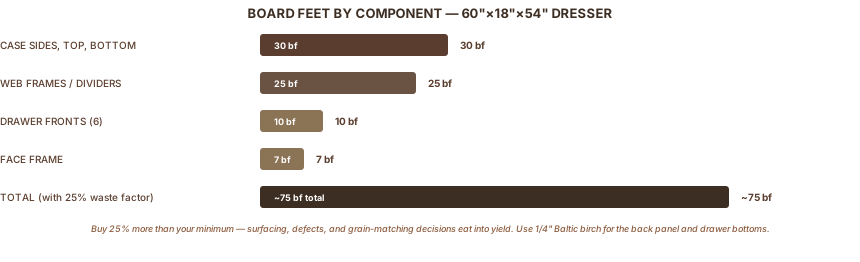
Use 1/4" Baltic birch plywood for the back panel and drawer bottoms, not solid white oak. Plan on purchasing 25% more than your calculated minimum; rough lumber loses material to surfacing, boards have defects, and grain-matching decisions cost you some length.
Where to Spend the Quartersawn Premium
Quartersawn white oak at $9.40/bf is worth the extra $0.50/bf for visible surfaces. For 12 bf of drawer fronts, the upgrade costs about $6 per board foot more, roughly $72 extra on a $1,000 project. Use flatsawn ($8.90/bf) for web frames, case internals, and anything that won't be seen.
Part 4: Designing for Wood Movement
Frame-and-Panel for Wide Case Parts
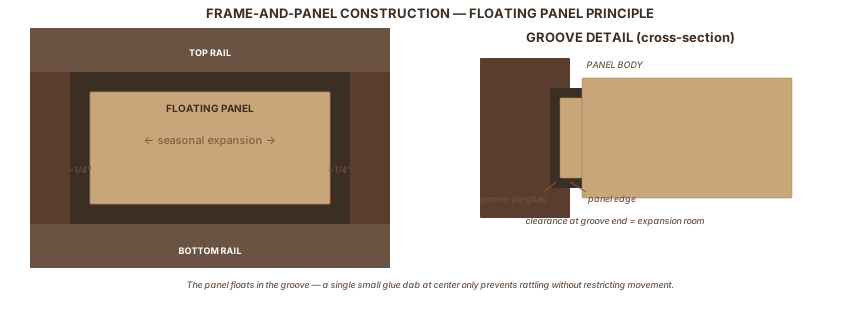
Case sides on an 18"-deep dresser are wide enough to require frame-and-panel construction, or plywood. A solid white oak panel that size will move 0.41" seasonally. Glue it solid into the case and you're borrowing trouble.
Frame-and-panel means a wide panel floats free inside a grooved frame. The panel is never glued except for a small centered dab to keep it from rattling. Standard floating gap is 1/4" between the panel edge and the groove bottom on each side, enough for the panel to move without binding.
For flatsawn panels wider than 18", leave at least the calculated seasonal movement plus 1/8" buffer as clearance.
Drawer Box Design
Drawer boxes should be secondary wood: poplar, soft maple, or Baltic birch plywood. Not white oak. The drawer box sides expand and contract in the same direction as the case opening. Both drawer box and case moving independently in solid white oak means the fit varies dramatically by season.
Secondary wood, poplar especially, moves less than white oak and costs a fraction as much. Reserve white oak for the visible drawer fronts.
Leave 1/16"–1/8" clearance on each side of the drawer box within the opening. Drawers that fit perfectly in summer will bind in humid weather without clearance.
Case Top
Attach the case top with figure-8 clips or elongated screw holes in the web frame below, not rigid gluing through the case sides. This lets the top expand and contract without splitting.
Alternatively, use a plywood top with solid white oak edge banding. The plywood core barely moves; the edge banding shows the grain. No movement concern.
RELATED: How to Build Drawers Sizing, slides, and fitting solid wood drawer boxes before you start on the fronts.
Part 5: Grain Matching Drawer Fronts
Six drawer fronts sit centimeters apart, stacked vertically, filling the most visible face of the dresser. This is where grain matching matters.
Random boards from different parts of the pile produce drawer fronts that look like they came from six different trees. Intentional selection produces fronts that look like they belong together. The difference is visible from across the room.
Three Approaches
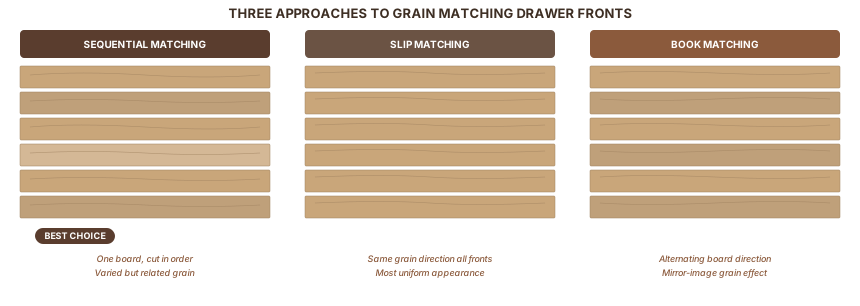
Sequential matching is the most practical for white oak dresser fronts. Find the longest board with consistent figure and buy all your fronts from it. Cut the fronts in order: top drawer from the top of the board, each successive drawer from the next section down. Each front differs from its neighbor, but they share tonality and character because they came from the same tree section. The result looks intentional without the complexity of bookmatching.
Slip matching lays adjacent boards side by side without flipping. The grain flows in the same direction across all fronts. Good for flatsawn; avoids the abrupt ray fleck direction reversals that bookmatching creates on quartersawn stock.
Book matching flips adjacent boards to create mirror-image grain. Dramatic on quartersawn white oak, with mirror-image ray fleck patterns. Best for wide single-panel applications like doors or full-face drawer fronts; less practical for six narrower horizontal fronts in a row.
Quartersawn vs. Flatsawn for Fronts
| Factor | Quartersawn | Flatsawn |
|---|---|---|
| Ray fleck | Prominent face platelets | Minimal |
| Seasonal movement (18" panel) | ~0.22" | ~0.41" |
| Price (specialty dealer, 2026) | $9.40/bf | $8.90/bf |
| Match consistency across drawers | Very consistent | Can vary dramatically |
Flatsawn drawer fronts give you cathedral grain (arching rings) and almost no ray fleck. That's a completely different look from quartersawn. Quartersawn also moves half as much, which means drawer-to-opening fit stays more consistent across seasons.
At the Lumber Yard
Buy from one board or one flitch. Find the longest piece with consistent figure and cut all drawer fronts from it. Mark the sequence immediately with chalk or pencil on the ends.
Ask the yard to unbundle. Most specialty yards let you sort through a bundle to find sequential pieces. Confirm quartersawn by looking at end grain: vertical lines mean quartersawn; arching rings mean flatsawn.
Part 6: Joinery for Every Skill Level
Case Joinery
Dado joints for horizontal components (web frames, drawer dividers, bottom panel): 3/4" wide, 1/4"–3/8" deep. Use a stopped dado to hide the joint from the front; a face frame covers through dados if you prefer. A dado stack on a table saw or a straight bit in a router handles this at beginner level.
Rabbet for the back panel: 3/8" x 3/8" or 1/2" x 3/8" routed into the back inside edges of the case. Also used for top and bottom panels if you're not using dados.
These don't change by skill level. Dados are the correct joint for case construction regardless of experience.
Face Frame Joinery
Pocket holes (Kreg Jig and similar): fast, beginner-accessible, adequate for face frames that see no tension stress. Face frames don't need the strongest possible joint. They just need to hold the pieces in alignment while the glue cures. A good choice for a first dresser.
Mortise and tenon: tenon sized at 1/3 the stock thickness, so a 1/4" tenon in 3/4" material. Strongest option. Worth pursuing once you have a few projects under your belt.
Drawer Box Joinery
| Experience Level | Drawer Corner Joint |
|---|---|
| First furniture project | Pocket screws in secondary wood |
| Intermediate | Box joints (table saw + dado stack + simple jig) |
| Advanced | Half-blind dovetails (hand-cut or router jig) |
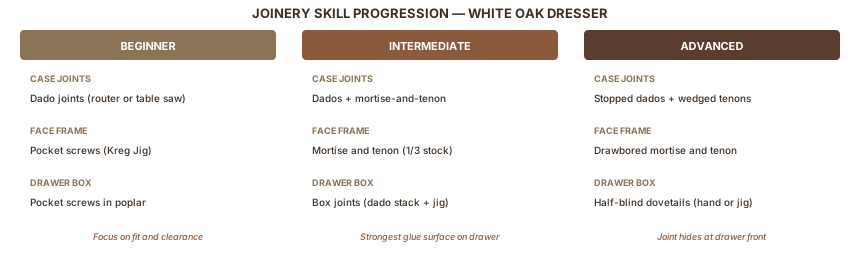
Pocket screws in a poplar drawer box will hold for decades of use. The drawer fit matters more than the corner joinery on a first project. Get the fit right first.
Box joints are the next step up: a table saw with a dado stack and a simple shop-made jig. Excellent glue surface area makes them very strong, and the joint is visible on all sides, which gives them a modern mechanical look.
Half-blind dovetails hide the joint at the drawer front, the hallmark of fine case furniture. Router jig versions (Leigh, Porter-Cable, Rockler) are intermediate-accessible. Hand-cut is advanced. Either way, they're worth learning.
Part 7: Finishing White Oak
Fill Grain or Leave It Open?
White oak is ring-porous with large open-grained pores in the early wood. Tyloses partially fill the heartwood pores (less so than red oak), but it's still a coarse-textured wood where your finishing decision is visible.
Leave it open: Oil or hardwax oil penetrates the pores rather than bridging them. The surface stays tactile, you feel the grain. This is the authentic Arts & Crafts look. Easier to apply and repair than film finishes. Less protective against water.
Fill pores first: Paste wood filler (General Finishes Paste Wood Filler, Timbermate) applied across the grain, scraped off with burlap, cured 24–48 hours, then lightly sanded before topcoat. Result: glass-smooth surface with pores invisible under the film. More formal, traditional furniture appearance.
Build a film finish: 6–8 coats of polyurethane with sanding between coats partially fills the pores over time. A middle ground between open and fully filled.
Which Finish for Which Look
| Finish | Ray Fleck | Tone | Durability | Repairability |
|---|---|---|---|---|
| Hardwax oil (Osmo, Rubio) | Best | Neutral-slight | Moderate | Easy |
| Penetrating oil (Waterlox) | Excellent | Slight amber | Low–moderate | Easy |
| Oil-based polyurethane | Good | Amber | High | Difficult |
| Water-based polyurethane | Moderate | Crystal clear | High | Difficult |
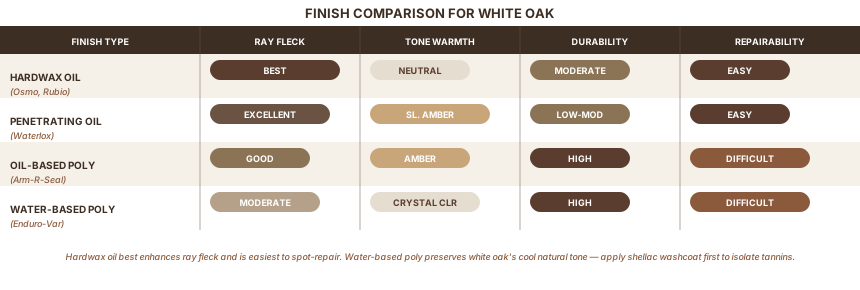
Modern/natural white oak: Rubio Monocoat or Osmo Polyx-Oil. Hardwax oil penetrates the wood and enhances ray fleck contrast more than any film finish. One coat, low VOC, easy spot repair. This is how contemporary Scandinavian furniture makers finish white oak.
Warm traditional look: Oil-based polyurethane (Minwax Wipe-On Poly, General Finishes Arm-R-Seal) over grain-filled surface. The amber tone warms the wood toward honey. More protective, harder to repair.
Pale/clean modern look: Water-based polyurethane (General Finishes Enduro-Var, Target Coatings EM6000). Crystal clear, shows white oak's cool tan-gray without adding amber. Apply a thin dewaxed shellac washcoat (Zinsser SealCoat) first to isolate tannins and prevent adhesion issues.
RELATED: Applying Polyurethane Coat counts, brush technique, between-coat sanding, and rubbing out for film finishes on furniture.
Fumed White Oak (Advanced)
Ammonia fuming darkens white oak from the inside out. 26–30% ammonium hydroxide reacts with the tannins to form iron tannate compounds, the same reaction as iron staining but controlled and intentional. The result: warm honey-brown to deep gray-brown, not a surface stain, colorfast, with grain and ray fleck enhanced because different cell types fume to different shades.
Process: build an airtight tent over the piece, place an open container of 26–30% ammonium hydroxide inside, and wait hours to days until you reach the target color. Test boards first; different boards from the same species can fume to noticeably different shades. Sapwood doesn't fume (no tannins).
Safety: 26–30% ammonium hydroxide is industrial-strength corrosive, far stronger than household ammonia. It causes serious burns to skin, eyes, and respiratory tract. Full respirator with ammonia cartridges, nitrile gloves, safety glasses, outdoor or dedicated ventilated space. Not appropriate for a beginner's first finishing project.
Part 8: Common Mistakes
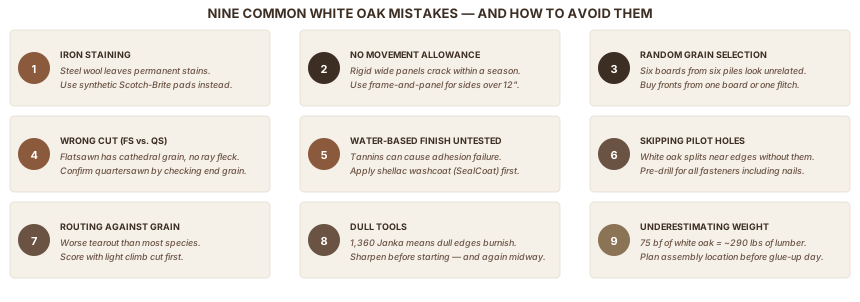
Iron staining. Steel wool is the usual culprit: a piece left on the bench, the surface damp from finishing. Switch to synthetic Scotch-Brite pads permanently. Use stainless screws. Put cauls between clamp jaws and wood.
No movement allowance. Wide solid-wood case sides glued rigidly will crack or blow a joint within a season or two. Learn frame-and-panel construction before building wide solid panels.
Random grain selection. Buying six boards from six different piles because they're all labeled "white oak" produces fronts that look unrelated. Buy from one flitch. Mark the sequence at the yard.
Expecting quartersawn look from flatsawn. Flatsawn white oak has arching cathedral grain and minimal ray fleck. Quartersawn has tight parallel grain and prominent silver platelets. These are dramatically different materials. Know which you're buying before you pay for it.
Water-based finish without testing. Some water-based polyurethanes react with white oak tannins, causing adhesion problems or unexpected color shift. Test on a scrap piece first, or apply a dewaxed shellac washcoat (SealCoat) to isolate tannins before the topcoat.
Not pre-drilling for fasteners. White oak splits near edges without pilot holes. This applies to finish nails, screws, and pocket screws close to corners.
Routing against grain. Score with a light climb cut first, then rout full-depth with the grain. Use sharp bits. White oak tearout is worse than most species.
Dull tools. A dull chisel or plane iron burnishes rather than cuts white oak. Sharpening pays for itself immediately on hard hardwoods.
Underestimating the weight. At 3.91 lbs/bf, plan your assembly and moving strategy before glue-up day. Get help.
Sources
Research for this guide drew on manufacturer pricing data, USDA Wood Handbook shrinkage data, and woodworking reference sources.
- Ocooch Hardwoods — White Oak — Janka hardness, price per bf, weight (April 2026)
- Ocooch Hardwoods — Quartersawn White Oak — QS pricing, ray fleck description
- Ocooch Hardwoods — Red Oak — price comparison
- WoodBin — Wood Shrinkage Table — radial and tangential shrinkage coefficients (USDA data)
- WoodBin — Wood Shrinkage Formula — movement calculations, fiber saturation point
- Wikipedia — Janka Hardness Test — hardness scale context
- Wikipedia — Frame and Panel — floating panel gap standard
- Wikipedia — Ammonia Fuming — fuming process, safety, history
- Wikipedia — Quarter Sawing — ray fleck, stability, Arts & Crafts use
- Wikipedia — Wood Finishing — finish type comparison
- Wikipedia — Grain Filler — application method for ring-porous hardwoods
- Wikipedia — Dovetail Joint — drawer joinery types and skill requirements
Wood Species
How We Research
We don't take affiliate revenue or accept review units. Picks come from multi-source research — manufacturer specs, OSHA / EPA / ASTM regs, and long-form practitioner threads — plus Ahmed's hands-on use where relevant. When we recommend something, we explain why.
Up Next
Acacia Wood Properties, Hardness, and Buying Guide
WOOD & MATERIALS · Beginner