
Outdoor Wood Glue at a Glance
Outdoor wood glue is an exterior-rated adhesive — Type I waterproof PVA, polyurethane, or epoxy — formulated to hold a strong bond through rain, UV exposure, and repeated freeze-thaw cycles that quickly destroy standard yellow carpenter's glue. Standard PVA softens when wet and degrades through repeated wet-dry cycles, making it unsuitable for any exterior application. Type I PVA (such as Titebond III) resists moisture at a lower cost; polyurethane expands slightly to fill gaps and bonds to wet wood; epoxy offers the highest chemical and waterproofing resistance where maximum strength is critical.
For most beginner outdoor builds (cedar furniture, pine planters, a garden bench), grab Titebond III. It's the easiest option, the most affordable, and it passes the ANSI/HPVA Type I waterproof rating.
| Best for most outdoor projects | Cross-linking Type I PVA (Titebond III) |
| Minimum application temp | 45°F |
| Waterproof rating needed | ANSI/HPVA Type I |
| Best for oily woods (teak, ipe) | Epoxy only |
| Best for wet or pressure-treated wood | Polyurethane glue |
| Fills gaps | Polyurethane (expands 3×) |
In this guide:
- Why regular glue fails outside
- The three types of outdoor wood glue
- Which glue for which wood
- Getting the joint right
- Quick reference comparison table
Part 1: Why Regular Glue Fails Outside
Standard yellow PVA glue (Titebond Original, Elmer's wood glue, basic carpenter's glue) forms a thermoplastic bond. That bond holds fine indoors. Outside, it fails reliably.
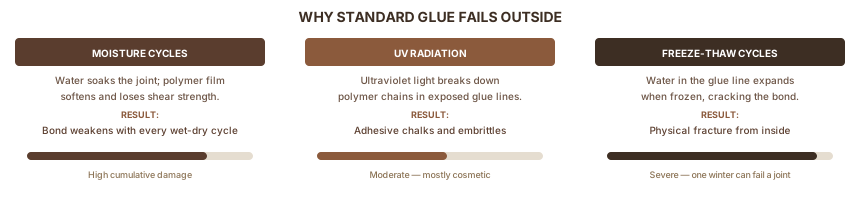
When water soaks the joint, the polymer film softens and loses shear strength. When the joint dries out, it hardens again, but the bond is weaker than before. A summer of rain and sun runs that cycle dozens of times. By fall, the joint is failing.
Freeze-thaw makes it worse. Water trapped in the glue line expands when it freezes. That expansion physically cracks the bond from the inside. One New England winter can undo what looked like a tight joint in July.
UV radiation rounds out the damage. Ultraviolet light breaks down polymer chains in exposed glue lines. Even if the joint survives moisture and freeze-thaw, UV slowly chalks and embrittles the adhesive.
What "waterproof" actually means
The ANSI/HPVA rating system (American National Standards Institute / Hardwood Plywood and Veneer Association) gives you a clear threshold:
- Type II (water-resistant): Survives a 2-cycle soak-dry test. Fine for humid interiors. Not for outdoor use.
- Type I (waterproof): Survives a 3-cycle soak-dry test. Required for all exterior applications.
Titebond Original: no rating (interior only). Titebond II: Type II. Titebond III: Type I. The name "II" vs "III" maps directly to worse vs better outdoor performance.
The practical stakes: in Wood By Wright's independent glue test, outdoor-exposed Titebond II and Titebond III blocks physically fell apart while being carried to the testing rig. The joints failed before any force was applied. That's what Type II glue does outside.
Part 2: The Three Types of Outdoor Wood Glue
Three types of adhesive hold up outside. Each has a specific use case. Know which one is which before you open a bottle.
Cross-linking PVA — the right call for most outdoor projects
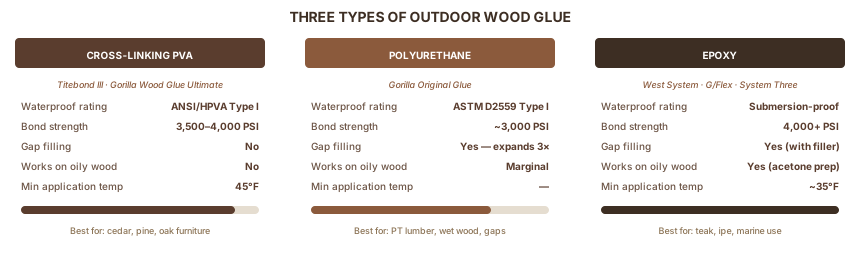
Titebond III Ultimate and Gorilla Wood Glue Ultimate are cross-linking PVAs, a modified version of regular wood glue with cross-linking agents that form tighter polymer bonds. Both pass ANSI/HPVA Type I.
Per Titebond's product specifications:
- Bond strength: 3,500–4,000 PSI
- Open time: ~8 minutes
- Minimum application temperature: 45°F
- Water cleanup before cure; tan colored, slight stain on some woods
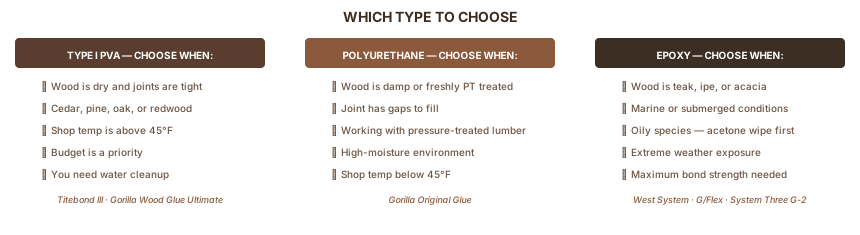
This is the glue for cedar planters, pine garden furniture, exterior door frames, and most outdoor builds using common species. It's the easiest to apply, the cheapest to buy, and the right tool for tight-fitting joints.
What it won't do: bond oily tropical hardwoods like teak or ipe. And it bonds poorly to wet pressure-treated lumber.
Polyurethane glue — for wet wood, gaps, and pressure-treated lumber
Polyurethane glue cures differently. It reacts with moisture in the wood and air, foaming and expanding as it hardens. That expansion makes it a genuine gap filler. Polyurethane expands up to 3 times its volume, pressing into voids that a standard PVA would bridge weakly.
Gorilla Original is the most common polyurethane wood glue in hardware stores. It carries an ASTM D2559 Type I rating, at least as good as ANSI Type I and better for some high-moisture applications.
What polyurethane does that PVA can't:
- Bonds reliably to damp wood (the moisture activates curing)
- Works on freshly treated pressure-treated lumber, even when the wood is still wet
- Fills gaps and imperfect joints
The trade-offs: foamy squeeze-out that's annoying to clean (mineral spirits before it cures, chisel after), slightly lower bond strength than Type I PVA (~3,000 PSI), and a 4-hour clamp time before you can remove clamps. Also more expensive per ounce.
In very dry conditions (under 20% relative humidity), lightly mist the wood surfaces before applying polyurethane glue. The glue needs moisture to start curing.
Epoxy — for oily woods and extreme conditions
Epoxy is a two-part adhesive: resin and hardener mix together to form a cross-linked polymer network. Once cured, it's completely waterproof, surviving full submersion without losing bond strength. This is what boat builders and marine cabinet makers use.
Bond strength runs 4,000 PSI and higher. West System 105/205, G/Flex, System Three G-2, and Loctite Marine Epoxy are the go-to products for woodworking.
Two situations call for epoxy specifically:
-
Oily tropical hardwoods. Teak and ipe contain natural oils that prevent standard adhesive from bonding to the wood fiber. Epoxy is the only adhesive that bonds reliably (details in Part 3).
-
Extreme exposure. For joints that stay wet, face standing water, or live in a marine environment, epoxy's complete waterproofing beats Type I PVA.
One limitation: UV light will chalk exposed epoxy over time. A glue line facing the sun will turn slightly white. This is cosmetic, not structural. According to The Wood Database, this is normal and doesn't affect bond strength. For most outdoor furniture, the glue line isn't exposed anyway.
Part 3: Which Glue for Which Wood
Most beginners building outdoor projects use cedar, pine, or pressure-treated lumber. For those woods, Titebond III is enough. Exotic hardwoods for outdoor furniture (teak chairs, ipe decking accessories, acacia tables) need a different approach.
Glue by wood type
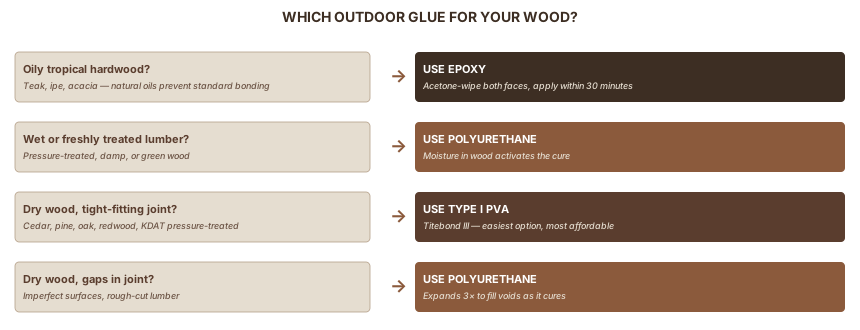
| Wood | Best Glue | Notes |
|---|---|---|
| Cedar | Type I PVA | Low oil content; bonds easily |
| Redwood | Type I PVA | Similar to cedar |
| Pine (kiln-dried PT) | Type I PVA or polyurethane | Plane surfaces first; see notes below |
| Pine (wet PT) | Polyurethane or epoxy | PVA won't bond to wet lumber |
| White oak / red oak | Type I PVA | Works well |
| Acacia | Epoxy or polyurethane | Moderately oily |
| Teak | Epoxy only | Acetone prep required |
| Ipe | Epoxy only | Same protocol as teak |
The oily wood protocol
Teak and ipe are dense, beautiful, and nearly glue-proof. Their natural oils migrate back to the surface after cutting, leaving a film that standard adhesive can't penetrate.
The fix:
- Sand the joint surfaces to 60–80 grit. Fresh wood fiber, not the oiled surface.
- Wipe both surfaces with acetone. This strips the surface oils.
- Apply epoxy within 30 minutes. The oils start migrating back as soon as the acetone evaporates. Wait longer and you're back to a compromised bond surface.
- Use moderate clamping pressure. Epoxy needs some glue film thickness. Squeezing it all out reduces bond strength.
The Wood Database's guide to gluing oily tropical hardwoods and Woodweb's ipe bonding reference both confirm: for outdoor exposure on these species, epoxy is the only reliable choice. Use West System 105/205, G/Flex, or System Three G-2.
Pressure-treated lumber
Pressure-treated lumber presents two problems for adhesive: high moisture content (recently treated wood is wet) and copper-based preservatives that interfere with some adhesives.
If the lumber is KDAT (kiln-dried after treatment), it acts more like regular dry wood. Plane both bonding faces to expose fresh fiber, then use Titebond III. Woodweb's treated lumber reference documents field success with this approach.
If the lumber is freshly treated and still wet, choose polyurethane or epoxy. Polyurethane is easier to work with here. The moisture in the wood helps it cure.
RELATED: Staining Pressure-Treated Wood If you're working with pressure-treated lumber for an outdoor build, this covers how to finish it after the frame is assembled.
Part 4: Getting the Joint Right
The right glue in the wrong conditions still fails. Three things matter: temperature, joint design, and clamping.
Temperature is the most common beginner mistake
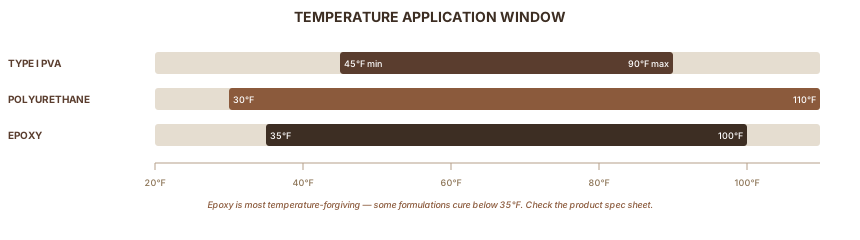
The Titebond III spec sheet sets a hard minimum of 45°F. Below that, the glue won't cure properly. Many woodworkers glue in a cold garage in early spring, the joints look fine, then the project falls apart by summer. The glue never cured correctly.
The practical rule: if you can see your breath in your shop, don't apply Type I PVA. Warm the wood and the glue before starting. Once applied, bring the project inside to cure if your shop is cold.
At the other extreme, above 90°F a surface skin forms before the glue penetrates the wood fiber. Bond strength drops. Apply Type I PVA in warm weather in the early morning or late afternoon, not at midday in direct sun.
Epoxy is more forgiving than PVA on temperature. Some formulations cure in cold conditions where PVA won't. If you're gluing outside in fall or spring, epoxy may be the better call regardless of wood type.
Joint design for outdoor durability
Long-grain to long-grain contact produces the strongest bond. End-grain to end-grain bonds at roughly 10% of long-grain strength. That's not sufficient for any outdoor joint that carries load. If your design calls for an end-grain joint, reinforce it with screws, dowels, or a mechanical fastener.
Beyond strength, outdoor joints need to shed water. A joint that traps moisture (a horizontal groove, a pocket that holds rain) will fail faster than the adhesive would predict. Design so water runs off the joint rather than pooling in it. This is why cedar planter boxes and cedar pergolas use lap joints and half-laps rather than butt joints for outdoor frames.
Clamping times
For all three glue types, remove clamps when the manufacturer specifies. Don't stress the joint for at least 24 hours after that:
- Type I PVA: 30–60 minutes to remove clamps; 24 hours to full strength
- Polyurethane: 4 hours to remove clamps; 24 hours to full strength
- Epoxy: varies by formulation (10 minutes to 6 hours); check the specific product
Clamping pressure for Type I PVA: 100–150 PSI for softwoods (cedar, pine), 125–175 PSI for medium hardwoods (oak), 175–250 PSI for dense hardwoods. Good bar clamps or F-clamps provide enough pressure for furniture-scale joints without over-compressing.
Quick Reference
| Cross-linking PVA | Polyurethane | Epoxy | |
|---|---|---|---|
| Water resistance | ANSI/HPVA Type I | ASTM D2559 Type I | Submersion-proof |
| Bond strength | 3,500–4,000 PSI | ~3,000 PSI | 4,000+ PSI |
| Gap filling | No (tight joints only) | Yes, expands 3× | Yes, with filler added |
| Works on wet wood | No | Yes | Yes |
| Works on oily wood | No | Marginal | Yes |
| Minimum temp | 45°F | — | ~35°F |
| Clamp time | 30–60 min | 4 hrs | Varies |
| Cleanup | Water | Mineral spirits | — |
| Cost | $ | $$ | $$$ |
| Best for | Cedar, pine, oak furniture | PT lumber, wet wood, gaps | Teak, ipe, marine |
Sources
This guide draws on manufacturer specifications, independent test data, and practitioner documentation from woodworking trade knowledge bases and publications.
- Titebond III Ultimate Wood Glue product page — Type I rating, 45°F minimum, open time specs
- Titebond FAQs — application conditions, clamping pressure
- Wood By Wright glue test — independent outdoor exposure results
- Original Gorilla Glue product page — polyurethane specs, ASTM Type I rating
- The Wood Database: Gluing Oily Tropical Hardwoods — teak and ipe acetone protocol
- Woodweb: Gluing Treated Lumber — pressure-treated lumber guidance
- Woodweb: Gluing Ipe Wood for Outdoor Exposures — ipe-specific outdoor bonding
- Fine Homebuilding: What's the Difference — Glue — PVA vs polyurethane comparison
- Bailey Line Road: Exterior Adhesives — outdoor adhesive selection
- Fine Woodworking: Which Glues Work in Cold Temperatures — cold performance data
Up Next
How to Build a Live Edge River Table
WOOD & MATERIALS · Beginner